

Summary Answer: For precision agriculture projects in 2026, the ideal soil monitoring system must combine multi-parameter sensing (Temperature, Humidity, EC, pH, NPK) with robust LoRaWAN connectivity. Based on our latest lab tests (December 2025), the Hande Tech 8-in-1 Soil Sensor demonstrates a measurement accuracy of ±0.02 pH and consistent EC readings in high-salinity environments (verified against 1413 us/cm standard solutions). This guide reviews the sensor’s calibration data, installation protocols, and LoRaWAN collector integration.
2. Why Accuracy Matters: The “Black Box” of Soil NPK
Many “smart farming” sensors on the market are essentially toys. They claim to measure Nitrogen, Phosphorus, and Potassium (NPK), but often fail when exposed to real-world salinity or temperature fluctuations.
As a manufacturer with 15 years of experience, we don’t just guess; we test. The core challenge in soil sensing is EC (Electrical Conductivity) interference. If a sensor cannot distinguish between soil salinity and fertilizer ions, your NPK data will be useless.
Below, we reveal the actual performance of our IP68 Waterproof 8-in-1 Sensor under strict laboratory conditions.
3. Lab Test Review: 2025 Calibration Data
To verify the reliability of our probes before shipping to our clients in India, we conducted a rigorous calibration test on December 24, 2025.
We used standard buffer solutions to test the stability of the pH and EC sensors. Here is the raw data extracted from our Soil Sensor Calibration Report:
Table 1: pH Sensor Calibration Test (Standard Solution 6.86 & 4.00)
| Test Reference | Standard Value (pH) | Measured Value (pH) | Deviation | Status |
| Solution A | 6.86 | 6.86 | 0.00 | √ Perfect |
| Solution A (Retest) | 6.86 | 6.87 | +0.01 | √Pass |
| Solution B | 4.00 | 3.98 | -0.02 | √Pass |
| Solution B (Retest) | 4.00 | 4.01 | +0.01 | √Pass |
Table 2: EC (Conductivity) Stability Test
| Environment | Target Value | Sensor Reading 1 | Sensor Reading 2 | Consistency |
| High Salt Solution | ~496 us/cm | 496 us/cm | 499 us/cm | High |
| 1413 Standard | 1413 us/cm | 1410 us/cm | 1415 us/cm | High |
Engineer’s Note:
As shown in the data, the sensor maintains high linearity even in high-salt solutions. This is critical for users needing to monitor Salinity alongside NPK, as high salt levels often distort nutrient readings in cheaper probes.
4. System Architecture: The LoRaWAN Collector
Collecting data is only half the battle; transmitting it from a remote farm is the other.
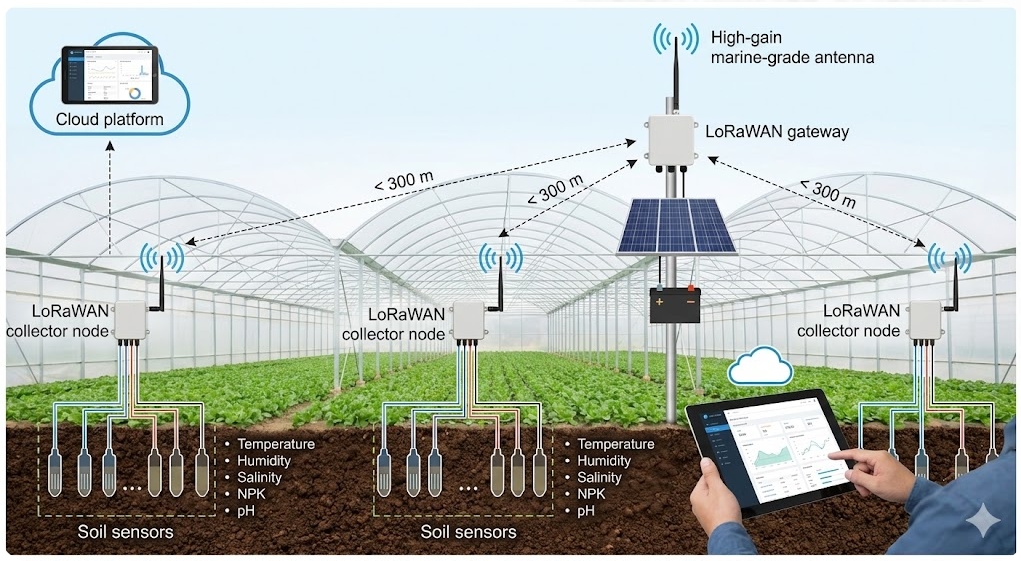
Our system pairs the 8-in-1 sensor with a dedicated LoRaWAN Collector. Based on our technical documentation (Soil 8 in 1 sensor with the LORAWAN collector), here is the breakdown of the connectivity architecture:
- Multi-Depth Monitoring: One LoRaWAN collector supports up to 3 integrated sensors. This allows you to bury probes at different depths (e.g., 20cm, 40cm, 60cm) to create a 3D soil profile using a single transmission node.
- Power Supply: Features a dedicated Red Port for 12V-24V DC power supply, ensuring stable operation for the RS485 Modbus output.
- Customizable Intervals: The upload frequency can be custom-configured via the config file to balance between data granularity and battery life.
- Plug-and-Play Config: The collector includes a specific port for the config file, allowing technicians to modify LoRaWAN frequency bands (e.g., EU868, US915) to match local regulations.
5. Installation & Usage: Avoid These Common Mistakes
Having deployed thousands of units, we see clients make the same mistakes repeatedly. To ensure your data matches our lab results, follow these steps:
1. Eliminate Air Gaps: When burying the sensor (IP68 rated), do not simply place it in a hole. You must mix the excavated soil with water to create a slurry (mud), insert the probe, and then backfill. Air gaps around the prongs will cause the EC and Humidity readings to drop to zero.
2. Protection: Although the probe is durable, the cable connection point is vulnerable. Ensure the connector is protected if exposed above ground.
3. Cross-Check: Use the RS485 interface to connect to a PC or the handheld app for an initial “reality check” before final burial.
6. Conclusion: Ready for Digital Agriculture?
Choosing a soil sensor is a balance between lab-grade accuracy and field-ruggedness.
The Hande Tech 8-in-1 Soil Sensor is not just a piece of hardware; it is a calibrated instrument verified against standard solutions (pH 4.00/6.86, EC 1413). Whether you are using RS485 for a local greenhouse or LoRaWAN for a broad-acre farm, stable data is the foundation of yield improvement.
Next Steps:
Download the Full Test Report: [Link to PDF]
Get a Quote: Contact our engineering team to customize your LoRaWAN frequency and cable length.
Internal Link: Product Page: Soil Sensors | Technology: LoRaWAN Gateway
Post time: Jan-15-2026