

Why does one piece of land do well and another not so much? Farmers for hundreds of years have been using their experience, their gut feeling, and a little bit of luck to figure out what’s going on with that dirt down there. But now the digital revolution is happening right at our feet, turning dirt into data and guessing into knowing. This is the world of precision agriculture, where tech gives us an amazing look at how alive the earth is.
This is not simply whether the ground is wet or dry. The most important agricultural asset has been given a full-body health examination by modern sensors. To get a sense of just how far this tech goes, let’s look at some surprising things uncovered by Honde Technology’s 8-in-1 soil sensor: four revelations that are shifting the way we view the bedrock of agriculture.
1. It’s not just wet or dry – it’s got its own chemical profile.
First surprise is how much useful information one little device can give you. Traditional tools may measure just one or two variables, but this sensor gives an up-to-the-minute look at eight different parts of the environment all at once from one spot in the dirt.
- Temperature: It’s important to know when it’s best to plant your seeds and when they will start to grow. Also, temperature can help us understand how fast nutrients are taken up by plants.
- Moisture / Humidity: It can enable precise irrigation so that there will be no wastage of expensive water resources, and also prevent crops from suffering due to lack of water or too much water.
- Electrical Conductivity (EC): It helps farmers know whether costly fertilizers are actually reaching the plant’s roots or getting washed away, allowing for significant cost savings and environmental protection.
- pH (Acidity/Alkalinity): Affects how well plants can take up nutrients. Right pH makes your fertilizer money work best.
- Salinity: High salinity can be toxic for plants. To keep crops healthy and soils viable for the long term.
- N, P, K: These three macronutrients are the foundation of soil fertility. Real time tracking lets you give the surgery exactly what it needs at just the right moment so plants grow better with less wasted food.
It’s a game changer. Being able to track the “big 3” nutrients – Nitrogen, Phosphorus, and Potassium – in real time goes way past just managing irrigation. It gives you a full, moving image of how good your soil is, so you can use numbers to put in just the right amount of food for plants, which makes them grow better and helps you make more money.
2. This sensor is designed to be forgotten under the harshest conditions.
A piece of electronics as advanced as this one should be fragile. To your surprise, this sensor has been made for great toughness. It has a high protection level of IP67/IP68, which means that it is totally waterproof.
So it can be put straight into the ground and left alone for as long as needed to watch what’s going on without getting hurt by rain or wind. It has been designed as “Plug and Play” system and due to its robust nature many such units can be installed at different depths. And this makes for an easy-to-care-for, dependable piece of property that lets farmers keep an eye on how different soil levels are doing, from right on top to way down where the roots go, getting unbroken flow of information all through the year after year.
3. How Meticulous Calibration Gets You Data You Can Count On
In agriculture, data is not just information, it is a command. One pH or nitrogen reading could lead to decisions costing thousands of dollars on fertilizers, water, and labor. If that data is incorrect, the results will be terrible. So, the most important thing about any kind of sensor is not what it can measure, but if you can believe what it measures.
That’s why this sensor has the simple plug-and-play nature that hides a whole lot of careful calibration work behind it. Not a feature, but a promise of dependability. The accuracy is made sure with a particular software interface called “Sensor Configuration Assistant V3.9” which calibrates every sensor against known scientific standards. Testing against standard chemical test solutions such as pH buffer solutions (pH 4.00, 6.86), conductivity solutions (1413 solution).
Technical report shows the result of this promise. Ten different sensor units were tested in a standard pH 6. 86 solution, and most of them gave an exact reading of 6. 86 or 6. 87. It’s not just consistent, it’s proof that you can count on this data for your harvest.
4. Your farm’s data, anywhere, on any device.
Farming reality is varied. A vineyard in a valley is connected differently from a large-scale grain operation on the plains. A real smart solution does not make the farm fit the tech, it makes the tech fit the farm. The sensor system is designed to be location agnostic so that there will always be a reliable data pipe wherever it may be.
It does so by means of avariety of contemporary wireless communication technologies.
- LoRaWAN / LoRa
- 4G / GPRS
- WIFI
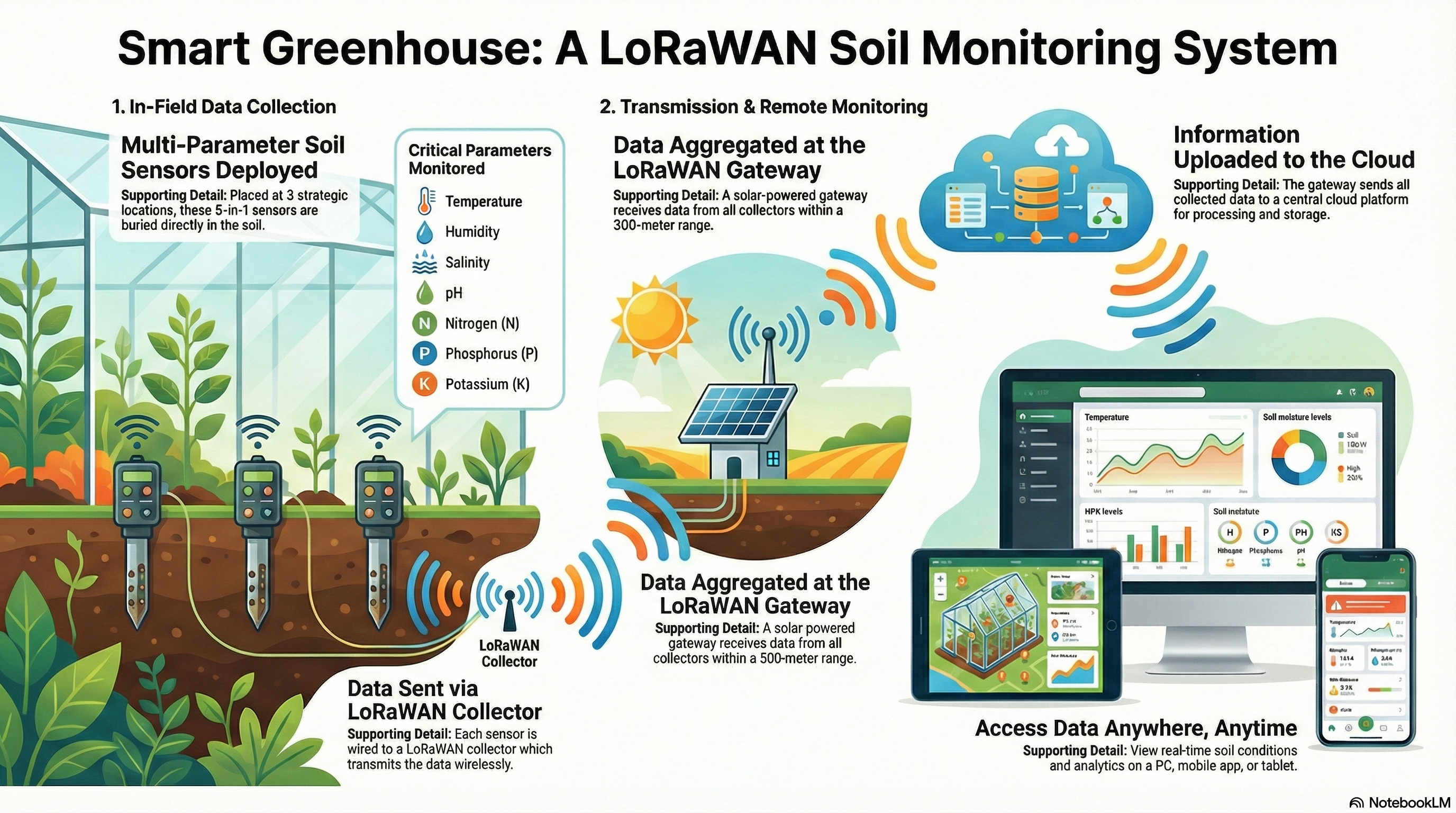
And this flexibility means that whether a farm is using a long-range, low-power LoRaWAN network way out in the middle of nowhere on some remote field with only 4G cellular service available, or sitting right next to a WiFi hotspot inside a greenhouse, all that matters is getting the data through. The best thing about it is that you have immediate access and control. Farmers can see real-time soil conditions on a clear and easy-to-understand dashboard, seeing things such as “Soil Temp 26.7 ℃” and “Soil pH 3.05″, from anywhere around the world via their phone apps, computers’ web browsers, or tablets.
Peek at Farming’s Future
These four takeaways give us a clear picture of how agriculture is changing: using lots of information to cut down on waste, strong tools that need less fixing up, and finding just the right amount for each little bit of land. It’s moving from farming based on the calendar to farming according to the soil’s real needs, doing it with surgical precision.
When one, neglected sensor can give a full chemical profile with lab-quality precision straight to a phone from anywhere on earth, the boundaries among farmer, field, and tomorrow are vanishing. It’s not about how we farm anymore; it’s about listening to the land as smartly as possible.
Tags: soil 8 in 1 sensor | All Kinds Of Wireless Modules, WIFI, 4G, GPRS, LORA, LORAWAN
For more soil sensor information, please contact Honde Technology Co., LTD.
WhatsApp: +86-15210548582
Email: info@hondetech.com
Company website: www.hondetechco.com
Post time: Jan-15-2026