

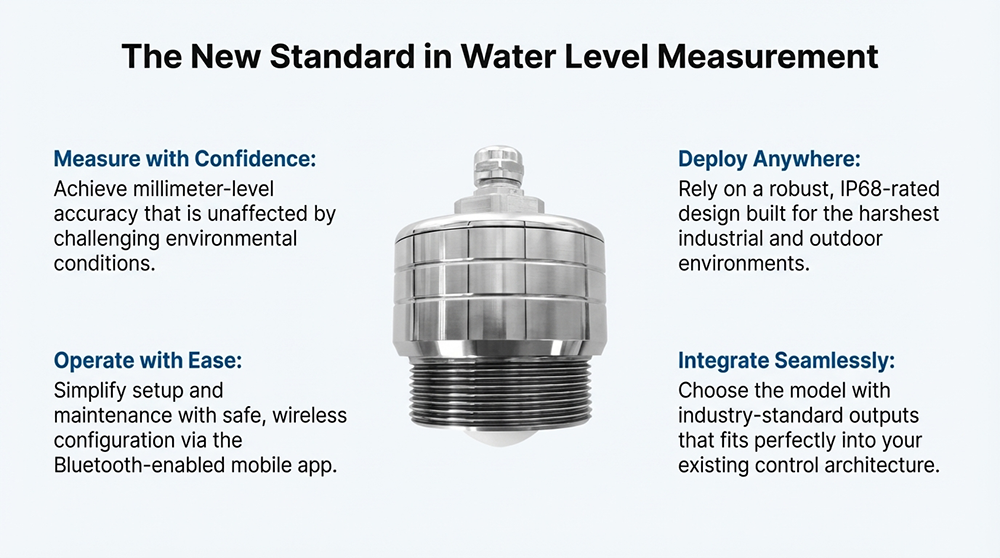
In the traditional field of hydrological monitoring, we are accustomed to physical tools like dipsticks, rulers, or floating bobbers. However, modern industry has transformed this simple act of measurement into a high-precision science. With the leap in Non-Contact Flow Meter technology—specifically the application of 76-81 GHz FMCW (Frequency-Modulated Continuous Wave) technology—water resource management is undergoing a revolution from “rough estimation” to “precise control”.
Based on the latest technical data, this article explores how this high-tech sensor is redefining the standards for Radar Flow Meter technology and analyzes its critical value in applications such as River Flow Monitoring and Sewer Flow Meter / Wastewater Flow Monitoring.
1. Technological Leap: Advancing to the 80GHz Era
While both 24GHz/80GHz Radar Flow Meter technologies exist in the market, the 76-81 GHz high-frequency sensor described in the source material represents the pinnacle of precision,. Unlike simple pulse radars, this sensor uses FMCW technology to emit a continuous “chirp” of radio waves, allowing for exceptionally reliable measurements.
Its core advantages lie in achieving “impossible precision”:
• Ultra-Long Range & Millimeter Accuracy: It can measure water levels from up to 65 meters away with an accuracy of ±1mm. To put this in perspective, that is like measuring the thickness of a credit card across a large swimming pool.
• Rapid Response: It delivers continuous data, taking a new measurement every 500 to 800 milliseconds.
• Minimal Blind Zone: Advanced design allows it to measure accurately even when water levels are very high and close to the sensor, eliminating the need for risky manual checks during flood events.
2. Focus and Intelligence: Open Channel Flow Meter Solutions for Complex Environments
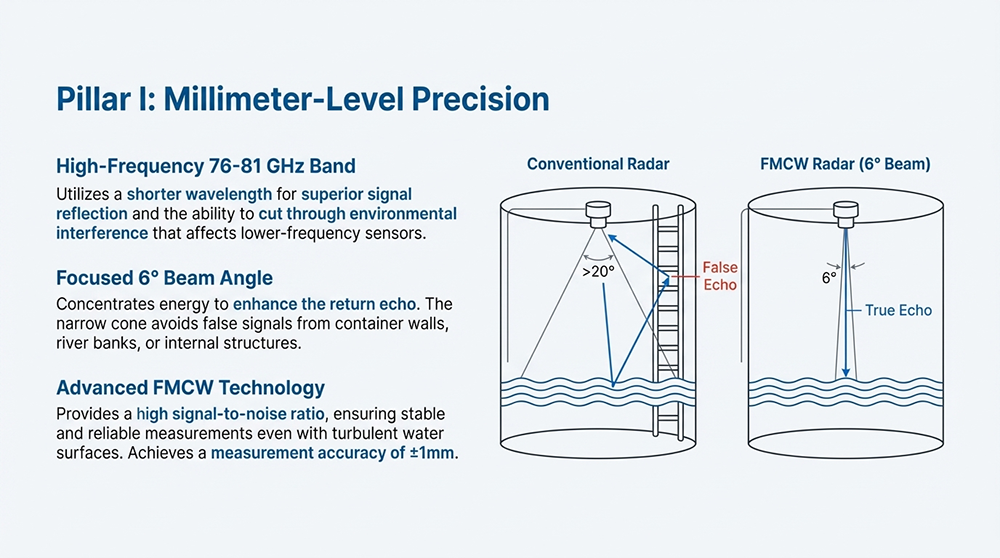
In Open Channel Flow Meter applications, the environment is often chaotic. Signals bouncing off river banks or channel walls can distort data. This sensor solves this problem with a highly focused radar beam featuring a narrow 6° beam angle, acting like a laser to target the water surface.
• Interference Immunity: Installation guidelines recommend mounting the sensor at least 30cm from walls to ensure energy is directed only at the water.
• False Echo Learning: It features a “False echo learning” capability that can be programmed to digitally ignore permanent obstacles within its view. This is crucial for Stormwater Flow Measurement, where drainage pipes or ditches often contain debris or irregular structures; intelligent filtering ensures automated systems are not triggered by false alarms.
3. Bluetooth Connectivity: Reshaping River Flow Monitoring Operations
When conducting River Flow Monitoring in the wild, traditional equipment often requires technicians to climb ladders or carry bulky laptops to connect cables. This high-tech sensor introduces the convenience of consumer electronics with built-in Bluetooth 5.0 technology.
Maintenance personnel can simply use a smartphone app called “Radar Tools” (available for iOS and Android) to wirelessly connect to the device from up to 12 meters away. This transforms a potentially hazardous two-person high-altitude job into a quick, safe task performed by a single person from the ground.
4. Rugged Durability: Meeting the Sewer Flow Meter / Wastewater Flow Monitoring Challenge
Sewer Flow Meter / Wastewater Flow Monitoring represents one of the harshest environments, where equipment must withstand corrosion, moisture, and physical impact.
This sensor is engineered for extreme conditions:
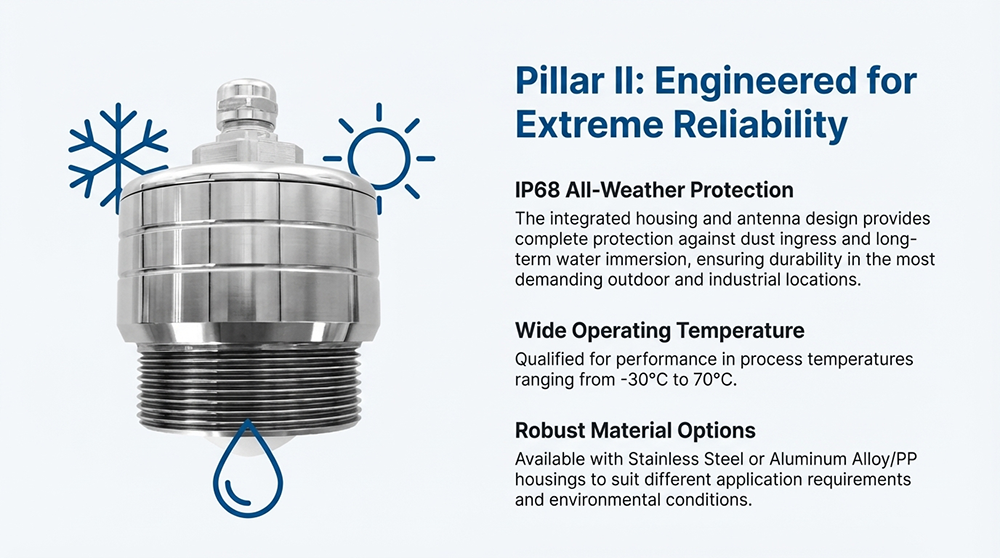
• IP68 Protection: It is completely sealed against dust and can survive long-term immersion in water, making it ideal for sewers that may become surcharged during storms.
• Wide Temperature & Robust Materials: It operates flawlessly from -30°C to 70°C. The shell is constructed from robust materials like stainless steel and PP, with an even more durable aluminum alloy option available for the 4-20mA model to resist corrosion.
5. Industrial Interconnection: The Core Data Source for Automation
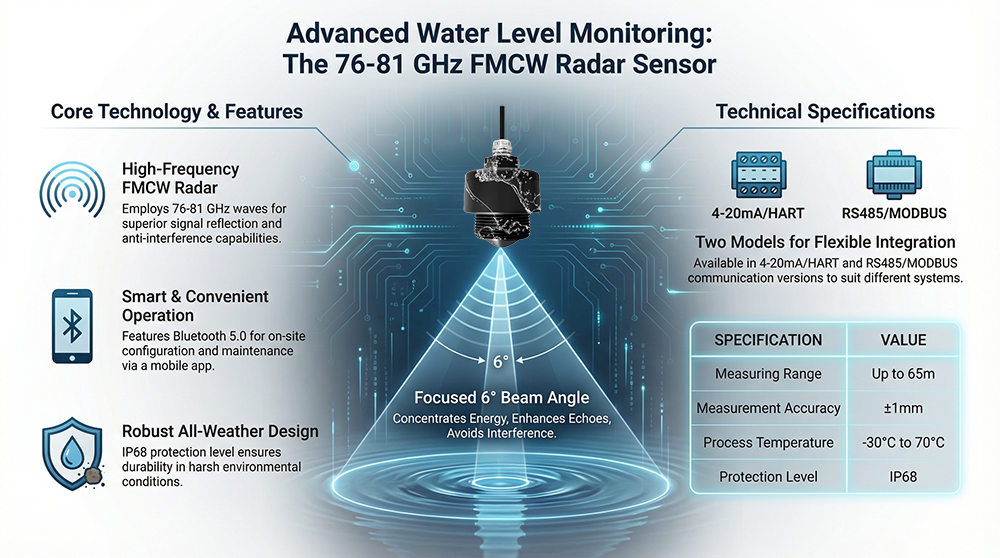
An isolated sensor cannot constitute a modern Radar Flow Meter system. This device “speaks” the language of industrial automation, offering two main output versions:
1. 4-20mA/HART: An industry-standard analog signal enhanced with digital diagnostic data.
2. RS485/MODBUS: A robust digital protocol for networking multiple devices.
These protocols allow it to seamlessly integrate with PLCs (Programmable Logic Controllers), transforming it from a standalone tool into a vital data source for large systems. Whether triggering flood warnings or controlling industrial tank filling, it enables precise management with minimal human intervention.
Complete set of servers and software wireless module, supports RS485 GPRS /4g/WIFI/LORA/LORAWAN
For more radar water level sensor information,
please contact Honde Technology Co., LTD.
Email: info@hondetech.com
Company website: www.hondetechco.com
Tel: +86-15210548582
Post time: Dec-30-2025