

In an era of lidar, microwave sensors, and AI forecasting, a plastic device costing less than a hundred dollars still performs the most fundamental rainfall measurement at 90% of the world’s weather stations—where does its enduring vitality come from?
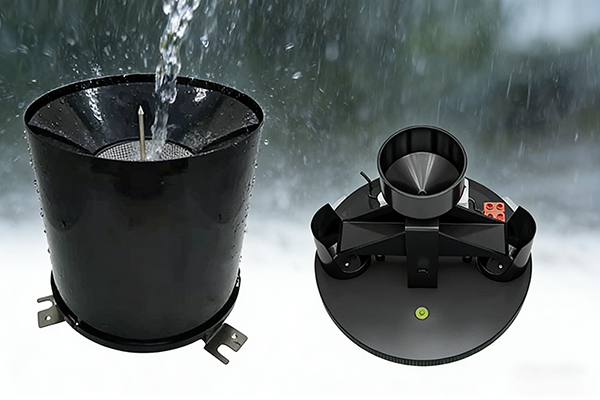
If you open up a modern automatic weather station, you’ll likely find that the core rainfall sensor isn’t a blinking laser head or a sophisticated microwave antenna, but a simple mechanical device made of a plastic tipping bucket, magnets, and a reed switch—the tipping-bucket rain gauge.
Since Irish engineer Thomas Robinson first conceived its prototype in 1860, this design has remained largely unchanged for over 160 years. Today, it has evolved from brass castings to injection-molded plastic, from manual reading to electronic signal output, but its core principle remains the same: let each raindrop drive a precise mechanical lever, transforming it into quantifiable data.
Design Philosophy: The Wisdom of Minimalism
The heart of the tipping-bucket rain gauge is a dual-bucket balancing system:
- A collecting funnel directs rainfall into one of the buckets.
- Each bucket is precisely calibrated (commonly 0.2mm or 0.5mm of precipitation per tip).
- A magnet and reed switch generate an electrical pulse each time a bucket tips.
- A data logger counts the pulses, multiplying by the calibration value to calculate total rainfall.
The brilliance of this design lies in its:
- Passive operation: It measures rainfall physically without needing power (electronics are only for signal conversion).
- Self-clearing: The bucket automatically resets after each tip, enabling continuous measurement.
- Linear response: Within rainfall intensities of 0–200mm/h, error can be controlled within ±3%.
Modern Vitality: Why High-Tech Hasn’t Replaced It
As meteorological instruments trend toward higher cost and precision, the plastic tipping-bucket rain gauge holds its ground with four key advantages:
1. Unmatched Cost-Effectiveness
- Professional-grade sensor unit cost: $500–$5,000
- Plastic tipping-bucket rain gauge unit cost: $20–$200
- When building high-density rainfall monitoring networks globally, the cost difference can span two orders of magnitude.
2. Extremely Low Operational Threshold
- No professional calibration needed, only periodic cleaning of filters and level checks.
- Volunteer weather networks in sub-Saharan Africa rely on thousands of simple tipping-bucket gauges to build regional rainfall databases for the first time.
3. Data Comparability and Continuity
- 80% of the world’s century-long rainfall series data comes from tipping-bucket or its predecessor, the siphon rain gauge.
- New technologies must be “aligned” with historical data, and tipping-bucket data serves as the baseline for climate research.
4. Robustness in Extreme Environments
- During the 2021 Germany floods, several ultrasonic and radar rain gauges failed due to power outages, while mechanical tipping buckets kept recording the entire storm on backup batteries.
- In unmanned stations in polar or high-altitude regions, its low power consumption (about 1 kWh per year) makes it an irreplaceable choice.
Real-World Impact: Three Key Scenarios
Case 1: Bangladesh Flood Warning System
The country deployed 1,200 simple plastic rain gauges across the Brahmaputra Delta, with villagers reporting daily readings via SMS. This “low-tech network” extended flood warning times from 6 to 48 hours, saving hundreds of lives annually, at a construction cost equivalent to just one high-end Doppler weather radar.
Case 2: California Wildfire Risk Assessment
The forestry department installed solar-powered tipping-bucket rain gauge networks on critical slopes to monitor short-term rainfall crucial for “burn index” calculations. In 2023, the system provided precise weather-window decision support for 97 prescribed burn operations.
Case 3: Capturing Urban Flood “Hotspots”
Singapore’s Public Utilities Board added micro tipping-bucket sensors on rooftops, parking lots, and drainage outlets, identifying three “micro-rainfall peak zones” missed by traditional weather station networks, optimizing a S$200 million drainage upgrade plan accordingly.
An Evolving Classic: When Mechanics Meet Intelligence
The new generation of tipping-bucket rain gauges is quietly upgrading:
- IoT Integration: Equipped with Narrowband IoT (NB-IoT) modules for remote data transmission.
- Self-Diagnostic Functions: Detecting blockages or mechanical faults through abnormal tipping frequencies.
- Material Innovation: Using UV-resistant ASA plastic, extending lifespan from 5 to 15 years.
- Open-Source Movement: Projects like the UK’s “RainGauge” provide 3D-printable designs and Arduino code, encouraging public science participation.
Its Limitations: Knowing the Boundaries to Use It Well
Of course, the tipping-bucket rain gauge isn’t perfect:
- In rainfall intensities exceeding 200mm/h, buckets may fail to reset in time, leading to undercounting.
- Solid precipitation (snow, hail) requires heating to melt before measurement.
- Wind effects may cause catchment errors (a problem shared by all ground-based rain gauges).
Conclusion: Reliability Over Perfection
In an era obsessed with technological dazzle, the plastic tipping-bucket rain gauge reminds us of an oft-forgotten truth: For infrastructure, reliability and scalability often matter more than absolute precision. It is the “AK-47” of rainfall monitoring—simple in structure, low in cost, highly adaptable, and thus ubiquitous.
Every raindrop falling into its funnel participates in building the most fundamental data layer for humanity’s understanding of the climate system. This humble plastic device is, in fact, a simple yet sturdy bridge connecting individual observation with global science, local disasters with climate action.
Complete set of servers and software wireless module, supports RS485 GPRS /4g/WIFI/LORA/LORAWAN
For more rain sensor information,
please contact Honde Technology Co., LTD.
Email: info@hondetech.com
Company website: www.hondetechco.com
Tel: +86-15210548582
Post time: Dec-04-2025