

In the process of agricultural production transforming from “relying on the weather for a living” to “acting in accordance with the weather”, precise perception of the microclimate in the fields is the cornerstone of intelligent management. Among them, wind, as a key meteorological factor affecting crop growth, agricultural operations and agricultural disasters, its precise measurement is particularly important. The mechanical wind speed and direction sensor launched by HONDE Company, with its classic and reliable design, excellent environmental adaptability and outstanding cost performance, is becoming an indispensable “field meteorological sentinel” in the modern smart agriculture system, providing solid and reliable data support for agricultural decision-making.
I. Product Overview: A proven guardian of farmland
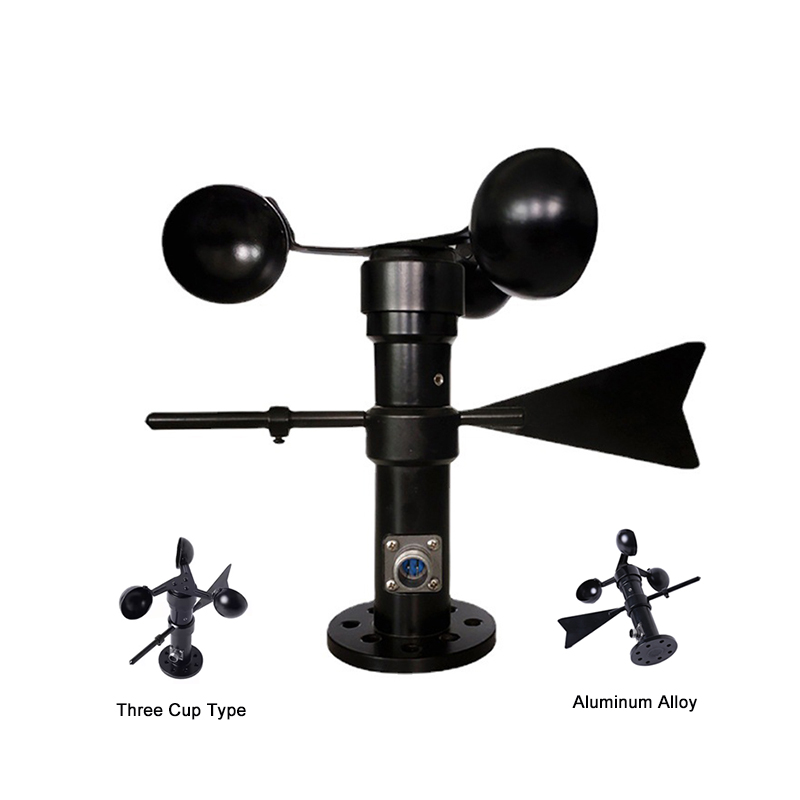
HONDE mechanical sensors are based on mature aerodynamic principles:
Wind speed measurement (three-cup type) : Three lightweight and high-strength wind cups rotate under the drive of wind force. The rotational speed has a highly linear relationship with the wind speed. Through the internal conversion device, a standard signal is output to accurately capture the wind speed changes from 0 to 60m/s.
Wind direction measurement (tail fin type) : Just like a wind vane, its tail fin naturally points towards the direction of the wind under the action of the wind. Through a precision potentiometer or encoder, the Angle signal is converted into precise wind direction data ranging from 0 to 360°.
Its simple structure and passive mechanical sensing characteristics enable it to demonstrate unparalleled reliability and durability in the complex and ever-changing farmland environment.
Ii. Core Application Scenarios in Smart Agriculture
The “Safety Commander” for precise Plant Protection operations
When spraying pesticides or foliar fertilizers, wind speed is the primary factor determining the effectiveness and safety.
Application: Real-time monitoring of field wind speed by sensors.
Decision value
When the wind speed drops below the safety threshold, the system prompts “Suitable for spraying” to ensure that the liquid medicine effectively settles on the crops.
When the wind speed exceeds the threshold, it automatically issues a warning of “excessive wind speed, suspend operation”, effectively preventing the drift of the pesticide solution, reducing the harm to nearby crops, the ecological environment and personnel, and avoiding the waste of pesticides at the same time.
Benefits: Enhance the effectiveness and safety of pesticide application, reduce the risk of environmental pollution, and comply with green agricultural standards.
2. “Key Correction Factors” for Intelligent Irrigation and Water and Fertilizer Management
The calculation of crop water requirement (evapotranspiration ET) is highly dependent on wind speed.
Application: The sensor is integrated with the temperature and humidity sensor in the field meteorological station.
Decision value: It provides precise real-time wind speed data to correct models such as Penman’s formula, thereby more accurately calculating crop evapotranspiration. This helps the irrigation system make a leap from “timed and quantification” to “on-demand and precise”, increasing irrigation volume in dry and windy weather and reducing irrigation in stable and quiet weather. It is expected to optimize water-saving efficiency by 10-20%.
3. The “Intelligent Ventilator” for Environmental Regulation in Facility Agriculture
In facilities such as multi-span greenhouses and livestock and poultry houses, ventilation is a key means to regulate temperature, humidity and carbon dioxide concentration.
Application: Monitor indoor and outdoor wind speed and direction.
Decision value
Based on the difference in indoor and outdoor wind speeds and wind directions, the opening, closing and angles of skylights, side Windows and fans are intelligently controlled to achieve efficient and energy-saving natural or forced ventilation.
Warn of strong winds, close the ventilation openings in time and protect the structural safety of the facilities.
4. The “Early Warning Outpost” for Agricultural Disasters
Strong winds, dry and hot winds, and frost (accompanied by specific wind conditions) are common agricultural meteorological disasters.
Application: Continuous field monitoring.
Decision value
Strong wind warning: Timely prompt to reinforce facilities and harvest fruits to reduce fruit drop and mechanical damage.
Dry and hot wind warning: Based on low humidity data, micro-sprinkler humidification and other mitigation measures should be initiated in advance to protect crops such as wheat from filling.
Frost Warning: On quiet and clear nights, the risk of sudden drops in ground temperature is high. The low wind speed data provided by sensors is a key indicator for determining the conditions under which radiation frost occurs.
5. A “Faithful Recorder” of agricultural research and data accumulation
In variety selection and breeding as well as cultivation model experiments, long-term and stable environmental background data are required.
Application: As a standard meteorological observation device.
Decision-making value: It provides reliable and continuous long-term sequence data on wind speed and direction for analyzing the correlation between crop traits and environmental factors, and establishing more accurate localized agricultural models.
Iii. Core Advantages of HONDE Products: Tailored for farmland environments
Ultimate reliability and durability: Equipped with stainless steel bearings and UV-resistant materials, it has no complex electronic sensing components, is not easily affected by moisture, dust or extreme temperatures, has a long maintenance cycle, and is suitable for long-term unattended operation in the field.
Outstanding environmental adaptability: Wide operating temperature range (-20℃ to +55℃), high protection level (IP65 and above), capable of withstanding the erosion of heavy rain, sand and dust, and salt spray (in coastal areas).
Precise and stable measurement: Low start-up wind speed, good linearity, and small accuracy attenuation over long-term use, ensuring the reliability and comparability of data year after year.
Flexible deployment and economical cost: Compact structure and easy installation; Compared with some precision electronic sensors, it has better purchase and maintenance costs and is suitable for multi-point and large-scale deployment within a farm.
Iv. Empirical Case: Data-Driven Scientific Orchard Management
In a large apple orchard, to enhance the efficiency of plant protection and deal with the late spring frost, five sets of HONDE mechanical wind speed and direction monitoring points have been deployed in four quadrants and the central highland within the park. Through the application of one production season:
Optimization of plant protection operations: Based on real-time wind speed data, the “window period” during which pesticides can be safely sprayed each day is refined from a vague period judged by experience to specific hours. The operation routes of drones are guided by zones, increasing the utilization rate of pesticides by approximately 15% and reducing drift complaints to zero.
Frost defense successfully: During a spring radiative cooling weather, the system detected that the wind speed in the park remained consistently below 1m/s and the humidity was moderate, triggering a red frost warning. The orchard immediately activated anti-frost fans throughout to stir the air, effectively preventing frost damage during the flowering period. It is estimated that the economic losses recovered exceeded one million yuan.
The technical director of the orchard said, “Wind used to be the most unpredictable factor for us.” Now with these reliable “sentinels”, it has become one of our clearest controllable variables.
Conclusion
In the grand vision of smart agriculture, reliable collection of basic data is the starting point for all advanced analysis and intelligent decision-making. HONDE mechanical wind speed and direction sensors, with their classic physical principles and modern industrial reliability design, provide agricultural production with a “certainty” weapon to combat natural uncertainties and achieve refined management. It stands silently in the fields and at the edges of the land, transforming every pulsation of the wind into scientific basis for safeguarding crop growth, optimizing resource utilization and avoiding production risks. This is not only the application of technology, but also a practice of deeply integrating traditional agricultural experience with objective data, marking the steady progress of modern agriculture towards a safer, more efficient and more sustainable direction.
About HONDE: As a seasoned player in the field of environmental monitoring, HONDE has a profound understanding of the actual needs of agricultural sites. We not only offer cutting-edge electronic sensors, but also strive to bring time-tested classic technologies to the ultimate level, ensuring their stable operation in the most demanding agricultural environments and creating long-term and reliable value for our customers. We believe that on the road to smart agriculture, stability and reliability will always be the top priorities.
For more wind speed and direction sensor information, please contact Honde Technology Co., LTD.
WhatsApp: +86-15210548582
Email: info@hondetech.com
Company website: www.hondetechco.com
Post time: Dec-18-2025