

Protect Workers. Detect Hazardous Gases. Improve Confined Space Safety.
Confined space work is common in wastewater treatment, municipal infrastructure, chemical processing, industrial maintenance, shipbuilding, mining, and energy production. However, enclosed or poorly ventilated environments can quickly become life-threatening when toxic gases accumulate, flammable gases reach dangerous concentrations, or oxygen levels fall outside safe limits.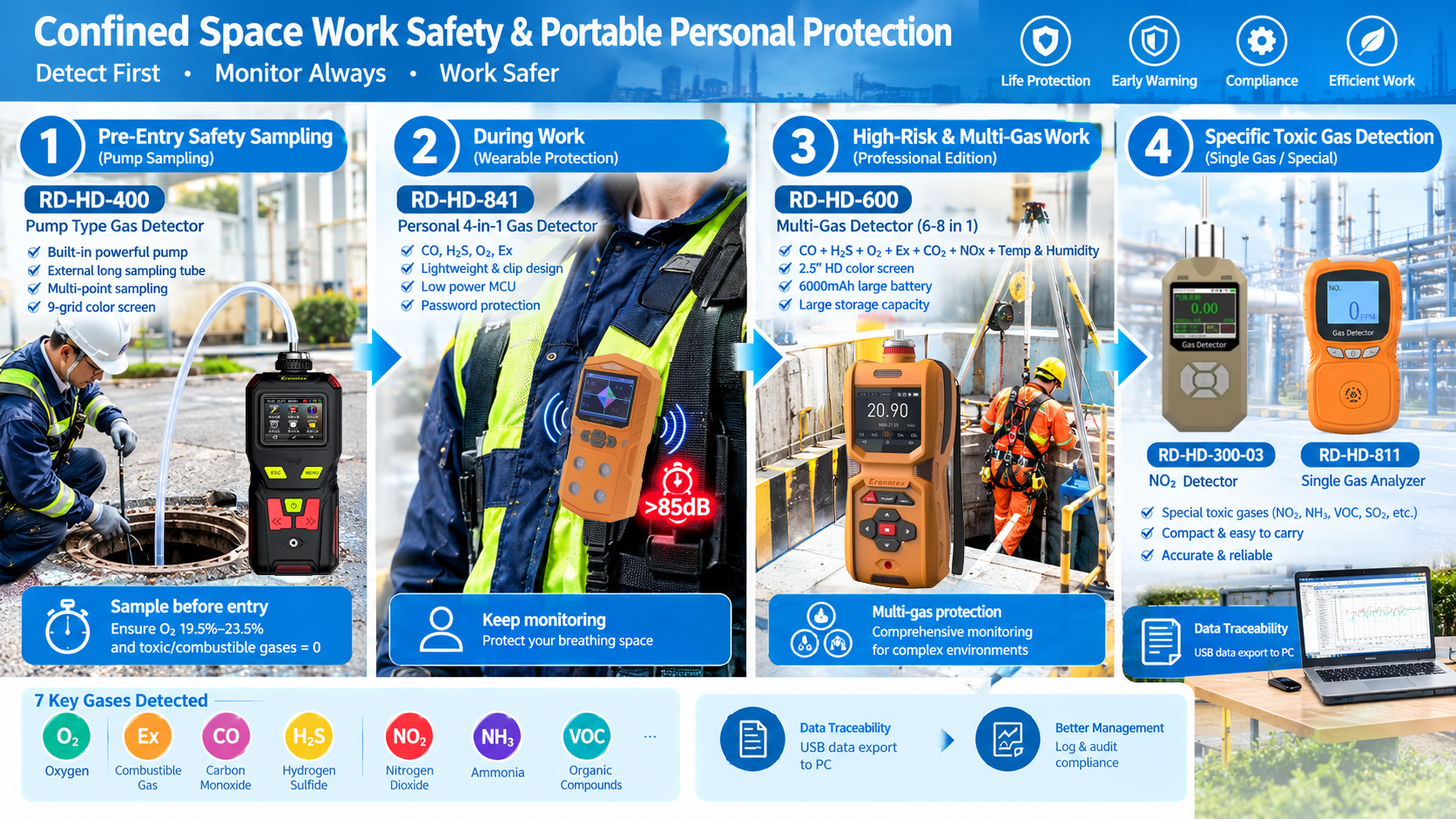
For safety managers, industrial contractors, equipment distributors, and engineering companies, reliable gas detection is an essential part of a confined space entry program.
Honde Technology Co., Ltd. provides a range of portable gas detection instruments designed for pre-entry gas sampling, personal protection during work, multi-gas monitoring, and detection of specific toxic gases. By combining the appropriate instruments with standardized operating procedures and data management, companies can build a practical, multi-stage confined space safety solution.
1. Why Is Confined Space Gas Detection Important?
Confined spaces may include:
- Sewer manholes and underground drainage networks
- Wastewater treatment tanks and pumping stations
- Chemical storage tanks and process reactors
- Underground utility tunnels and cable galleries
- Ship compartments and cargo tanks
- Mines, industrial pits, and maintenance chambers
These environments may have limited ventilation, restricted access, and difficult escape routes. Hazardous atmospheres can develop unexpectedly due to decomposition, chemical reactions, leakage, cleaning operations, or maintenance activities.
Common hazards include:
- Oxygen deficiency or enrichment: Abnormal oxygen concentrations can create serious health and fire risks.
- Flammable gases: Methane and other combustible gases may create explosion hazards.
- Carbon monoxide (CO): A toxic gas that can cause severe poisoning.
- Hydrogen sulfide (H₂S): A highly toxic gas associated with sewage systems, wastewater treatment, and certain industrial processes.
- Other toxic gases: Depending on the process, nitrogen dioxide (NO₂), ammonia (NH₃), sulfur dioxide (SO₂), and volatile organic compounds (VOCs) may also require monitoring.
A single gas detector may not meet every site’s requirements. The appropriate configuration depends on the substances that may be present, the work process, the atmosphere, and the site’s risk assessment.
2. Core Monitoring Parameters for Confined Space Safety
A standard four-gas configuration commonly includes the following parameters:
| Gas parameter | Main safety purpose |
|---|---|
| O₂ – Oxygen | Identify oxygen-deficient or oxygen-enriched atmospheres |
| Ex / LEL – Combustible gases | Assess flammable gas concentrations relative to the lower explosive limit |
| CO – Carbon monoxide | Detect carbon monoxide exposure risks |
| H₂S – Hydrogen sulfide | Identify hydrogen sulfide hazards |
Additional monitoring may be necessary in specialized industrial environments.
| Additional gas | Typical application |
|---|---|
| NO₂ – Nitrogen dioxide | Combustion-related work and selected industrial processes |
| NH₃ – Ammonia | Refrigeration systems, chemical facilities, and fertilizer handling |
| SO₂ – Sulfur dioxide | Combustion processes and chemical production |
| VOCs – Volatile organic compounds | Solvent handling, chemical storage, and industrial cleaning |
Important: Gas sensors must be selected according to the actual hazards. A detector does not automatically measure every gas listed above. Confirm the installed sensor configuration, measurement range, alarm settings, and applicable certifications before purchase and use.
3. Four Stages of Confined Space Gas Monitoring
An effective confined space safety procedure should combine pre-entry testing, continuous personal monitoring, enhanced multi-gas detection where required, and targeted detection for specific toxic gases.
Stage 1: Pre-Entry Gas Sampling — RD-HD-400
Product: RD-HD-400 Pump-Type Gas Detector
Before opening or entering a potentially hazardous space, workers should assess the atmosphere from a safe position outside the entrance.
The RD-HD-400 features a built-in electric sampling pump and supports external sampling tubing. This configuration allows operators to draw gas samples from locations that are difficult or unsafe to access directly.
Key features:
- Built-in electric sampling pump
- External sampling tube for remote gas collection
- Multi-depth sampling capability when used with suitable tubing
- Color display with a 9-grid function interface
- Audible, visual, and vibration alarms
Recommended application: Sewer manholes, underground utility chambers, storage tanks, and industrial vessels.
Operational benefit: Operators can assess the atmosphere before entry and reduce the need to expose personnel to an unverified environment.
For deep or stratified spaces, sampling should follow the site’s approved procedure and cover appropriate upper, middle, and lower levels. Allow sufficient sampling and response time for the tubing length and instrument configuration.
Stage 2: Personal Protection During Work — RD-HD-841
Product: RD-HD-841 Portable Four-Gas Detector
Pre-entry testing alone is not enough. Conditions can change during maintenance, cleaning, pumping, or chemical handling. Workers therefore need suitable personal monitoring throughout the task.
The RD-HD-841 is designed as a portable four-gas detector for monitoring:
- CO – Carbon monoxide
- H₂S – Hydrogen sulfide
- O₂ – Oxygen
- Ex – Combustible gases
Key features:
- Portable design with a practical clip-on form
- Low-power MCU design
- Password protection to help prevent unintended operation
- Configurable alarm settings according to the instrument configuration
Recommended application: Wastewater maintenance, underground pipeline inspections, industrial equipment servicing, and routine confined space work.
Operational benefit: Personal monitoring helps alert workers to changing atmospheric conditions while they are working.
Position the detector in accordance with its instructions, typically within the breathing zone. Configure alarm thresholds according to the site risk assessment and applicable requirements. Where supported by the instrument, audible, visual, and vibration alerts can provide multiple warning methods.
Stage 3: High-Risk Multi-Gas Monitoring — RD-HD-600
Product: RD-HD-600 Multi-Gas Detector
Some industrial environments require broader monitoring than a conventional four-gas configuration. Chemical plants, process facilities, industrial tanks, and complex maintenance sites may present multiple atmospheric hazards.
The RD-HD-600 is a multi-gas detection platform that can be configured for approximately 6–8 measurement channels, depending on the selected configuration.
Potential monitoring parameters include:
- CO – Carbon monoxide
- H₂S – Hydrogen sulfide
- O₂ – Oxygen
- Ex – Combustible gases
- CO₂ – Carbon dioxide
- NOx-related gases, subject to the installed sensor configuration
- Temperature and humidity, where configured
Key features:
- 2.5-inch high-definition color display
- 6000 mAh battery capacity
- Large data storage capacity
- Multi-parameter monitoring in one portable instrument
Recommended application: Chemical processing, industrial vessel maintenance, complex plant shutdowns, and high-risk inspection operations.
Operational benefit: A broader sensor configuration can help safety teams evaluate multiple atmospheric hazards with one instrument, reducing the need to carry several separate detectors.
Before ordering, confirm the exact gas channels, sensor technologies, detection ranges, battery specifications, and required certifications for the intended application.
Stage 4: Specific Toxic Gas Detection — RD-HD-300-03 and RD-HD-811
Products: RD-HD-300-03 NO₂ Detector and RD-HD-811 Single-Gas Detector
Certain tasks require monitoring for a specific toxic gas that is not included in the site’s standard four-gas configuration.
The RD-HD-300-03 is intended for dedicated nitrogen dioxide (NO₂) detection. The RD-HD-811 is a portable single-gas detector that can be specified for a target gas according to the available sensor configuration.
Potential applications include:
- NO₂ monitoring in relevant combustion and industrial processes
- NH₃ monitoring in refrigeration and chemical facilities
- SO₂ monitoring in selected industrial processes
- VOC monitoring where a suitable sensor technology and configuration are available
Key selection considerations:
- Target gas and required detection range
- Sensor technology and measurement performance
- Alarm thresholds and response requirements
- Environmental conditions and instrument compatibility
Operational benefit: Dedicated gas detection helps address site-specific risks that may not be adequately covered by a standard four-gas instrument.
The RD-HD-811 should be ordered with the correct sensor for the target gas. NO₂, NH₃, SO₂, and VOC detection are not interchangeable; verify each requested configuration with the supplier.
4. How to Build a Complete Confined Space Safety Workflow
A practical solution integrates the instruments into a clear sequence rather than relying on a single detector.
| Work stage | Recommended instrument | Main objective |
|---|---|---|
| Before opening or entry | RD-HD-400 | Sample the atmosphere remotely using the pump and sampling tube |
| Before authorizing entry | Appropriate configured gas detectors | Verify oxygen, flammable gas, and toxic gas conditions against approved entry criteria |
| During the task | RD-HD-841 | Provide personal monitoring for the configured four gases |
| High-risk or complex operations | RD-HD-600 | Monitor additional gases when required by the site risk assessment |
| Specific chemical hazards | RD-HD-300-03 / RD-HD-811 | Detect targeted gases using the correct sensor configuration |
| After the task | Instrument data export, where supported | Review and retain records for internal safety management |
Step 1: Test Before Entry
Use the RD-HD-400 from outside the confined space, with suitable sampling tubing to collect gas from relevant depths.
Assess oxygen, combustible gases, and toxic gases according to the site procedure. Do not assume that a single sample at the opening represents the atmosphere throughout the entire space.
For many confined space programs, an oxygen concentration of 19.5%–23.5% by volume is used as an acceptable entry range, subject to applicable local regulations and the site’s approved safety procedure. Combustible and toxic gas acceptance limits must be determined separately.
Do not enter if the atmosphere fails the approved entry criteria, the instrument indicates an alarm, or the results are uncertain. Follow the site’s isolation, ventilation, re-testing, and authorization procedures.
Step 2: Maintain Personal Monitoring
Once entry has been authorized, workers should carry the RD-HD-841 or another detector appropriate to the hazards identified.
Set alarm thresholds before the task begins. Workers must understand the alarm signals and evacuation procedure.
If an alarm occurs, conditions change unexpectedly, or monitoring becomes unreliable, personnel should follow the emergency response plan and leave the hazardous area when required.
Step 3: Add Multi-Gas or Targeted Detection
Use the RD-HD-600 where a broader range of atmospheric hazards must be monitored. Add the RD-HD-300-03 or appropriately configured RD-HD-811 when a specific gas requires dedicated detection.
This approach allows contractors, plant operators, and safety managers to select equipment based on actual hazards rather than purchasing an unnecessarily broad or unsuitable configuration.
Step 4: Preserve Monitoring Records
Where supported by the instrument, transfer stored measurement logs to a computer through the USB interface for review and recordkeeping.
Records may help safety teams:
- Review gas concentration changes during a task
- Investigate alarm events
- Maintain maintenance and inspection records
- Support internal safety audits
- Improve future risk assessments
Confirm the available export format, logging interval, timestamp functionality, and software compatibility before deployment.
5. Industries and Applications
Wastewater Treatment and Municipal Infrastructure
Sewer systems, manholes, pumping stations, and underground drainage networks may contain H₂S, methane, or oxygen-deficient atmospheres. Pump sampling before entry and personal monitoring during work are especially important.
Chemical and Petrochemical Plants
Storage tanks, process vessels, and maintenance chambers may present combustible gas and toxic chemical risks. A multi-gas detector and targeted gas sensors can be selected according to the process chemicals.
Industrial Maintenance and Manufacturing
Inspection pits, underground utility tunnels, and equipment enclosures may have restricted ventilation. Portable monitoring helps maintenance teams evaluate atmospheric hazards before and during work.
Shipbuilding, Marine, and Mining Operations
Ship compartments, tanks, mine chambers, and other enclosed work areas can have complex atmospheric conditions. Monitoring plans should reflect the site’s specific hazards, environmental conditions, and emergency response requirements.
6. Why Choose Honde Technology for Portable Gas Detection?
Honde Technology Co., Ltd. supplies portable gas detection products for industrial monitoring and workplace safety applications.
Our product range supports different operational requirements, from remote pre-entry sampling to personal four-gas monitoring, broader multi-gas detection, and dedicated single-gas detection.
Key advantages of a properly configured solution:
- Stage-based equipment selection: Match detectors to pre-entry, personal, multi-gas, and specialized monitoring tasks.
- Flexible gas configurations: Select the required sensor channels according to the application.
- Portable operation: Support inspection and maintenance teams working across different locations.
- Alarm-based monitoring: Help personnel recognize hazardous atmospheric changes promptly.
- Data record management: Use available data logging and export functions to support review and documentation.
- Application-focused support: Discuss target gases, measurement ranges, installation conditions, and project requirements before selecting equipment.
The best configuration depends on the target gases, required detection ranges, environmental conditions, local compliance requirements, and intended operating procedures.
7. How to Select the Right Gas Detector
Use the following guide as a starting point when preparing an inquiry.
| Your requirement | Suggested model |
|---|---|
| Remote sampling before entering a tank or manhole | RD-HD-400 |
| Portable personal four-gas monitoring | RD-HD-841 |
| Multi-gas monitoring for higher-risk operations | RD-HD-600 |
| Dedicated NO₂ detection | RD-HD-300-03 |
| Portable single-gas detection for a specified gas | RD-HD-811 |
To receive a suitable recommendation, provide the target gas list, measurement range, number of sensors, operating environment, required alarm functions, and any applicable certification requirements.
8. Frequently Asked Questions
Q1: Can the RD-HD-400 test a confined space before a worker enters?
The RD-HD-400 is designed for pump-based gas sampling using external tubing. It can collect samples from accessible sampling points before entry, subject to the instrument’s configuration and operating instructions.
Q2: Which gases should be monitored in a sewer manhole?
Oxygen, combustible gases, carbon monoxide, and hydrogen sulfide are common starting points for a risk assessment. Other gases may be required depending on the sewer system, nearby processes, and maintenance activities.
Q3: Is a four-gas detector sufficient for every confined space?
No. A standard four-gas detector does not cover every possible toxic or combustible substance. Additional sensors or dedicated detectors may be necessary when the risk assessment identifies other hazards.
Q4: Can the RD-HD-600 detect all six to eight gases at the same time?
The available measurement channels depend on the selected configuration. Confirm the exact installed sensors and simultaneous measurement capabilities for the model being quoted.
Q5: Can measurement records be exported to a computer?
Data export depends on the model and configuration. Where supported, records can be transferred through the available USB interface. Confirm logging and export functions before purchase.
9. Build a Safer Confined Space Monitoring Plan
Confined space safety requires more than a portable gas detector. It requires the right instrument, the right sensor configuration, correct pre-entry testing, continuous monitoring where needed, and a clear emergency response procedure.
With the RD-HD-400, RD-HD-841, RD-HD-600, RD-HD-300-03, and RD-HD-811 product range, Honde Technology can help customers evaluate options for different confined space applications.
Contact Honde Technology Co., Ltd. to discuss your gas detection requirements and request a product recommendation.
- WhatsApp: +86-15210548582
- Email: info@hondetech.com
- Website: www.hondetechco.com
- Company: Honde Technology Co., Ltd.
Honde Technology — Portable Gas Detection Solutions for Safer Industrial Operations.
Post time: Oct-09-2026