

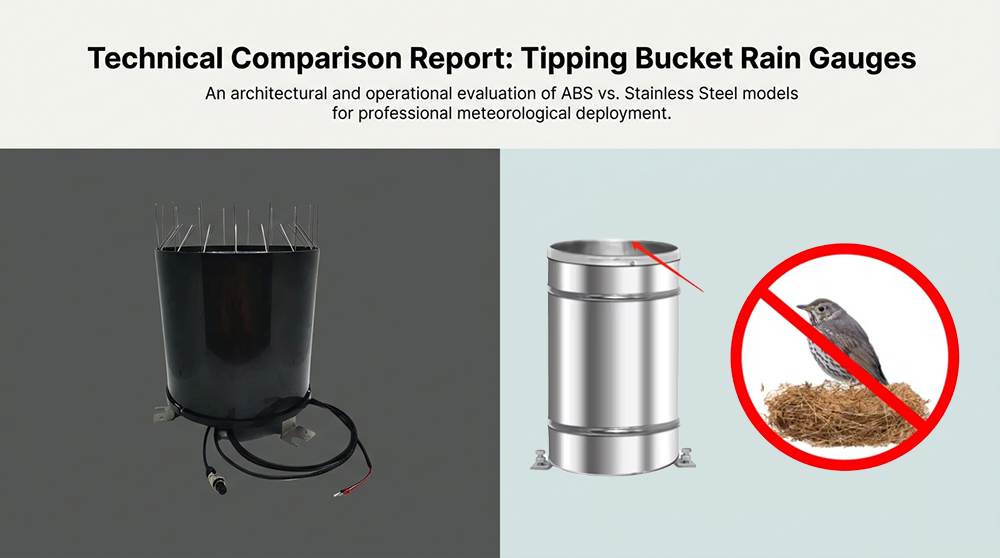
Accurate precipitation data is the bedrock of modern meteorology, hydrology, and agricultural management. As a senior meteorological instrument engineer, I prioritize sensors that balance mechanical reliability with high-fidelity signal output. This report examines two professional-grade solutions: the ABS (Engineering Plastic) and the Stainless Steel tipping bucket rain gauges, evaluating their engineering nuances and environmental suitability.
1. Introduction to Tipping Bucket Technology
The tipping bucket rain gauge utilizes a mechanical bistable structure designed for high-precision, long-term volumetric measurement. Rainwater enters a collection port and is directed through an internal funnel into a metering tipping bucket. This bucket is injection-molded and divided into two half-cone chambers of equal volume by a middle partition.
The signaling mechanism is a refined mechanical process:
- Volumetric Threshold: When one chamber receives a predetermined volume of rainwater (typically 0.5mm), the center of gravity shifts, causing the bucket to overturn. As the full chamber empties, the opposing chamber moves into position.
- Precision Signaling: A magnetic steel element is installed on the side wall of the tipping bucket. As the bucket overturns, the magnet “scans from the side” of a dry reed tube. This scanning action opens and closes the switch, generating a pulse signal that corresponds to the specific rainfall increment.
2. Product Profile: The ABS (Engineering Plastic) Rain Gauge
The ABS model is a compact, high-precision instrument engineered for environments where oxidation resistance and ease of installation are paramount.
Key Technical Attributes:
- Material Science: Constructed from high-durability ABS engineering plastic. This material is not only rust-proof but offers “high smoothness,” a critical factor in reducing measurement errors caused by stagnant water.
- Inlet Engineering: Features a \phi 200mm rain inlet with a 40–45 degree “sharp edge” design to minimize splashing and ensure catch accuracy.
- Physical Specifications: A compact footprint with a Height of 220mm and a Base Diameter of \phi 217mm.
- Installation & Integration: Includes a built-in level adjustment bubble in the base. It is equipped with a dedicated four-core shielded wire that is water-proof, oil-proof, and designed with strong anti-interference capabilities.
- Power Efficiency: Optimized for low-power deployments with a consumption rate of only 0.24W.
3. Product Profile: The Stainless Steel Rain Gauge
The Stainless Steel model is a robust, aesthetically superior instrument designed for extreme durability and specialized performance in cold climates.
Key Technical Attributes:
- Structural Integrity: Features a corrosion-resistant, polished stainless steel shell that provides maximum protection in harsh environments.
- Cold Climate Performance: Uniquely designed for snowy conditions, this model includes a heating wire terminal. A 220VAC heating device can be integrated to melt snow and prevent freezing, ensuring year-round data continuity.
- Inlet Engineering: Utilizes the same \phi 200mm inlet with a 40–45 degree sharp edge to maintain consistent catch dynamics.
- Physical Specifications: A larger, more prominent profile measuring \phi 216mm \times 460mm.
- Maintenance Profile: Engineered for long-term remote deployments with a rated battery life of 5 years.
4. Critical Maintenance Feature: The Anti-Bird Nesting System
To maintain data integrity and reduce field maintenance cycles, both models utilize a specialized “ANTI-Bird Net” system.
- Mechanical Deterrent: Despite the “net” terminology, the physical system consists of sharp steel needles/spikes installed around the rim or in the center. These prevent birds from nesting on the instrument and obstructing the funnel.
- Multi-Stage Filtration: The primary defense involves mesh holes at the funnel to prevent leaves from blocking the flow. This is supplemented by a secondary built-in stainless steel filter designed to trap smaller debris before it reaches the tipping mechanism.
5. Technical Specification Comparison
| Feature | ABS Engineering Plastic Model | Stainless Steel Model |
| Material | Engineering ABS Plastic | Stainless Steel |
| Resolution | 0.2mm / 0.5mm | 0.5mm |
| Rain Intensity Range | 0.01mm \sim 4mm/min | 0.01mm \sim 4mm/min |
| Max Rain Intensity | 8mm/min | 8mm/min |
| Measurement Accuracy | \le \pm 3\% | \le \pm 3\% |
| Dimensions | Height: 220mm, Diameter: \phi 217mm | \phi 216mm \times 460mm |
| Power Supply | 4.5–30V DC (for RS485) | 5–24V / 12–24V DC (variant dependent) |
| Power / Battery | 0.24W Power Consumption | 5-Year Battery Life |
| Output Signals | RS485, Pulse, 4-20mA, 0-5V/10V | RS485, Pulse, 4-20mA, Voltage (0-2V/5V/10V) |
| Working Temperature | 0^\circ C to 70^\circ C | -10^\circ C to 50^\circ C (supports heating) |
| Relative Humidity | < 100\% (40^\circ C) | < 95\% (40^\circ C) |
6. Data Integration and Connectivity
These sensors are designed for seamless integration into modern IoT ecosystems. They support various wireless transmission modules (GPRS, 4G, WIFI, LORA, LORAWAN) for remote monitoring.
For system integrators, the RS485 output utilizes the standard Modbus-RTU protocol with a default device address of 01. Data can be visualized in real-time through cloud platforms accessible via Web browsers, Mobile apps, and Tablet PCs.
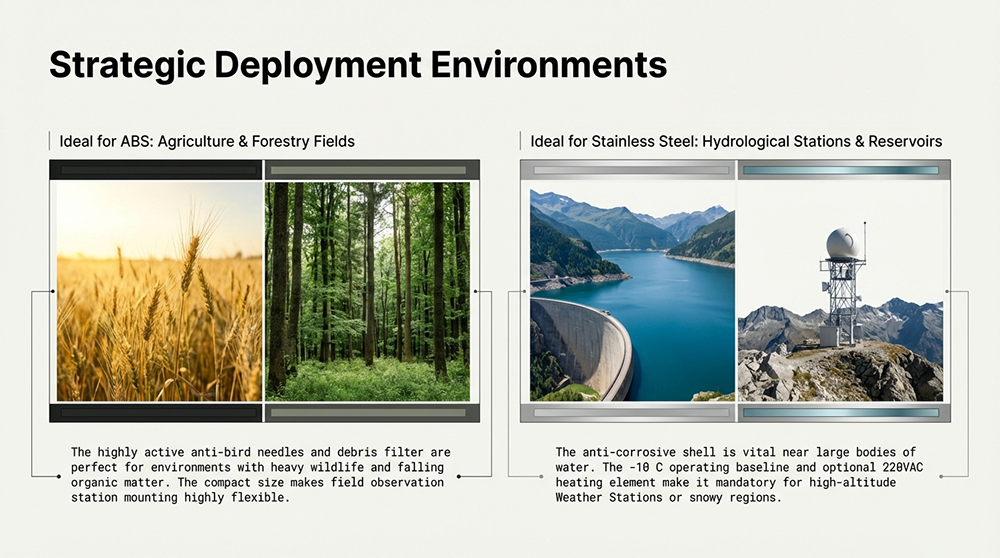
7. Strategic Application Scenarios
- Meteorology & Hydrology: National weather stations and critical hydrological monitoring.
- Water Management: Reservoir level and dam safety observations.
- Land & Natural Resources:
- Agriculture: Irrigation management and crop climate analysis.
- Forestry: Fire risk assessment and forest health monitoring.
- Scientific Research: Remote field observation stations.
8. Selection Guide: Choosing the Right Material
Selecting the correct model requires an assessment of the specific deployment environment:
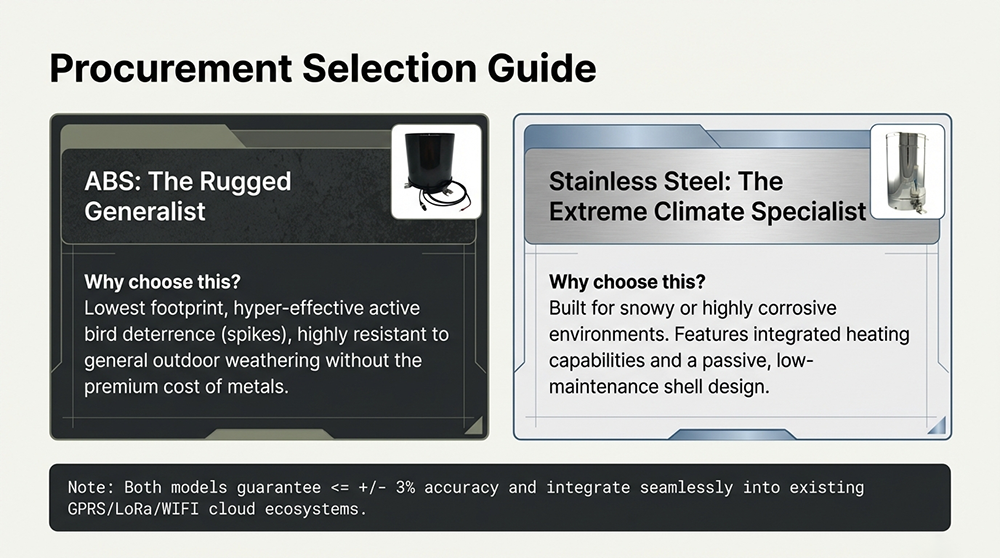
- Recommend the ABS Model for:
- Standard meteorological deployments where “no rust” durability is required.
- High-temperature environments (up to 70^\circ C) or tropical regions where humidity frequently reaches 100\%.
- Projects prioritizing high precision due to the material’s high smoothness and reduced water stagnation.
- Recommend the Stainless Steel Model for:
- Regions subject to snowy weather where the 220VAC heating option is essential.
- Coastal or industrial environments requiring maximum structural corrosion resistance.
- Remote locations where the 5-year battery life minimizes maintenance costs.
- Note: For humid tropical environments, confirm the humidity stays within the < 95\% specification.
9. Final Summary
Both the ABS and Stainless Steel tipping bucket rain gauges deliver professional-grade measurement accuracy of \le \pm 3\%. By utilizing a bistable mechanical design, sharp-edge inlets, and integrated anti-bird spikes, these instruments ensure reliable data collection with minimal maintenance. Whether prioritizing the thermal stability and smoothness of ABS or the robust, heated capability of Stainless Steel, both models represent the gold standard for modern environmental monitoring.
Tags:
Tipping bucket rain gauge|Rainfall sensor|Precipitation gauge|0.2mm rain gauge|0.5mm rain gauge|High resolution rain gauge|Accuracy of rain gauge
For more rain gauge information,
please contact Honde Technology Co., LTD.
WhatsApp: +86-15210548582
Email: info@hondetech.com
Company website: www.hondetechco.com
Post time: Mar-03-2026