

Meta Title: Online Wastewater Discharge Monitoring System | Honde Technology
Meta Description: Discover an online wastewater discharge monitoring solution featuring COD, nitrogen, pH and suspended solids sensors, with wireless data transmission, cloud monitoring and alarm functions.
URL Slug: online-wastewater-discharge-monitoring-system
Focus Keyword: online wastewater discharge monitoring system
Related Keywords: wastewater discharge monitoring, industrial wastewater monitoring system, online COD sensor, ammonia nitrogen sensor, nitrate nitrogen sensor, pH water quality sensor, suspended solids sensor, turbidity sensor, wastewater compliance monitoring
1. Why Online Monitoring Matters at Wastewater Discharge Outlets
For municipal wastewater treatment plants and industrial facilities, the final discharge outlet is an important point for checking effluent quality before treated wastewater is released into a receiving environment or connected drainage network.
Operators need to know whether key water quality parameters are changing, when an abnormal condition occurs, and whether monitoring records are available for internal management and environmental reporting.
An online wastewater discharge monitoring system helps address these needs by measuring selected parameters, displaying readings locally, and transmitting data to a monitoring platform when suitable communication equipment is installed.
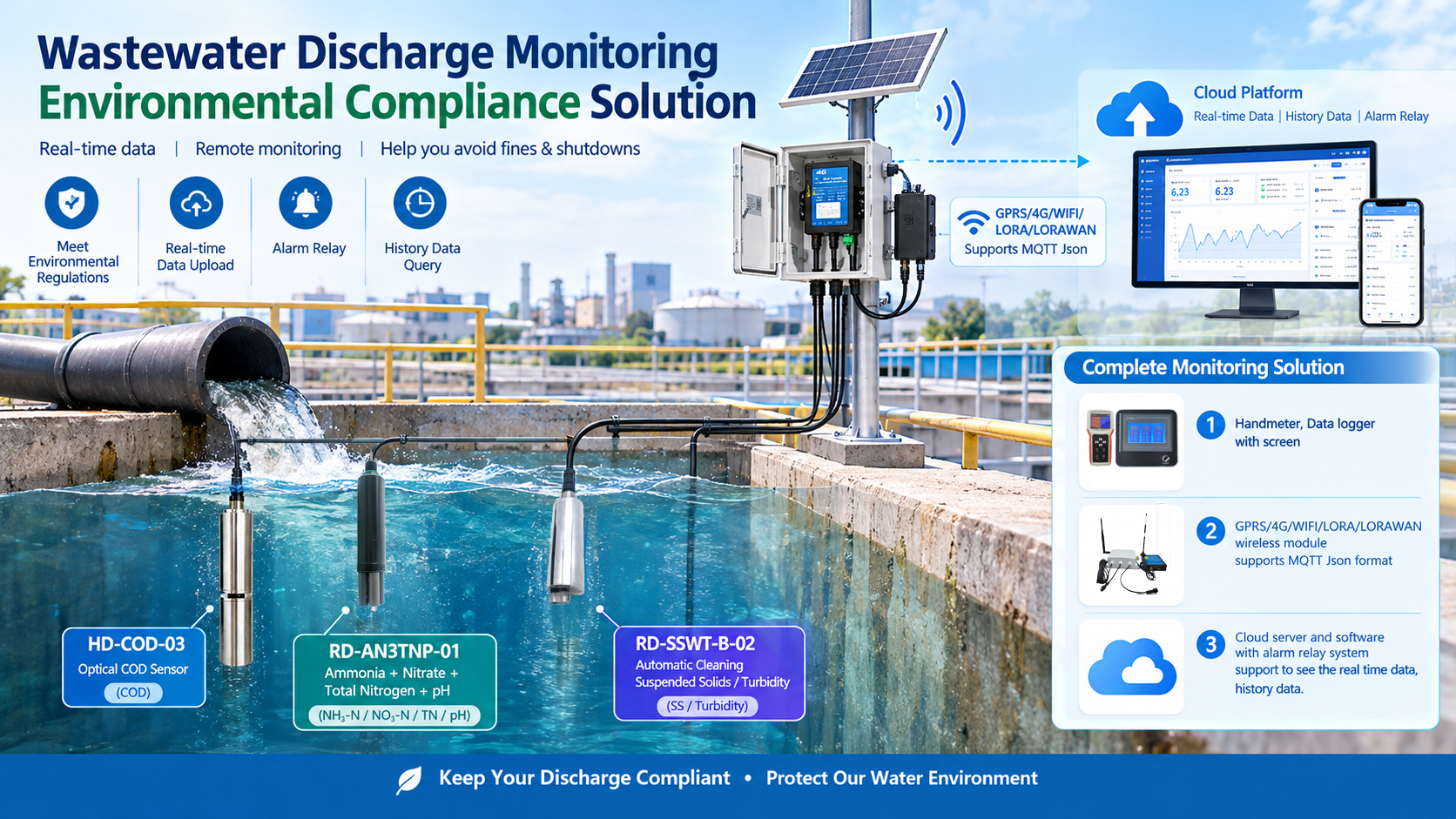
For many projects, a practical starting configuration includes three monitoring instruments:
- HD-COD-03: Reagent-free optical COD sensor.
- RD-AN3TP-01: Multi-parameter sensor for ammonia nitrogen, nitrate nitrogen/total nitrogen and pH, according to the supplied product specification.
- RD-SSWT-B-02: Suspended solids/turbidity meter with an automatic cleaning brush.
Together, these instruments provide a starting point for monitoring organic pollution indicators, nitrogen-related parameters, pH and suspended particles at a wastewater discharge outlet.
The final configuration should be selected according to the facility’s discharge permit, required monitoring parameters, local environmental regulations and the measurement methods accepted by the relevant authority.
2. Three Key Instruments for Wastewater Discharge Monitoring
Rather than installing a separate instrument for every parameter, a project can use a multi-parameter sensor where the measurement functions are supported by the selected model.
| Product model | Monitoring function | Role in the discharge outlet |
|---|---|---|
| HD-COD-03 | Optical chemical oxygen demand (COD) measurement without reagents | Tracks changes in the organic pollution indicator |
| RD-AN3TP-01 | Ammonia nitrogen, nitrate nitrogen/total nitrogen and pH, as specified for the model | Monitors nitrogen-related indicators and acidity/alkalinity |
| RD-SSWT-B-02 | Suspended solids/turbidity measurement with an automatic cleaning brush | Tracks changes in suspended particles and turbidity |
HD-COD-03: Reagent-Free Optical COD Monitoring
Chemical oxygen demand (COD) is a commonly used indicator in wastewater monitoring. Changes in COD readings can help operators identify variations in effluent quality and investigate potential treatment-process problems.
The HD-COD-03 is intended for optical COD measurement without routine chemical reagents for the sensing method.
At the final discharge outlet, online COD data can help operators observe trends and identify abnormal changes that may require further investigation.
Actual accuracy, measurement range, response time and suitability for the wastewater matrix should be confirmed against the product datasheet and site conditions.
RD-AN3TP-01: Multi-Parameter Nitrogen and pH Monitoring
Nitrogen-related parameters and pH can be important in wastewater treatment and discharge management.
The RD-AN3TP-01 is recommended for projects that need the combination of ammonia nitrogen, nitrate nitrogen/total nitrogen and pH, subject to confirmation of the exact measurement functions of the supplied model.
Using one compatible multi-parameter probe can simplify the sensor arrangement compared with installing separate instruments for each supported parameter.
Before ordering, the project team should confirm the available nitrogen outputs, measurement ranges, installation requirements and whether the required parameter is nitrate nitrogen, total nitrogen or both.
RD-SSWT-B-02: Suspended Solids and Turbidity Monitoring
Suspended solids and turbidity provide information about particles in wastewater. Changes in these readings may indicate variations in treatment performance, solids carryover or other abnormal operating conditions.
The RD-SSWT-B-02 is specified as a suspended solids/turbidity meter with an automatic cleaning brush.
The cleaning mechanism is intended to help manage sensor-surface fouling during operation. Regular inspection and verification are still necessary, especially where wastewater contains significant solids, grease or deposits.
Suspended solids and turbidity are related but different measurements. If the discharge permit specifically requires total suspended solids (TSS) in mg/L, confirm that the selected instrument and its measurement method meet the project’s requirements.
3. How the Online Monitoring System Works
The monitoring solution can combine the three instruments with a handmeter or data logger, wireless communication equipment and a cloud server.
The system can be organized into four functional layers.
Layer 1 — Water quality sensing
The COD, nitrogen/pH and suspended solids/turbidity instruments are installed at suitable monitoring positions. Depending on the design, they may be placed in a sampling tank, flow-through arrangement or directly in the wastewater stream where the sensor specifications permit.
Layer 2 — Data collection and local display
A compatible handmeter or data logger with a screen collects and displays the measurements. The selected interface must support the sensors’ output signals and communication protocols.
Layer 3 — Wireless data transmission
A suitable communication module transmits monitoring information to the designated platform. Available options include GPRS, 4G, Wi-Fi, LoRa and LoRaWAN, depending on the project configuration.
MQTT/JSON data transmission can be used where supported by the selected module and server interface.
Layer 4 — Cloud monitoring and alarms
The cloud server and monitoring software can display real-time readings and historical data. Where configured, alarm functions and relay outputs can help notify operators when readings exceed defined thresholds.
The complete workflow is:
COD + Nitrogen/pH + Suspended Solids/Turbidity Sensors → Data Logger → Wireless Communication Module → Cloud Platform → Monitoring, Alarm and Maintenance Response
The system’s ability to transmit data to a cloud platform does not automatically establish acceptance by an environmental authority. Any required reporting interface, data format, sampling frequency, validation process and certification must be confirmed separately.
4. Typical Application: Municipal and Industrial Wastewater Discharge Outlets
Consider a wastewater treatment facility that needs to monitor treated effluent before discharge.
The operator wants to observe COD, nitrogen-related parameters, pH and suspended solids/turbidity without relying exclusively on periodic manual checks.
A proposed installation could place the three instruments at a representative discharge monitoring point. The sensors connect to a compatible data logger, which displays the readings and transmits them to the cloud platform through the selected communication module.
The operating process may follow these steps:
- Establish the monitoring point. Select a representative location at the final outlet, following the site’s sampling and installation requirements.
- Install the selected instruments. Confirm that each sensor is suitable for the wastewater characteristics and required measurement range.
- Configure data collection. Set the appropriate communication parameters, data intervals and measurement units.
- Set alarm thresholds. Configure limits according to the facility’s applicable permit and monitoring requirements.
- Verify the complete system. Compare readings against suitable reference measurements and test local alarms, data transmission and historical records.
- Review abnormal readings. Use alarm records and measurement trends to determine whether sampling, maintenance or treatment-process investigation is required.
For example, a sudden change in COD or suspended solids readings may prompt the operator to check the treatment process and collect a confirmatory sample. A change in nitrogen-related readings or pH may also indicate that further investigation is needed.
These are monitoring and troubleshooting functions, not proof that an individual reading establishes a regulatory violation. Decisions should follow the applicable sampling procedures, reference methods and permit conditions.
5. Why Combine Local Monitoring with Cloud Data Management?
A local display and a remote monitoring platform serve different operational purposes.
| Function | Local handmeter/data logger | Cloud server and software |
|---|---|---|
| View current readings | Yes, when supported by the selected device | Yes, when data transmission is available |
| Check instrument status | According to device functions | According to available platform data |
| Review historical records | Depends on logger storage | Depends on platform storage and configuration |
| Alarm management | Local alarm if supported | Remote alarm if configured |
| Data integration | Depends on output interface | Depends on protocol and server compatibility |
For sites with limited network coverage, local monitoring and data storage can be important. For facilities with several monitoring points, remote access can make it easier for operators and managers to review data without visiting every location.
Where environmental reporting is required, the system integrator should confirm whether the platform can provide the required data export, records, timestamps, audit trail and authority-specific interface.
6. Installation and Maintenance Considerations
Online wastewater monitoring requires more than choosing sensors with the correct parameter names. Installation quality, wastewater characteristics and verification procedures also affect the reliability of the results.
Sampling location: The monitoring point should represent the discharge stream and avoid unsuitable locations where sediment accumulation, poor mixing or intermittent flow could distort measurements.
Sensor compatibility: Confirm the sensor’s measurement range, output interface, material compatibility and permitted operating conditions before installation.
Automatic cleaning: The cleaning brush on the RD-SSWT-B-02 can help reduce surface fouling, but it should not be treated as eliminating all maintenance.
Calibration and verification: Establish a routine based on the manufacturer’s instructions, the wastewater matrix and applicable monitoring requirements. Optical measurements may require comparison against an accepted reference method.
Alarm configuration: Thresholds should reflect the actual permit or operating limits. Avoid using generic limits that may not apply to the facility.
Communication and data integrity: Test the full transmission path from the sensor to the monitoring platform. Verify timestamps, units, missing-data handling and alarm behavior.
For regulated discharge monitoring, the applicable authority’s approved methods and reporting requirements take priority over a general-purpose IoT configuration.
7. Frequently Asked Questions
Which sensors are needed for a wastewater discharge outlet?
A proposed configuration includes the HD-COD-03 for COD, the RD-AN3TP-01 for its supported nitrogen and pH parameters, and the RD-SSWT-B-02 for suspended solids/turbidity. The final selection depends on the discharge permit and required measurement methods.
Can one probe replace separate ammonia nitrogen and pH instruments?
The RD-AN3TP-01 is intended to combine several parameters in one probe according to the supplied product description. Confirm the exact supported outputs and measurement specifications before removing separate instruments from a project design.
Can the system send wastewater data to a cloud platform?
Yes, when compatible data collection hardware, a communication module and cloud software are configured. Options may include GPRS, 4G, Wi-Fi, LoRa or LoRaWAN, with MQTT/JSON where supported.
Does the system automatically meet environmental compliance requirements?
Not by itself. Compliance depends on the applicable permit, required parameters, accepted measurement methods, instrument performance, calibration and verification procedures, and any mandatory reporting or certification requirements.
Is the automatic cleaning brush maintenance-free?
No. It can help reduce sensor-surface fouling, but inspection, cleaning verification and periodic maintenance may still be required.
8. Request a Wastewater Monitoring Solution from Honde Technology
For municipal wastewater treatment plants, industrial facilities and environmental monitoring integrators, a well-designed discharge monitoring system can provide a clearer picture of effluent quality and help operators respond to abnormal readings.
Honde Technology Co., Ltd. offers water quality sensing products and monitoring solution options that can be configured around the project’s measurement and communication requirements.
When requesting a quotation, please provide the required parameters, wastewater type, expected measurement ranges, installation method, communication preference and any applicable reporting specifications. This information helps the technical team evaluate sensor compatibility and recommend a suitable configuration.
Contact Honde Technology Co., Ltd.
- Website: https://www.hondetechco.com/
- Email: info@hondetech.com
- WhatsApp: +86-15210548582
Contact our team to discuss an online wastewater discharge monitoring solution for your project.
Technical note: Product functions and system compatibility should be verified against the latest datasheets and project requirements. This article describes a proposed application configuration and does not represent a claim of completed customer deployment or guaranteed regulatory approval.
Post time: Oct-15-2026