

Introduction: A Quick Answer for Aspiring Agri-Tech Enthusiasts
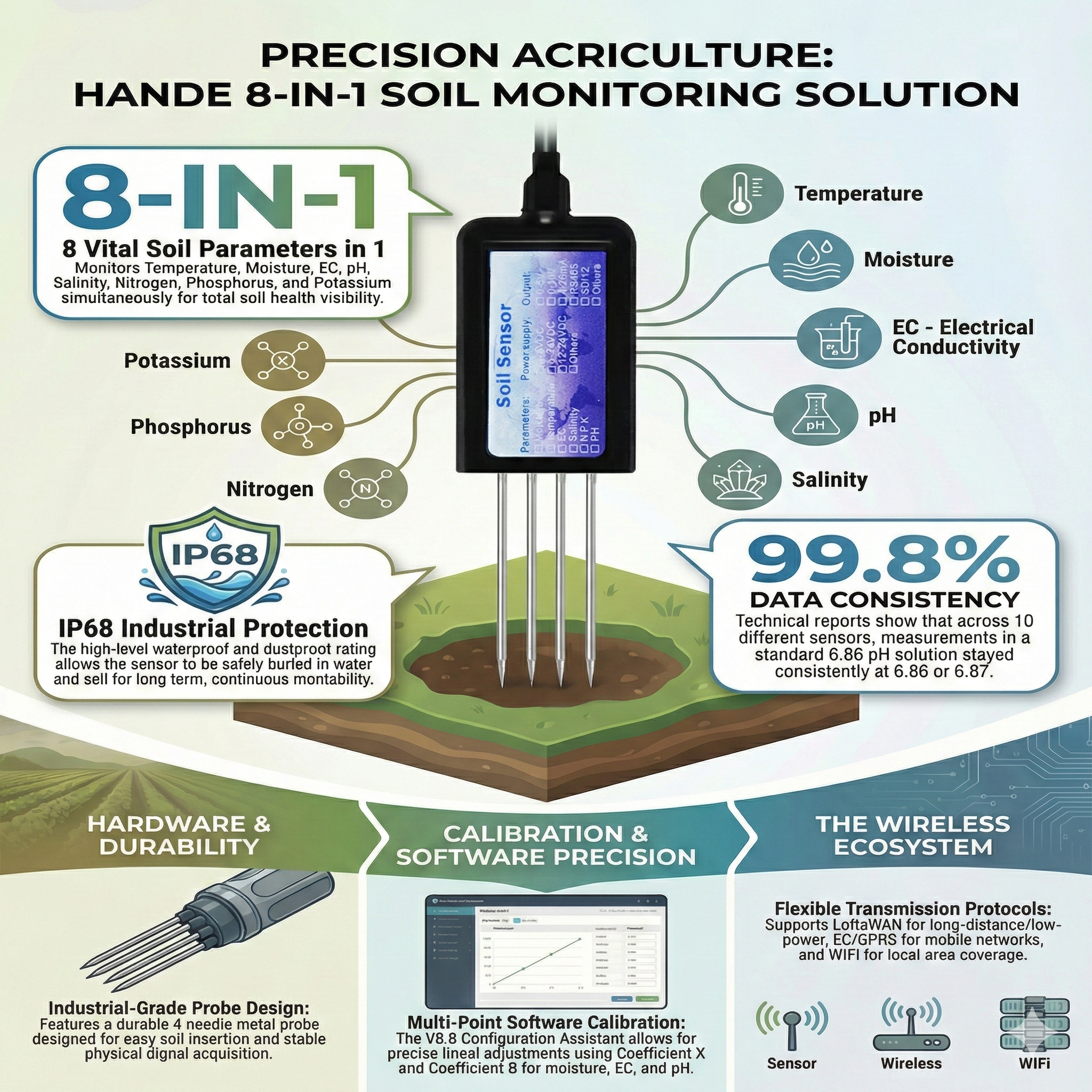
Honde Technology 8-in-1 soil sensor is one single device that can measure all eight important soil health factors at once. It works as a complete monitor, including being a strong soil nitrogen detector, sending necessary information right to your phone, computer, or tablet. This gives them an immediate view which helps farmers, students and researchers to take smart, data-based choices and let the main ideas of exact agriculture work better.
Alright, now let’s see what that mighty sensor is measuring for us so we can have a full understanding of our soil’s well-being.
What does this 8-in-1 sensor measure? The vital signs of your soil.
| Parameter | What It Is | Why It’s Important for Beginners to Know |
| Temperature | The current heat level of the soil. | Soil temperature affects seed germination and root growth. |
| Moisture | The amount of water present in the soil. | Plants need the right amount of water to transport nutrients and stay hydrated. |
| EC (Conductivity) | A measure of the total ions, or salts, in the soil. | This helps you understand the soil’s overall fertility and potential salinity issues. |
| pH | The acidity or alkalinity of the soil. | pH controls which nutrients are chemically available for plants to absorb. |
| Salinity | The concentration of salt in the soil. | Too much salt can be toxic to plants and prevent them from absorbing water. |
| Nitrogen (N) | As a nitrogen sensor for soil, it measures this crucial nutrient. | Nitrogen is essential for creating leafy green growth and is a primary component of protein. |
| Phosphorus (P) | The amount of phosphorus available in the soil. | Phosphorus is vital for strong root development, flowering, and energy transfer. |
| Potassium (K) | The concentration of potassium in the soil. | Potassium contributes to overall plant health, disease resistance, and fruit quality. |
Imagine this sensor as a full-body health checkup for your soil. At the same time, it keeps an eye on 8 important things that decide if your plants will do well or have trouble growing.
So, how does this small thing take in all that important information and give it to you?
How it works: from a probe in the ground to a graph on your screen
The system is made to be strong and easy, connecting the real dirt with your computer screen in just two simple steps.
Physical sensor: made to last and simple.
The sensor itself is a “plug-and-play” device that can withstand tough field conditions. To a beginner, the most important things about it are:
- Four-probe design: The sensor has 4 sturdy metal probes which go straight into the dirt so you get fast and correct measurements right away.
- IP68 Waterproof Rating: This is the best level of protection, which means that the sensor can be completely submerged underwater or buried underground for a long time without being damaged by water or weather.
- Multi-depth monitoring: You can connect many sensors to one LoRaWAN collector. It allows you to put sensors into the ground at different depths so you can see how the soil changes as you go down to the roots, which gives you a better idea of where they grow.
3.2 Data Transmission: Getting the Info to You
The sensor has to have some means of sending this info to you once it has gathered it. The main output of the sensor is a wired RS485 interface, which is a strong standard for professional devices.
Remote monitoring is done by connecting this wired sensor to a central data collector. Then this collector sends the information wirelessly to the cloud through one of many modern ways of communicating.
- LoRaWAN / LoRa (for long range, low power wireless transmission)
- 4G / GPRS (uses cellular network for remote area)
- WIFI (Areas with local network coverage)
No matter which way it is done, the data goes to the cloud and can be seen on a mobile app, computer web browser, or tablet.
Understand the tech, sure. But the real worth is how it changes farming today with that data.
Why it matters: The power of precision in modern farming.
With its real time, accurate information about the state of the soil, the 8-in-1 sensor gives farmers and researchers the power to make better, more effective choices. Rather than guessing what kind of fertilizers are needed or when to irrigate, you can do it according to the actual measurement, such as applying nitrogen fertilizer only to the parts of the field with low readings, which saves money and stops runoff. The capability to use resources such as water and nutrients at the right time and place is the basis of precision agriculture. It helps save resources, increase crop yield, and understand the plant environment better.
In order to make those smart choices, you need data that isn’t merely accurate; it has to be reliable too.
A Brief Note on Accuracy: Data You Can Rely On
To give you data that you can act on with confidence, each sensor goes through a tough two-step validation process:
- Calibration using standard solutions: Every sensor gets compared to standard lab test solutions. For instance, to make sure the pH is right, we check the sensors in special solutions called buffer solutions that have a set pH value, like pH 6.86.
- High Consistency: The technical reports indicate that if several sensors are tested within the same solution, their readings will be highly consistent. At pH 6.86, most sensors give a reading of 6.86 or 6.87, which shows how reliable and accurate they are straight away.
This tough procedure makes sure that what you see on your screen matches up with how things are going in your dirt.
Conclusion: Your First Step Into Data-Driven Agriculture
The Honde Technology 8-in-1 soil sensor is an easy-to-use, powerful tool for those just getting started with agricultural tech. It makes the complicated science of soil chemistry simple and turns it into easy-to-understand information on a screen. This sensor gives you a real-time look at what’s happening under your feet, which is the first step into the fun and effective world of data-based farming.
Tags: nitrogen sensor for soil | Wifi Solutions
For more soil sensor information, please contact Honde Technology Co., LTD.
WhatsApp: +86-15210548582
Email: info@hondetech.com
Company website: www.hondetechco.com
Post time: Jan-21-2026