

While mechanical parts jam in downpours and shatter in hail, a sensor with no moving parts is quietly becoming the ‘silent sentinel’ of meteorological observation—not just counting rain, but decoding the unique identity of every drop.
For centuries, the core logic of measuring rainfall has remained unchanged: catch rainwater in a container of known area, then weigh, measure, or count it. From ancient Chinese rain gauges to modern tipping-bucket models, the essence has been “capture” and “quantity.”
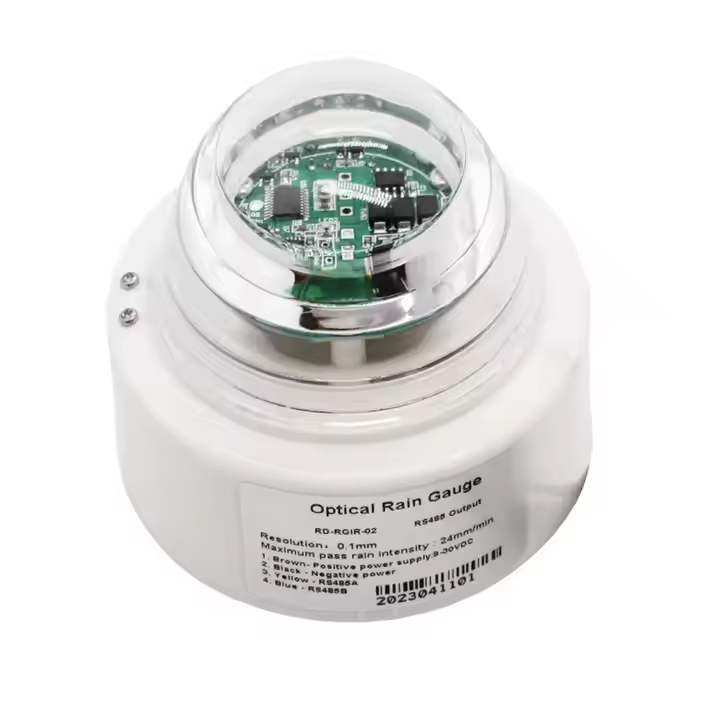
Yet, a silent revolution in perception is underway. The optical rain sensor—or optical disdrometer—discards all mechanical components. It doesn’t “collect” rain; instead, it “scans” the sky with a beam of light, like a tireless physics detective, creating an instant “digital profile” for every precipitation particle passing through its field of view.
The Technical Core: When Light Meets a Raindrop
Its working principle is elegant in its physics:
- Emit & Receive: The sensor emits a highly focused beam of laser or infrared light, with a precise optical receiver at the opposite end.
- Signal Modulation & Interruption: With no precipitation, the receiver gets a stable signal. The moment a raindrop (or snowflake, hailstone) crosses the beam, it momentarily blocks and scatters the light, causing a characteristic “dip” in the received signal.
- Intelligent Calculation: An onboard processor analyzes this signal dip’s duration and depth in real-time. Sophisticated algorithms then derive the individual particle’s diameter and fall velocity.
- Data Output: Through continuous statistics, it yields not just total rainfall and intensity, but also a drop size distribution, and can even distinguish between rain, snow, hail, and drizzle.
Why is This Revolutionary? Four Disruptive Advantages
1. Ultimate Accuracy, Goodbye to “Undercounting”
Traditional tipping-bucket gauges can severely undercount during heavy rain (errors over 20%) as the bucket can’t flip fast enough. Optical sensors sample at millisecond frequency, achieving over 99% data completeness even in the strongest convective storms, excelling at capturing the precise start, end, and instantaneous peaks of rainfall.
2. Multi-Dimensional Data: From “Total” to “Portrait”
Traditional devices only answer “how much.” Optical sensors paint a “microphysical portrait” of the rain: Is it composed of countless small drops or dominated by a few large ones? This is crucial for studying soil erosion (large drops are more destructive), radar calibration, climate model validation, and hydrological forecasting.
3. Zero-Maintenance Operation, Fearless in Extreme Environments
With no mechanical parts to freeze, clog, wear, or corrode, its “solid-state” design allows deployment on remote mountain peaks, oceanic buoys, moving vehicles, and drones. It requires almost no maintenance, with a lifespan exceeding a decade.
4. Native IoT Compatibility
Inherently digital, data transmits directly via wireless networks. It is the ideal node for building high-density, low-cost, intelligent weather observation networks, providing unprecedented high-resolution data for smart city flood control, precision agriculture, aviation safety, and scientific research.
World-Changing Application Scenarios
Scenario 1: The “Whistleblower” for Flash Floods
In the Swiss Alps, optical sensor networks deployed in steep catchments provide not just accurate rainfall totals but, via real-time drop size data, determine if the rain is “high runoff-risk” (large drops) or “low-risk.” In 2023, such a system provided a critical 45-minute earlier warning for a flash flood compared to traditional networks.
Scenario 2: Airport Safety “Watchtower”
At Frankfurt Airport, optical sensors beside runways distinguish in real-time between freezing rain, ice pellets, and snow, sending type and intensity data directly to the control tower and de-icing teams. This boosted de-icing efficiency by 30% and significantly improved takeoff/landing decision safety.
Scenario 3: The Agricultural Research “Microscope”
A UC research team uses optical sensors to analyze the “rainfall” characteristics produced by different irrigation methods (drip vs. sprinkler). The data helped optimize sprinkler head design, improving irrigation water uniformity by 15% and reducing soil crusting caused by large drops.
Scenario 4: The Climate Science “Archivist”
In Antarctic research stations, optical sensors are among the few precipitation monitors that operate year-round at -50°C. They provide scientists with the first continuous, accurate records of solid precipitation (snow, ice crystal) spectra from the region, improving global climate models.
Challenges & Future: Smaller, Smarter, Everywhere
Currently, optical sensors are more expensive than traditional mechanical ones and require careful leveling during installation. But the future is clear:
- Chip-Scale Miniaturization & Plummeting Costs: MEMS (Micro-Electro-Mechanical Systems) technology is integrating optical sensing units onto chips, with costs expected to reach consumer markets within five years.
- AI-Enhanced Recognition: Machine learning algorithms are being used to identify and filter out non-precipitation signals (like insects, dust) and more accurately classify precipitation types.
- Networked “Swarm Intelligence”: Thousands of micro-optical sensors forming dense networks will map “3D rainfall fields” at city scale, visualizing the movement and evolution of rain in real-time.
Conclusion: From “Measuring Weather” to “Understanding Atmospheric Physics”
The significance of the optical rain sensor extends far beyond providing more accurate numbers. It marks the transition of meteorological and hydrological observation from the era of macro-measurement to the era of micro-analysis.
For the first time, it allows us to “see” the fundamental particle units of precipitation on a large scale and affordably, turning every rain shower and snow flurry into a data stream ripe for deep analysis. This quiet beam of light illuminates not just the path of raindrops, but also humanity’s path toward wiser, more detailed management of water resources in an era of climate change.
When we move beyond asking “how much rain fell” to questioning “how did the rain fall,” we truly begin a new chapter in hydrometeorology.
Complete set of servers and software wireless module, supports RS485 GPRS /4g/WIFI/LORA/LORAWAN
For more rain sensors information,
please contact Honde Technology Co., LTD.
Email: info@hondetech.com
Company website: www.hondetechco.com
Tel: +86-15210548582
Post time: Dec-09-2025