

Hidden metric vital for our planet: soil moisture
A farmer planning the next irrigation cycle, a hydrologist forecasting flood danger following a downpour, or a citizen scientist monitoring the well-being of a nearby ecosystem all have one concealed variable in common: the quantity of water in the ground. Under our feet, this important environmental measure has a huge effect on agriculture, hydrology, and ecology. However, for years, access to dependable soil moisture information was restricted. The most precise conventional technique, the gravimetric method, is labor-intensive and unsuitable for immediate assessments. Modern commercial sensors provide a solution but they are too expensive for many people. To tackle these issues, researchers created the Low-Cost Soil Moisture Sensor, which is a revolutionary device that makes it possible for anyone to get accurate, up-to-the-minute soil moisture readings.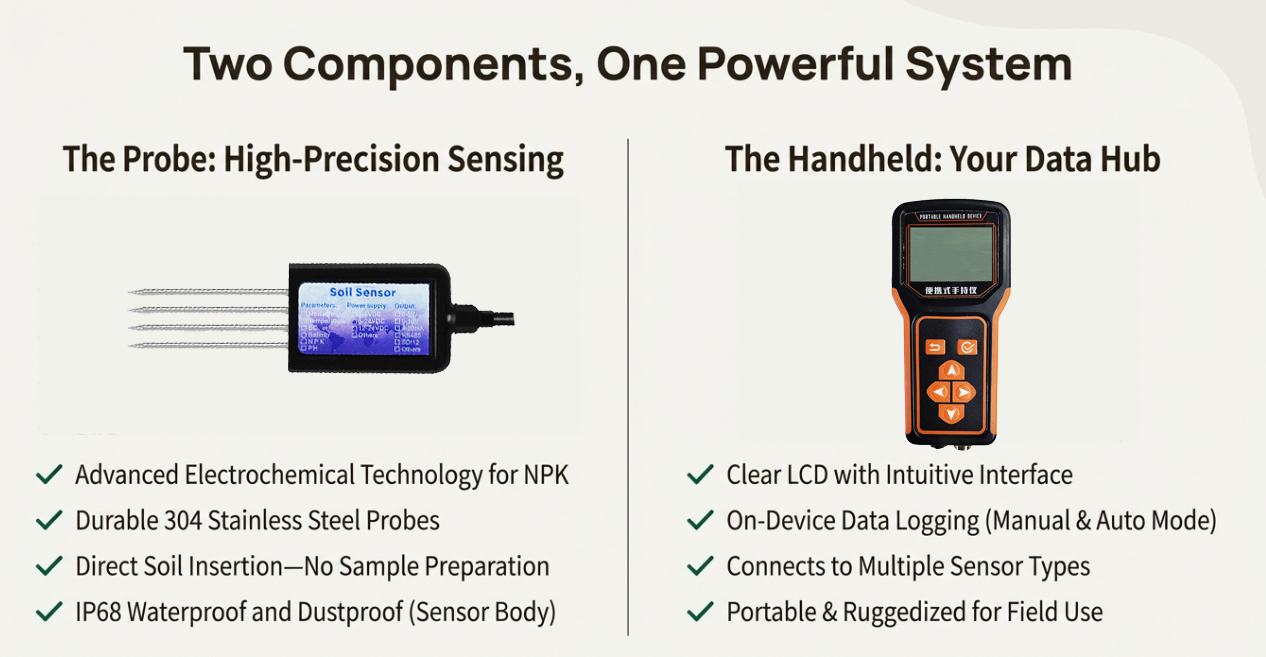 Meet the Soil Sensor, a tool for farmers and citizen scientists.
Soil Sensor was created mainly for one purpose: to give farmers and other people a cheap, strong, easy-to-use tool that can measure how much water is inside the soil when they are working outside. It’s designed with farmers in mind so they can do more precise farming using this information and also regular folks who love nature can help watch over big parts of our environment together. This device is small and light and simple enough to be used in the field.
Core features: Power at your fingertips, Simplicity in hand.
Soil Sensor packs pro capability in an affordable package. It was made for being accurate, easy to use, and cheap.
Proven accuracy: In the field test of mineral soil such as loam and sandy loam, the soil sensor has shown similar accuracy to expensive and popular commercial sensors such as HydraProbe and ThetaProbe. Tests show strong connections to those already known devices. It performs exceptionally well in mineral soils, but it should be noted that, similar to other dielectric sensors, it has lower accuracy in highly organic forest soils, which is something scientists are still working on.
Smart Connectivity: The sensor connects easily by Bluetooth/WIFI to a simple-to-use mobile app that works on both Android and iOS devices.
Powerful mobile app: Companion app gives full data management solution. You can see the actual soil VWC numbers right away, pick between general or specific soil calibrations to make things more accurate, keep every number with where it was taken (latitude and longitude), and send all your numbers to .txt or .csv files so you can look at them later.
Durable and Field-Ready: The device is made for use in the field. It is small, light and has a simple design that lets people do repairs with things they can find easily. A detailed manual includes all the maintenance procedures.
How can it be so accurate?
Soil sensor is a dielectric permittivity based sensor working with TLO technique. It uses the scientifically proven way of sending a low frequency electromagnetic wave into the ground via its metal rods. Then it takes the wave back and looks at how much of it came back. This depends on how much water there is. This is due to the fact that water has a much higher dielectric constant than dry soil minerals. Imagine throwing a ball through the soil. Dry soil gives little resistance, but water acts as thick mud slowing the ball down a lot. Measuring how much the “ball” is slowed and reflected by the sensor allows for a precise calculation of how much “mud”, or water, is present in the soil.
Proven in the field: from university farms to NASA campaigns.
To make sure that it is reliable and believable, the soil sensor went through many difficult tests and checks in different real-life situations.
Extensive calibration was done with a set of 408 soil samples taken from 83 places, divided into 70 mineral soil spots (301 samples) and 13 organic soil spots (107 samples). It included many kinds of farmlands and forests.
Agricultural Trials: The sensor was tested on agricultural research farms at Michigan State University (MSU) where it was used to monitor soil moisture in fields with crops such as soybeans and corn.
Application cases: Unleashing the potential of soil data
The soil sensor gives many people access to correct information about how much water is in the ground so they can make good choices.
For Precision Agriculture
Farmers get the info they need for their fields with this soil sensor without spending too much money. This tool enables you to make educated choices regarding your irrigation schedule and more precisely gauge the water requirements of your crops, which improves both crop yield and operational efficiency as well as reduces water waste and nutrient runoff.
For Citizen Science
Soil sensors are great tools for citizen science projects such as NASA’s GLOBE program. It is affordable and easy to use, which allows community volunteers, students, and teachers to take part in large-scale data gathering activities. This work adds to the denser ground-truth datasets needed for calibrating and validating satellite-based soil moisture products, such as those from NASA’s SMAP mission.
Research and environmental monitoring
To researchers, it provides an affordable means to get good data. It can be applied to studies about rainfall-runoff relations, ecological procedures in drylands, and creation of sustainable land use methods. Also, the sensor’s inner circuit board has ports that allow other weather sensors to be connected, making it useful for all-around environmental monitoring.
Conclusion: Accurate soil moisture data is now within reach.
Low-Cost Soil Moisture Sensor successfully connects the dots of accurate and affordable. Combining a price point below $100 with performance on par with costly commercial models and a user-friendly interface makes this device accessible for everyone to have one of the world’s most important environmental indicators. The soil sensor isn’t merely measuring the wetness of the earth, but rather it gives a whole new group of people the power to take care of the land, giving them important information about nature so they can help make the world stronger and better for everyone, one piece of farmland, river area, and forest at a time.
For more soil sensor information,
please contact Honde Technology Co., LTD.
WhatsApp: +86-15210548582
Email: info@hondetech.com
Company website: www.hondetechco.com
Post time: Jan-07-2026