

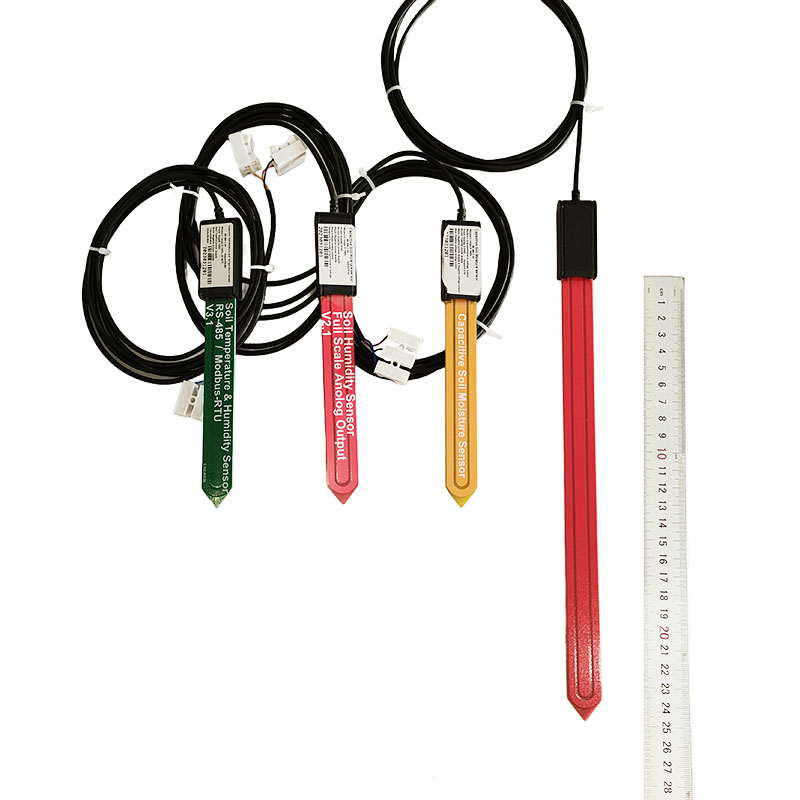
Capacitive soil sensors are one of the most common techniques in modern soil moisture measurement (usually belonging to a type of frequency-domain reflectometry (FDR)). The core principle is to indirectly obtain the volumetric moisture content of the soil by measuring its dielectric constant. Since the dielectric constant of water (about 80) is much higher than that of other components in the soil (about 1 for air and about 3-5 for soil matrix), the overall change in the dielectric constant of the soil mainly depends on the moisture content.
The following are its main features:
I. Core Strengths and Advantages
1. Low cost and easy to popularize
Compared with high-precision time-domain reflectometry (TDR) sensors, capacitive sensors have lower electronic components and manufacturing costs, which enables them to be widely applied in scenarios that require large-scale deployment, such as smart agriculture and garden irrigation.
2. Extremely low power consumption
Capacitive measurement circuits themselves have very low power consumption and are highly suitable for long-term field monitoring and Internet of Things applications powered by batteries and solar panels. They can operate continuously for months or even years.
3. It can be continuously monitored for a long time
Compared with the drying method that requires manual operation, capacitive sensors can be buried in the soil to conduct unattended, continuous and automatic data collection, and can capture the dynamic change process of soil moisture, such as the influence of irrigation, rainfall and evaporation.
4. Compact in size and easy to install
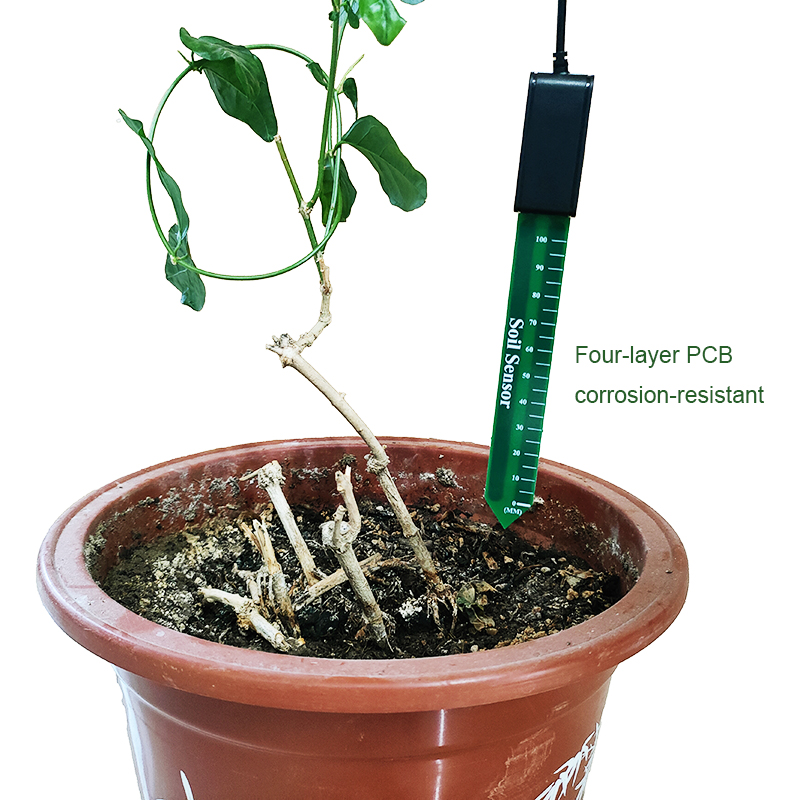
Sensors are usually designed as probes. Just drill a hole at the measurement position and insert the probe vertically into the soil, causing little damage to the soil structure.
5. Good stability and no radioactivity
Unlike neutron meters, capacitive sensors do not involve any radioactive sources, are safe to use, and do not require special permission or protection.
6. Integrable and intelligent
It is very easy to integrate with data collectors and wireless transmission modules (such as 4G/LoRa/NB-IoT) to form a complete soil moisture monitoring network. Users can remotely view the data in real time through mobile phone or computer platforms.
Ii. Limitations and Challenges
The measurement accuracy is affected by multiple factors
Soil texture influence: The calibration curves for clay, loam and sandy soil are different. Sensors are usually calibrated with standard sand and soil when leaving the factory. Direct use in soils of different textures will cause errors.
Soil electrical conductivity (salinity) influence: This is one of the main sources of error for capacitive sensors. Salt ions in the soil can interfere with electromagnetic fields, causing the measured values to be higher. In salinized soil, the measurement accuracy will decline significantly.
Soil compaction and porosity influence: Whether the probe is in close contact with the soil and whether there are large pores or stones in the soil will all affect the accuracy of the measurement results.
Temperature influence: The dielectric constant changes with temperature. High-quality sensors have built-in temperature sensors for compensation, but the compensation effect is limited.
2. On-site calibration is required
To obtain high-precision measurement results, especially in specific soil types, on-site calibration is usually required. That is, soil samples are collected, the actual moisture content is measured by the standard drying method, and then compared with the sensor readings to establish a localized calibration equation. This is a crucial step to ensure the accuracy of the data, but it also increases the usage cost and technical threshold.
3. The measurement range is relatively local
The measurement range of the sensor is limited to the finite volume of soil around the probe (i.e., the “sensitive area” of the sensor). This area is usually very small (a few cubic centimeters), so the measurement result represents the information of a “point”. To understand the soil moisture conditions of the entire field, multiple points need to be set up.
4. Long-term stability and drift
If buried in the soil for a long time, the metal of the probe may age due to electrolytic corrosion or chemical action, causing the measurement values to drift. Regular inspection and recalibration are required.
Iii. Applicable Scenarios and Selection Suggestions
Very suitable scenarios
Smart agriculture and Precision Irrigation: Monitoring soil moisture dynamics, guiding when to irrigate and how much water to irrigate, achieving water conservation and increased production.
Landscape greening and golf course maintenance: Core sensors of automated irrigation systems.
Scientific research: Research in fields such as ecology, hydrology, and meteorology that requires long-term and continuous monitoring of soil moisture.
Geological disaster early warning: Monitor soil moisture on slopes and roadbeds to warn of landslide risks.
Scenarios that require cautious use:
In areas with high-salinity and high-alkali soil: Unless specially designed and calibrated models are used, the reliability of the data is low.
In metrological certification scenarios with extremely high requirements for absolute accuracy: At this time, it may be necessary to consider more expensive TDR sensors or directly use the drying method.
In simple terms, capacitive soil sensors are a “cost-effective” option. Although it may not provide absolute precise values at the laboratory level, it can very well reflect the relative change trend and pattern of soil moisture from dry to wet. For the vast majority of production and management decisions, this already has great value. Correctly understanding its characteristics and doing a good job in calibration are the keys to using it well.
For more soil sensor information, please contact Honde Technology Co., LTD.
WhatsApp: +86-15210548582
Email: info@hondetech.com
Company website: www.hondetechco.com
Post time: Dec-01-2025