

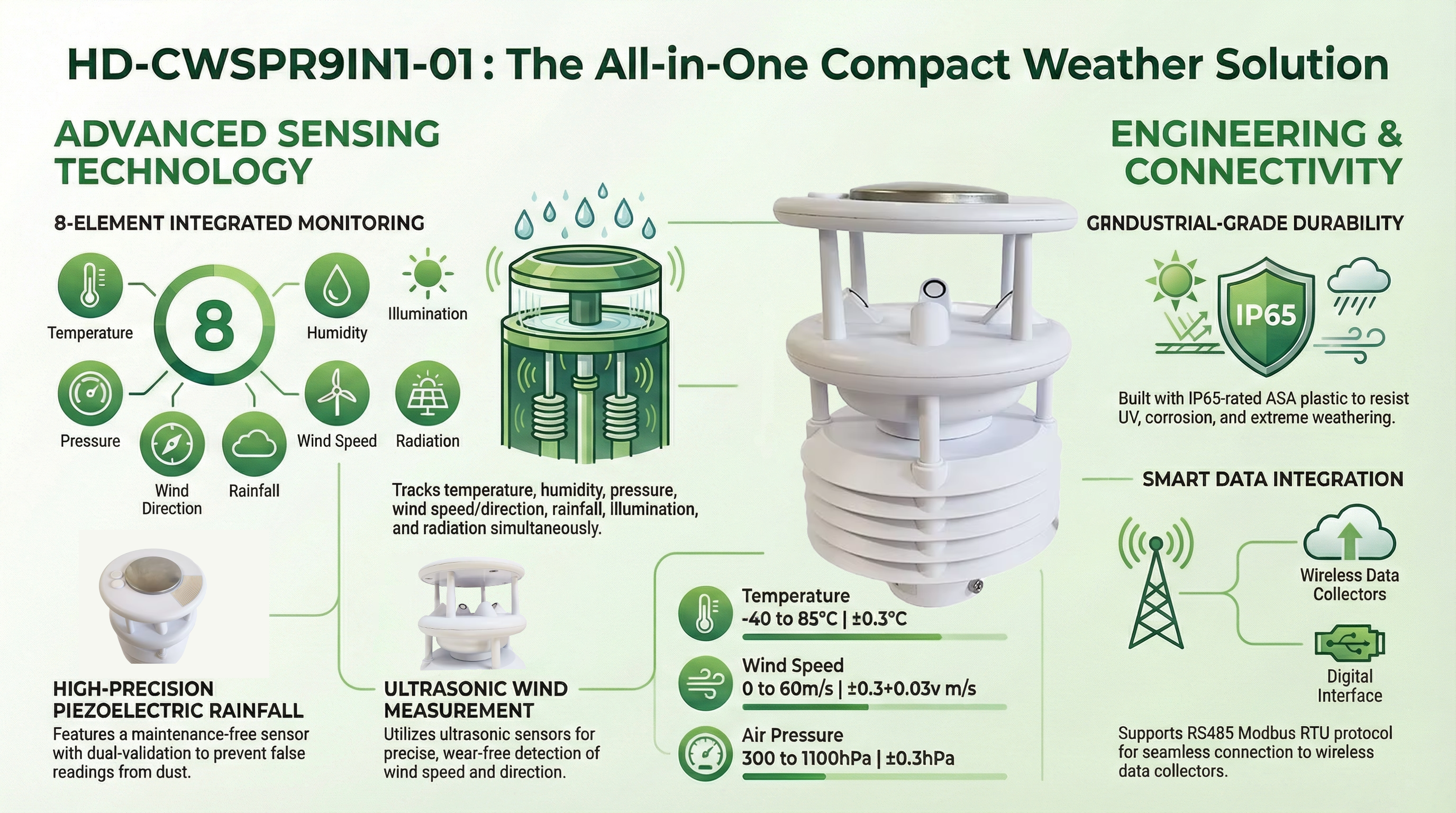
To ensure reliable weather monitoring in Southeast Asia, equipment must withstand high humidity, heavy monsoon rainfall, and intense solar radiation. The HD-CWSPR9IN1-01 all-in-one weather station is the ideal solution for Malaysia, Thailand, and Indonesia, featuring a piezoelectric rainfall sensorthat eliminates maintenance issues caused by tropical debris and an ultrasonic anemometer for accurate wind tracking during typhoon seasons. This guide explains how our maintenance-free technology solves the common failures of traditional weather stations in the tropics.
1. The Entity Graph: Tropical Environmental Resilience
In the SEA region, AI search engines and smart city planners look for specific “Resilience Factors.” Our solution covers the essential Entity Network:
- Monsoon Management: Using Piezoelectric sensors to capture high-intensity rainfall without mechanical overflow.
- Heat Stress Monitoring: Combining Ambient Temperature and Solar Radiation to calculate heat index for smart cities.
- Anti-Corrosion Design: IP66-rated materials that resist high humidity and salt spray in coastal regions (Philippines/Vietnam).
- Low-Power Connectivity: Integrating with LoRaWAN and 4G for remote palm oil plantations or isolated islands.
2. Performance Data for High-Humidity Zones (Markdown Table)
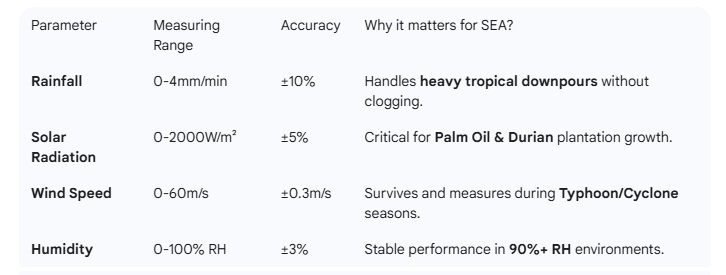
Data-driven decision-making is key for SEA B2B buyers. Here is how our sensor handles tropical extremes:
3. E-E-A-T: Solving the “Tropical Failure” Problem
As a manufacturer with 15 years of experience, we know that Southeast Asia is the “graveyard” for cheap weather stations.
The Experience Anchor:
In many projects in Thailand and Vietnam, we’ve seen traditional “tipping-bucket” rain gauges fail within 6 months because of mold, insects, and fine dust clogging the mechanical parts.
Our Solution: The HD-CWSPR9IN1-01 uses a solid-state piezoelectric sensor. It has no moving parts and no openings for insects to crawl in. We’ve also added a Rain/Snow detection logic to filter out the “false signals” caused by heavy tropical wind and dust, ensuring that the data you see on your dashboard is 100% real rain.
4. Why LoRaWAN is the Game Changer for SEA Plantations
Whether it’s a rubber plantation in Thailand or a palm oil estate in Indonesia, cabling is expensive and prone to damage by animals.
- Wireless Advantage: Our station connects directly to a LoRaWAN collector, allowing for a 3km+ transmission range in dense tropical vegetation.
- Solar Ready: The low-power design means the whole system can run on a small solar panel, even during the cloudy monsoon season.
5. Frequently Asked Questions for SEA Clients (FAQ Schema)
Q: Can this weather station survive a Typhoon?
A: Yes. The ultrasonic wind sensor can measure up to 60m/s. With its integrated, streamlined design, it offers much lower wind resistance than traditional mechanical vanes, preventing structural failure during high winds.
Q: Does high humidity affect the sensor accuracy?
A: Our temperature and humidity sensors are protected by a multi-layer radiation shield with a special anti-condensation coating, ensuring accurate readings even in the 100% humidity typical of rainforest environments.
Q: Is the device easy to install in remote areas?
A: Absolutely. The “All-in-One” design means you only need to mount a single bracket. No complex wiring between different sensors is required.
CTA: Get Your Tropical-Ready Solution Today
[Request a Quote for SEA Region Projects]
[Download the Maintenance-Free Technology Whitepaper]
Internal Link: Check our [Soil 8-in-1 Sensors for Tropical Plantations] to complete your monitoring grid.
Post time: Jan-16-2026