

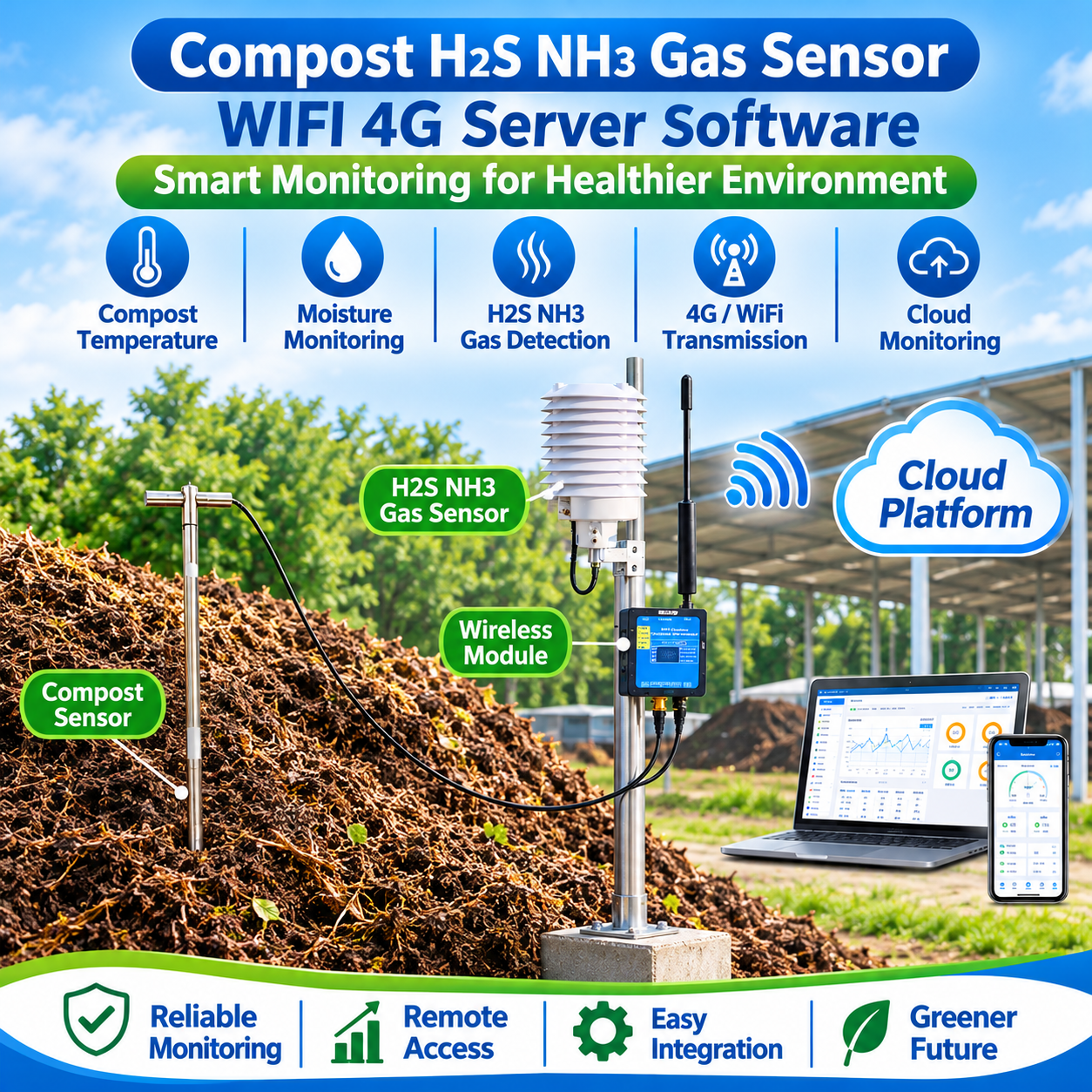
Quick Answer: What Is a Smart Compost Monitoring System?
A smart compost monitoring system combines an organic compost sensor, air gas detectors, wireless communication modules, and cloud-based monitoring software to monitor composting conditions in real time. By measuring internal compost parameters and detecting potentially harmful gases such as hydrogen sulfide (H2S) and ammonia (NH3), operators can better understand the decomposition process, identify abnormal environmental conditions, and improve operational management.
Honde Technology provides an integrated IoT monitoring solution featuring an RS485 organic compost sensor and industrial air gas sensors with 4-20mA output options. With compatible 4G or WiFi communication and cloud software, users can access monitoring data remotely through a PC or mobile device.
This solution is suitable for commercial composting facilities, organic fertilizer production plants, agricultural waste treatment projects, municipal organic waste management, and environmental monitoring applications.
1. Why Is Real-Time Monitoring Important in Organic Composting?
Composting is a biological decomposition process in which microorganisms break down organic materials such as agricultural residues, food waste, leaves, and animal manure.
The efficiency of this process depends on several environmental factors, including temperature, moisture, oxygen availability, and the composition of the organic materials.
According to the US Environmental Protection Agency (EPA), adequate oxygen and moisture are essential for microbial activity. Temperature changes also provide useful information about the decomposition process.
However, traditional compost management often relies on manual inspection and periodic measurements. This creates several challenges:
- Insufficient monitoring frequency: Manual measurements cannot continuously reflect changing compost conditions.
- Uneven decomposition: Different locations within a compost pile may have different environmental conditions.
- Potential gas accumulation: Decomposition may release ammonia and other gases, while oxygen-deficient areas can produce hydrogen sulfide.
- Labor-intensive management: Operators need to visit multiple composting areas to collect data.
- Delayed response: Without continuous monitoring, abnormal conditions may not be identified promptly.
A smart compost monitoring system provides a more systematic approach by combining internal compost sensing with surrounding air gas detection.
2. Two Key Monitoring Devices for a Smart Composting System
Honde’s compost monitoring solution integrates two types of sensing equipment to provide complementary information about the composting environment.
2.1 Organic Compost Sensor – Monitoring Conditions Inside the Compost Pile
The organic compost sensor is installed directly inside the compost material to collect selected internal environmental parameters.
Product: Honde RS485 Waterproof Organic Compost Sensor
Key features:
- Designed for compost and organic waste monitoring applications.
- Waterproof sensor construction for demanding environmental conditions.
- RS485 digital communication interface.
- Suitable for integration with industrial data acquisition systems.
- Supports centralized data collection and remote monitoring through compatible communication equipment.
Product link: https://www.alibaba.com/product-detail/RS485-Waterproof-Organic-Compost-Sensor-Soil_1601245512557.html
The sensor provides internal compost data to help operators evaluate changes during different decomposition stages.
For commercial projects, the measurement parameters, probe configuration, installation depth, and communication settings should be confirmed according to the selected product model.
2.2 Air Gas Sensor – Monitoring H2S and NH3 Around Composting Facilities
During organic waste decomposition, gases may be released into the surrounding environment. Ammonia (NH3) and hydrogen sulfide (H2S) are particularly important monitoring targets in many waste treatment applications.
- Ammonia (NH3): Can be released during the decomposition of nitrogen-rich organic materials. Excessive concentrations may cause unpleasant odors and respiratory irritation.
- Hydrogen Sulfide (H2S): Can form under anaerobic conditions and is a toxic gas that requires appropriate detection and safety management.
Honde’s industrial air gas sensor can be configured for different target gases according to project requirements.
Product: Industrial Air Gas Sensor with 4-20mA Output
Key features:
- Industrial gas detection for environmental monitoring.
- 4-20mA analog output for integration with PLCs and industrial controllers.
- RS485 and other output or communication options can be selected for compatible configurations.
- Suitable for integration with wireless transmission systems.
- Target gas selection can be customized according to the application.
Product link: https://www.alibaba.com/product-detail/Gas-Monitor-Meter-Sensor-4-20mA_1601471938134.html
For H2S and NH3 monitoring, the correct gas-specific sensor model must be selected. These gases require dedicated sensing elements and calibration; one gas sensor should not be assumed to detect both gases unless the selected configuration explicitly supports them.
3. How Does the Compost Monitoring System Work?
The system combines internal compost sensing, surrounding air gas detection, wireless data transmission, and cloud-based software.
System Architecture
Step 1: Internal Compost Monitoring
Install the RS485 organic compost sensor at representative positions inside the compost pile. The sensor collects the configured internal parameters.
Step 2: Air Gas Detection
Install the selected H2S and NH3 gas detectors in appropriate locations around the composting facility. The installation positions should reflect the site’s ventilation conditions and risk assessment.
Step 3: Data Acquisition
Connect the compost sensor and gas sensor to a compatible data acquisition unit or controller. The RS485 and 4-20mA interfaces can be integrated according to the selected system configuration.
Step 4: Wireless Data Transmission
Transmit collected data through a compatible 4G or WiFi wireless module. LoRa or LoRaWAN can also be considered for suitable project architectures.
Step 5: Cloud Server and Software Monitoring
Upload the monitoring data to the cloud server. Authorized users can view real-time measurements, historical records, and trends through PC or mobile interfaces.
Step 6: Alarm and Management
Configure alarm thresholds according to the measurement range, site conditions, and applicable safety requirements. When readings exceed preset limits, the system can provide notifications through supported software or alarm configurations.
System Configuration Overview
| System Component | Main Function |
|---|---|
| Organic Compost Sensor | Monitors selected parameters inside compost |
| H2S Gas Sensor | Detects hydrogen sulfide |
| NH3 Gas Sensor | Detects ammonia |
| RS485 Interface | Digital data communication |
| 4-20mA Interface | Analog industrial signal transmission |
| 4G / WiFi Module | Wireless data transmission |
| Cloud Server | Centralized data storage and processing |
| PC / Mobile Software | Remote monitoring and data visualization |
The final configuration depends on the number of monitoring points, selected gas types, communication distance, power availability, and customer software requirements.
4. Why Combine Compost Sensors with Air Gas Sensors?
Monitoring only the internal compost environment may not provide sufficient information about the surrounding working environment. Similarly, monitoring only ambient gases cannot fully explain the conditions inside a compost pile.
Combining both monitoring methods provides a more comprehensive picture.
| Comparison | Compost Sensor | Air Gas Sensor |
|---|---|---|
| Installation | Inside compost material | Around composting areas |
| Monitoring Focus | Internal compost conditions | Surrounding gas concentrations |
| Typical Parameters | Selected compost parameters | H2S, NH3 or other configured gases |
| Main Purpose | Understand decomposition conditions | Monitor gas accumulation and environmental risks |
| Integration | RS485 | 4-20mA / RS485 options |
The key advantage is complementary monitoring: one device focuses on the compost itself, while the other focuses on the surrounding air environment.
This helps operators make more informed decisions about compost management, ventilation, and environmental safety.
5. Wireless 4G WiFi Cloud Monitoring for Remote Compost Management
For large composting facilities, installing sensors is only part of the solution. Reliable data transmission and centralized management are equally important.
Honde supports different communication solutions according to project requirements.
RS485 Modbus Communication
RS485 is suitable for industrial data acquisition and communication between sensors and controllers. It is especially useful when multiple monitoring devices need to be connected to a centralized system.
4G Wireless Communication
A 4G module can transmit monitoring data to a cloud server without depending on a local wired Ethernet network. It is suitable for distributed composting sites with cellular network coverage.
WiFi Communication
WiFi provides a convenient solution for composting facilities with existing wireless network infrastructure.
Cloud Server and PC/Mobile Software
The monitoring platform can provide:
- Real-time monitoring dashboards.
- Historical data recording and trend analysis.
- Multi-point monitoring.
- Remote data access.
- Configurable alarm notifications, subject to system configuration.
For more information, see Honde’s Cloud Server and Software Solutions.
6. Typical Applications of a Compost Monitoring System
The combination of compost sensors and air gas detectors can support different organic waste management projects.
Commercial Composting Plants
Monitor internal compost conditions and surrounding gas concentrations across different processing areas. Operators can use recorded data to improve process management.
Organic Fertilizer Production
Monitor composting conditions during the production of organic fertilizer. Continuous data records help operators evaluate changes throughout the decomposition process.
Agricultural Waste Treatment
Suitable for monitoring compost made from crop residues, livestock manure, leaves, and other biodegradable agricultural materials.
Municipal Organic Waste Management
Support environmental monitoring at municipal organic waste treatment and resource recovery facilities.
Industrial Organic Waste Facilities
Monitor selected compost parameters and gas concentrations in large-scale treatment areas, helping facility managers improve environmental oversight.
7. Important Factors When Selecting Compost Monitoring Equipment
Before purchasing a compost monitoring system, B2B buyers should evaluate the following factors:
- Measurement Parameters: Confirm exactly which internal compost parameters need to be monitored and select the appropriate sensor configuration.
- Gas Selection: Specify whether the project requires H2S, NH3, or additional gas detection. Each target gas must have a suitable sensing element.
- Installation Environment: Consider high humidity, temperature fluctuations, dust, corrosive gases, and potential water exposure.
- Output Interface: Choose RS485 Modbus, 4-20mA, or another compatible interface according to the existing controller.
- Communication Method: Evaluate 4G, WiFi, LoRa, or LoRaWAN according to site coverage and network architecture.
- Monitoring Platform: Confirm whether the customer needs a PC dashboard, mobile application, cloud server, historical records, or alarm functions.
- Calibration and Maintenance: Confirm gas-specific calibration requirements, sensor service life, and maintenance intervals.
A well-designed system should be based on actual site conditions rather than simply selecting sensors by price.
8. Watch the Honde Compost Monitoring Product Video
Explore the product demonstration to understand how the compost sensor, H2S/NH3 gas monitoring equipment, wireless communication, and server software can work together.
Video Title: Compost H2S NH3 Gas Sensor with WiFi/4G Server Software
Watch on YouTube: https://youtu.be/wRMQ5NYMqCI
The demonstration provides a practical introduction to the monitoring concept and its potential applications in organic waste management.
9. Why Choose Honde Technology for Compost Monitoring Solutions?
Honde Technology Co., Ltd. was founded in 2011 and specializes in IoT sensing equipment, smart agriculture, smart environmental monitoring, and integrated monitoring solutions.
Our company provides:
- Industrial environmental and agricultural sensors.
- RS485 and industrial analog output options.
- Wireless communication solutions, including 4G, WiFi, LoRa, and LoRaWAN.
- Cloud server and software integration.
- Customized monitoring configurations for different applications.
- OEM/ODM cooperation and project-based technical support.
With experience in environmental monitoring and IoT system integration, Honde helps customers build monitoring solutions that match their actual project requirements.
For additional information about compost temperature monitoring, read our related guide: How a Wireless Compost Temperature Monitoring System Works.
You can also explore our Air Gas Sensor Solutions for more information about industrial gas detection and wireless monitoring.
10. Frequently Asked Questions (FAQ)
Q1: What is a compost monitoring system?
A compost monitoring system uses sensors and data acquisition equipment to monitor environmental conditions inside compost materials and around composting facilities. It can integrate wireless communication and cloud software for remote data management.
Q2: Which gases should be monitored in a composting facility?
Common monitoring targets may include ammonia (NH3) and hydrogen sulfide (H2S). The actual gas selection should be determined by the feedstock, process conditions, facility ventilation, and safety assessment.
Q3: Can compost sensors and gas sensors work in one monitoring system?
Yes. Compost sensors and air gas sensors can be integrated through compatible controllers or data acquisition equipment. Their readings can then be transmitted to a centralized monitoring platform.
Q4: Can the monitoring data be viewed remotely?
Yes. With a compatible 4G or WiFi communication module and cloud server, authorized users can access monitoring data through PC or mobile devices.
Q5: Does Honde support customized monitoring solutions?
Yes. Honde can discuss sensor parameters, gas types, output interfaces, wireless communication methods, and software integration according to specific project requirements.
Q6: Can the gas sensor detect both H2S and NH3?
The gas sensor configuration depends on the selected sensing elements. H2S and NH3 generally require different gas-specific detection elements. Customers should confirm the required gases before ordering.
11. Get a Customized Compost Monitoring Solution from Honde
Are you planning an organic fertilizer production project, commercial composting facility, or agricultural waste treatment system?
Honde Technology can help you select suitable compost sensors, H2S/NH3 gas detectors, wireless communication modules, and cloud monitoring software.
Contact us today to discuss your project requirements and request a customized technical solution.
Company Name: Honde Technology Co., Ltd.
Website: https://www.hondetechco.com
Email: info@hondetech.com
Honde Technology Co., Ltd. – Smart Sensors, IoT Monitoring, and Environmental Solutions.
Post time: Nov-06-2026