

1. Introduction: The Evolution of Water Quality Management
Modern environmental stewardship demands a transition from manual sampling to a robust, integrated “closed-loop” system topology. Achieving regulatory compliance and ecological stability requires the seamless orchestration of “all-weather online monitoring” and “portable mobile inspection.” This architectural approach ensures high-precision data acquisition, redundant transmission pathways, and intelligent cloud-based analysis. By synthesizing field-hardened hardware with sophisticated data management, we provide a total solution that moves beyond simple data collection toward actionable environmental intelligence.
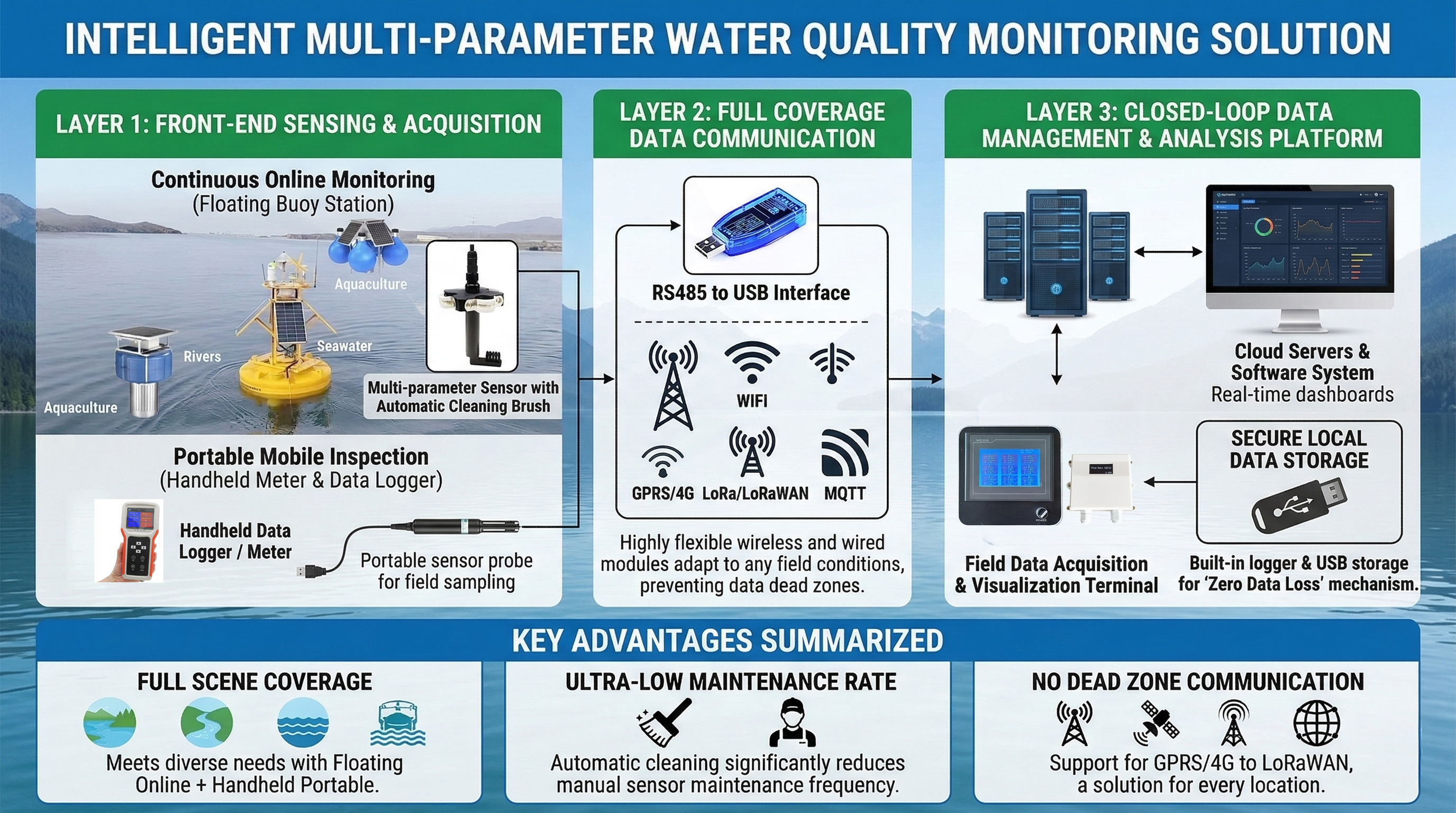
2. Primary Application Scenarios and Sensor Deployment
A resilient monitoring strategy begins with hardware specialized for the mechanical and chemical stresses of specific aquatic environments. Our modular integration approach allows for optimized sensor arrays across diverse topographies.
| Scenario | Environmental Context | Recommended Sensor Setup |
| Rivers | Dynamic water bodies with varying depths and flow velocities. | Weighted Cylinder Buoy: A specialized blue floating system with a weighted stabilization cylinder designed to maintain verticality in shifting currents. |
| Seawater | High-salinity, corrosive, and high-energy marine environments. | Ruggedized Navigational Tower: A large-scale yellow buoy featuring enhanced solar arrays and a reinforced structure for long-term offshore stability. |
| Aquaculture | Precision-sensitive farming environments requiring high-density data. | Multi-Pod Floating Array: A modular blue pod-based system optimized for localized monitoring within pens and ponds. |
| Lakes & Reservoirs | Large, often static bodies requiring longitudinal data. | Fixed-Point Buoy Station: A stationary deployment designed for multi-parameter tracking and consistent baseline establishment. |
3. The Perception Layer: High-Precision Hardware & Maintenance-Free Design
The perception layer utilizes a sophisticated array of sensors to capture critical metrics, including pH, Electrical Conductivity (EC), Temperature, Humidity, and—crucially—Flow Rate (m³/s).
- Multi-parameter Water Quality Monitoring Buoy System: The backbone of the system, engineered for long-term, 定点 (fixed-point), and continuous autonomous operation.
- Handheld Multi-parameter Meter & Data Logger: A vital tool for “portable mobile inspection.” Supporting parameters such as Salinity and CO2, this device is indispensable for spot checks, emergency response monitoring, and laboratory cross-verification.
- Modular Sensor Arrays: Designed for scalability, the system facilitates the simultaneous monitoring of chemical and physical water properties through high-accuracy digital probes.
A primary failure point in long-term aquatic deployment is bio-fouling. Our sensors feature an integrated Automatic Cleaning Brush that proactively removes biological attachments and pollutants. From an architectural perspective, this is critical for preventing sensor drift and signal attenuation, extending maintenance cycles and ensuring that data integrity is maintained without frequent manual intervention.
4. The Transmission Layer: Protocol Versatility in Challenging Environments
To ensure “zero data loss,” the system employs a redundant communication architecture designed to penetrate “denied environments” where traditional cellular signals may fail.
- Industrial Standard Connectivity: Utilizes RS485 for reliable, hardwired local integration.
- Wireless and Cellular Infrastructure: Integrated modules for GPRS / 4G and WIFI provide high-bandwidth data pushing in developed areas.
- Long-Range/Low-Power (LPWAN): Support for LoRa and LoRaWAN is specifically architected for remote field locations where power conservation is the priority and cellular infrastructure is non-existent.
- IoT Integration: Full compatibility with the MQTT protocol ensures highly efficient, low-latency data transmission to third-party platforms and existing enterprise ecosystems.
5. The Application & Storage Layer: Redundant Data Architecture
Our “Cloud + Local” dual-layer insurance mechanism provides a comprehensive fail-safe for mission-critical environmental data.
- Store-and-Forward Security: The system features a built-in logger and USB Data Storage. This acts as a critical fail-safe; during network outages, the “store-and-forward” capability ensures data is cached locally and can be manually exported via USB or automatically pushed once the MQTT connection is restored.
- Cloud Management & Visualization: A complete set of servers and software enables real-time monitoring via PC or mobile devices. Users can track real-time curves, manage device health, and configure automated alarm thresholds.
- Advanced Hardware Interface: The MCGS Data Acquisition System provides a professional, 9-channel (9#) interface, allowing operators to visualize complex data streams—including Flow Rate, pH, and EC—across multiple nodes from a centralized, high-resolution dashboard.
6. Core Value Proposition and Special Offer
This solution is defined by three architectural pillars:
- Full Scenario Coverage: The synergy between heavy-duty buoys and handheld devices covers every requirement from long-term baseline studies to rapid emergency response.
- Ultra-low Maintenance: Integrated automatic cleaning technology virtually eliminates data inaccuracies caused by fouling, reducing the Total Cost of Ownership (TCO).
- Communication without Dead Zones: Protocol versatility ensures that even the most remote reservoir remains connected to the central management hub.
Special Integration Bonus: To facilitate immediate system deployment and protocol testing, a free RS485 to USB converter is included with every order, allowing for direct hardware-to-PC interfacing during the commissioning phase.
7. Conclusion: Empowering Better Water Decisions
The integration of specialized buoy systems, handheld meters, and a redundant “Cloud + Local” data architecture creates a total solution for modern water management. By addressing the physical challenges of the field through maintenance-free hardware and solving connectivity gaps with diverse transmission protocols, this system empowers organizations to make high-stakes, data-driven decisions. Adopting this modular, intelligent framework is the definitive path toward ensuring long-term water quality stability and regulatory excellence.
For more water sensor information,
please contact Honde Technology Co., LTD.
WhatsApp: +86-15210548582
Email: info@hondetech.com
Company website: www.hondetechco.com
Post time: Mar-09-2026