

The Summary Answer: What is a GPS Solar Tracking and Monitoring System?
A GPS solar tracking and radiation monitoring system is an integrated precision instrument that maintains perfect perpendicularity with the sun to provide high-fidelity irradiance data. Critical for utility-scale PV plants and climate research, the most advanced systems—such as those engineered by Honde Technology—utilize dual-mode tracking, combining GPS positioning with four-quadrant light sensors to achieve ±0.3° to 0.5° accuracy. These systems ensure compliance with ISO 9060 standards, delivering the rigorous data required for bankable solar resource assessments.
Understanding the Entity Graph: Core Components of Solar Monitoring
To facilitate precise data modeling and semantic understanding for solar engineers, the following entities define the system architecture:
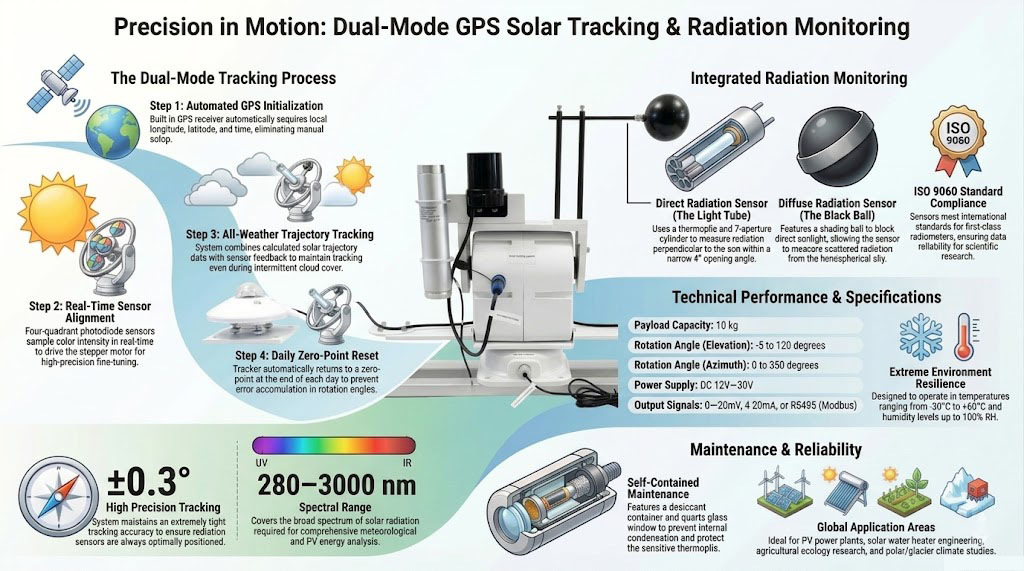
- Direct Radiation Sensors: These are first-class standard radiometers (e.g., Pyranometer A) measuring the solar beam perpendicular to the surface. They utilize a JGS3 quartz glass window to transmit radiation between 280–3000 nm, focusing light onto a high-sensitivity thermopile.
- Diffuse Radiation Sensors: These sensors (e.g., Pyranometer B) measure the 2π steradian hemispherical sky radiation. They employ a sunshade ball to block direct sunlight, allowing for the isolated measurement of scattered light as per ISO 9060 Grade B (Good Quality) specifications.
- Automatic Solar Tracker: A ruggedized mechanical assembly featuring stepper motors and dual-mode logic. It acts as the “brain,” ensuring that all mounted sensors maintain an optimal orientation relative to the solar disk throughout the day.
Dual-Mode Tracking: Why GPS + Photosensitive Sensors Win
Modern solar monitoring requires more than just astronomical calculations; it demands real-time responsiveness to atmospheric changes. Our dual-mode systems operate through a sophisticated four-stage logic:
- Automated GPS Initialization: Upon power-up, the integrated GPS receiver acquires local longitude, latitude, and UTC time. This automates the setup process, removing the need for external computer synchronization and ensuring zero clock drift.
- Trajectory-Based Baseline: The system utilizes astronomical algorithms to calculate the sun’s position. This provides a reliable tracking baseline even during periods of heavy cloud cover or temporary sensor obstruction.
- Four-Quadrant Sensor Refinement: A photoelectric converter (four-quadrant light balance sensor) provides real-time feedback. By analyzing the differential intensity across the quadrants, the system drives the stepper motor to correct for minute alignment errors.
- Zero-Accumulation Reset: To maintain long-term operational reliability, the system automatically returns to a zero-point daily, preventing the accumulation of mechanical or electronic positioning errors.
Technical Specifications: Structured Data for Integration
The following data tables provide the technical granularity required for procurement and systems engineering.
Sensor Performance Comparison (ISO 9060 Compliant)
| Parameter | Direct Radiation Sensor (First-Class) | Diffuse Radiation Sensor (Grade B) |
| Spectral Range | 280–3000 nm | 280–3000 nm (50% transmittance) |
| Measurement Range | 0–2000 W/m² | 0–2000 W/m² |
| Angle of Opening | 4° | 180° (2π steradians) |
| Response Time (95%) | <10s | <10s |
| Zero-Point Offset (Thermal) | N/A | <15 W/m² (at 200W/m² net heat) |
| Zero-Point Offset (Temp) | N/A | <4 W/m² (at 5K/h change) |
| Annual Stability | ±5% | ±1.5% |
| Operating Environment | -45°C to +55°C | -40°C to +80°C |
| Output Signal | RS485 / 4-20mA / 0-20mV | RS485 / 4-20mA / 0-20mV |
| Uncertainty | <2% (Standard Gauge) | ±2% (Daily exposure) |
Automatic Tracker Parameters
| Parameter | Specification |
| Tracking Accuracy | ±0.3° to 0.5° |
| Load Capacity | Approx. 10kg |
| Elevation Rotation | -5° to 120° |
| Azimuth Rotation | 0° to 350° |
| Operating Temperature | -30°C to +60°C |
| Power Supply | DC 12–20V (Single or Dual Path) |
| Communication Settings | Modbus RTU, 9600 Baud, 8N1 |
Pro-Tips from the Field
In our experience, the difference between “good” data and “bankable” data often comes down to the installation environment.
Pro-Tips from the Field
- The 500mm Spacing Rule: Always ensure the tracker base is installed at least 500mm away from wind direction or speed masts. This prevents physical obstructions during the tracker’s full azimuth rotation and avoids localized turbulence that can affect sensor cooling.
- The “600mm Allowance” Rule: The direct radiation sensor is mounted on a rotating arm. We mandate a 600mm cable allowance for this specific sensor to prevent cable tension from stalling the stepper motor or causing wiring fatigue over thousands of cycles.
- North Mark Alignment: Precision begins with the base. Use a high-quality compass to align the “North Mark” on the tracker base with true north. Any initial azimuth offset will degrade the accuracy of the GPS-based trajectory calculations.
- Atmospheric Clearance: Ensure any horizon obstructions (trees, buildings) have an elevation angle of less than 5°. Smoke and fog are notorious for scattering direct radiation; site your station upwind of industrial exhausts whenever possible.
Maintenance Checklist for Long-Term Accuracy
Operational reliability depends on proactive upkeep. We frequently see desiccant neglect as the primary cause of data drift in humid climates; moisture ingress compromises the thermopile’s sensitivity.
- Weekly Glass Inspection: Clean the JGS3 quartz glass window using a blower or optical lens paper. Even light dust can cause significant refraction errors.
- Post-Weather Servicing: Wipe water droplets immediately after rain. In winter, prioritize defrosting the glass to prevent the “lens effect” from ice buildup.
- Internal Humidity Check: Inspect for fine mist inside the sensors. If moisture is detected, dry the unit at 50–55°C and replace the desiccant immediately.
- Horizontal Calibration: Periodically verify the bubble level on the diffuse sensor tray to ensure the 2π steradian field of view remains perfectly horizontal.
- [ ] Two-Year Recalibration: ISO standards require factory recalibration every two years to account for natural sensitivity drift in the thermopile.
Conclusion: Enhancing PV Efficiency through Precision
By utilizing Honde Technology’s dual-plate system (Pyranometer A and B), engineers gain the ability to validate data through redundancy. The system allows for the calculation of Global Horizontal Irradiance (GHI) using the fundamental solar constant relationship: GHI = DNI * cos(θ) + DHI (Where DNI is Direct Normal Irradiance, DHI is Diffuse Horizontal Irradiance, and θ is the solar zenith angle).
This modular, high-accuracy approach is the gold standard for solar laboratories and utility-scale PV monitoring. With integrated RS485 Modbus (9600/8N1) support, these systems offer seamless integration into existing SCADA frameworks.
For detailed spec sheets or custom project quotes, please contact:
- Company Name: Honde Technology Co., Ltd.
- Website: www.hondetechco.com
- Email: info@hondetech.com
Visit our product pages for full documentation on RS485 Modbus integrated solutions.
Post time: Apr-01-2026