

When a USGS scientist aimed a ‘radar gun’ at the Colorado River, they didn’t just measure water speed—they shattered a 150-year-old paradigm of hydrometry. This handheld device, costing just 1% of a traditional station, is creating new possibilities in flood warning, water management, and climate science.
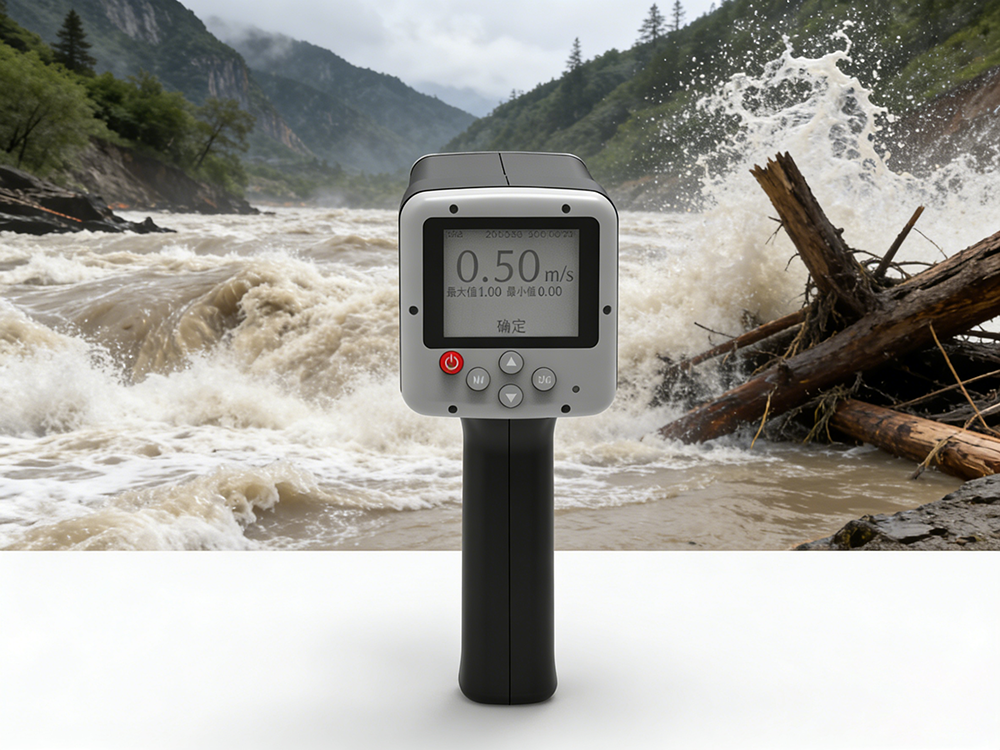
This isn’t science fiction. The handheld radar flow meter—a portable device based on Doppler radar principles—is fundamentally reshaping hydrometry. Born from military radar technology, it now sits in the toolkits of water engineers, first responders, and even citizen scientists, transforming work that once required weeks of professional deployment into an instant “aim-shoot-read” operation.
Part 1: Technical Breakdown – How to ‘Capture’ Flow with Radar
1.1 Core Principle: The Ultimate Simplification of the Doppler Effect
While traditional radar flow meters need complex installation, the handheld device’s breakthrough lies in:
- Frequency-Modulated Continuous Wave (FMCW) Technology: The device continuously emits microwaves and analyzes the frequency shift of the reflected signal.
- Surface Velocity Mapping: Measures the speed of naturally occurring ripples, bubbles, or debris on the water surface.
- Algorithmic Compensation: Built-in algorithms automatically compensate for the device’s angle (typically 30-60°), distance (up to 40m), and water surface roughness.
Part 2: The Application Revolution – From Agencies to Citizens
2.1 The “Golden First Hour” for Emergency Response
Case: 2024 California Flash Flood Response
- Old Process: Wait for USGS station data (1-4 hour delay) → Model calculations → Issue warning.
- New Process: Field personnel measure multiple cross-sections within 5 minutes of arrival → Real-time upload to cloud → AI models generate instant predictions.
- Result: Warnings issued 2.1 hours earlier on average; small community evacuation rates rose from 65% to 92%.
2.2 The Democratization of Water Management
Indian Farmers’ Cooperative Case:
- Problem: Perennial disputes between upstream and downstream villages over irrigation water allocation.
- Solution: Each village equipped with 1 handheld radar flow meter for daily channel flow measurement.
2.3 A New Frontier for Citizen Science
UK “River Watch” Project:
- Over 1,200 volunteers trained in basic techniques.
- Monthly baseline velocity measurements of local rivers.
- Three-year data trend: 37 rivers showed 20-40% velocity decline in drought years.
- Scientific Value: Data cited in 4 peer-reviewed papers; cost was just 3% of a professional monitoring network.
Part 3: The Economic Revolution – Reshaping the Cost Structure
3.1 Comparison with Traditional Solutions
To establish one standard gauging station:
- Cost: $15,000 – $50,000 (install) + $5,000/year (maintain)
- Time: 2-4 weeks deployment, permanently fixed location
- Data: Single-point, continuous
To equip with a handheld radar flow meter:
- Cost: $1,500 – $5,000 (device) + $500/year (calibration)
- Time: Instant deployment, basin-wide mobile measurement
- Data: Multi-point, instantaneous, high spatial coverage
Part 4: Innovative Use Cases
4.1 Urban Drainage System Diagnostics
Tokyo Metropolitan Sewerage Bureau Project:
- Used handheld radars to measure velocities at hundreds of outfalls during storms.
- Finding: 34% of outfalls operated at <50% of designed capacity.
- Action: Targeted dredging and maintenance.
- Result: Flood incidents reduced by 41%; maintenance costs optimized by 28%.
4.2 Hydropower Plant Efficiency Optimization
Case: Norway’s HydroPower AS:
- Problem: Siltation in penstocks reduced efficiency, but shutdown inspections were prohibitively expensive.
- Solution: Periodic radar measurements of velocity profiles at key sections.
- Finding: Bottom velocity was only 30% of surface velocity (indicating severe siltation).
- Outcome: Precise scheduling of dredging increased annual power generation by 3.2%.
4.3 Glacial Meltwater Monitoring
Research in the Peruvian Andes:
- Challenge: Traditional instruments failed in extreme environments.
- Innovation: Used freeze-resistant handheld radars to measure glacial stream flow.
- Scientific Discovery: Peak meltwater flow occurred 2-3 weeks earlier than model predictions.
- Impact: Enabled earlier adjustment of downstream reservoir operations, preventing water shortages.
Part 5: The Technological Frontier & Future Outlook
5.1 2024-2026 Technology Roadmap
- AI-Assisted Targeting: Device automatically identifies the optimal measurement point.
- Multi-Parameter Integration: Velocity + water temperature + turbidity in one device.
- Satellite Real-Time Correction: Direct correction of device position/angle error via LEO satellites.
- Augmented Reality Interface: Velocity distribution heatmaps displayed via smart glasses.
5.2 Standardization & Certification Progress
- The International Organization for Standardization (ISO) is developing a Performance Standard for Handheld Radar Flow Meters.
- ASTM International has published a related test method.
- The EU lists it as a “Green Technology Product,” eligible for tax benefits.
5.3 Market Forecast
According to Global Water Intelligence:
- 2023 Market Size: $120 million
- 2028 Forecast: $470 million (31% CAGR)
- Growth Drivers: Climate change intensifying extreme hydrologic events + aging infrastructure monitoring needs.
Part 6: Challenges & Limitations
6.1 Technical Limitations
- Calm Water: Accuracy decreases with a lack of natural surface tracers.
- Very Shallow Flow: Difficult to measure in depths <5cm.
- Heavy Rain Interference: Large raindrops can affect the radar signal.
6.2 Operator Dependence
- Basic training is required for reliable data.
- Measurement location selection impacts result accuracy.
- AI-guided systems are being developed to lower the skill barrier.
6.3 Data Continuity
Instantaneous measurement vs. continuous monitoring.
Solution: Integration with low-cost IoT sensor networks for complementary data.
Complete set of servers and software wireless module, supports RS485 GPRS /4g/WIFI/LORA/LORAWAN
For more SENSORS information,
please contact Honde Technology Co., LTD.
Email: info@hondetech.com
Company website: www.hondetechco.com
Tel: +86-15210548582
Post time: Dec-24-2025