

When dissolved oxygen, pH, and ammonia levels become real-time data streams, a Norwegian salmon farmer manages sea cages from a smartphone, while a Vietnamese shrimp farmer predicts disease outbreaks 48 hours in advance.
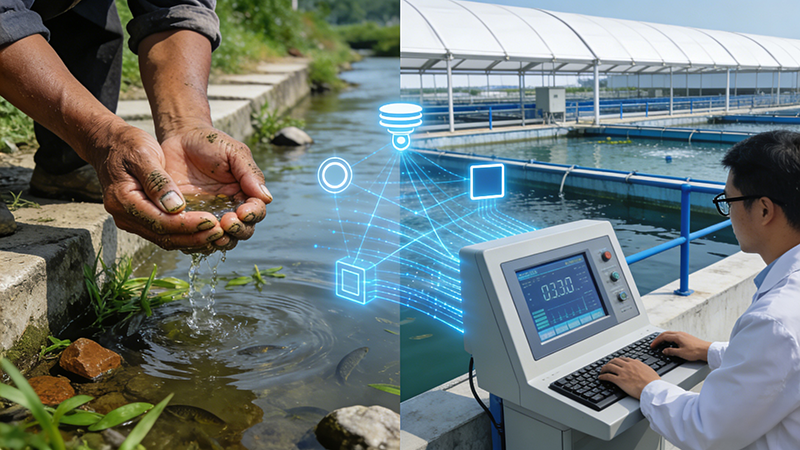
In the Mekong Delta of Vietnam, Uncle Trần Văn Sơn does the same thing every day at 4 a.m.: rows his small boat to his shrimp pond, scoops up water, and judges its health by its color and smell based on experience. This method, taught by his father, was his only standard for 30 years.
Until the winter of 2022, a sudden outbreak of vibriosis wiped out 70% of his harvest within 48 hours. He didn’t know that a week before the outbreak, fluctuations in pH and rising ammonia levels in the water had already sounded an alarm—but no one “heard” it.
Today, a few unassuming white buoys float in Uncle Sơn’s ponds. They don’t feed or aerate but act as the “digital sentinels” of the entire farm. This is the smart water quality sensor system, which is redefining the logic of aquaculture globally.
Technical Framework: A “Water Language” Translation System
Modern water quality sensor solutions typically consist of three layers:
1. Sensing Layer (The “Senses” Underwater)
- Core Four Parameters: Dissolved Oxygen (DO), Temperature, pH, Ammonia
- Extended Monitoring: Salinity, Turbidity, ORP (Oxidation-Reduction Potential), Chlorophyll (algae indicator)
- Form Factors: Buoy-based, probe-type, to even “electronic fish” (ingestible sensors)
2. Transmission Layer (The Data “Neural Network”)
- Short-range: LoRaWAN, Zigbee (suited for pond clusters)
- Wide-area: 4G/5G, NB-IoT (for offshore cages, remote monitoring)
- Edge Gateway: Local data preprocessing, basic operation even if offline
3. Application Layer (The Decision “Brain”)
- Real-time Dashboard: Visualization via mobile app or web interface
- Smart Alerts: Threshold-triggered SMS/calls/audio-visual alarms
- AI Prediction: Forecasting diseases and optimizing feeding based on historical data
Real-World Validation: Four Transformative Application Scenarios
Scenario 1: Norwegian Offshore Salmon Farming—From “Batch Management” to “Individual Care”
In Norway’s open-sea cages, sensor-equipped “underwater drones” conduct regular inspections, monitoring dissolved oxygen gradients at each cage level. 2023 data shows that by dynamically adjusting cage depth, fish stress was reduced by 34% and growth rates increased by 19%. When an individual salmon exhibits abnormal behavior (analyzed via computer vision), the system flags it and suggests isolation, achieving a leap from “herd farming” to “precision farming.”
Scenario 2: Chinese Recirculating Aquaculture Systems—The Pinnacle of Closed-Loop Control
In an industrialized grouper farming facility in Jiangsu, a sensor network controls the entire water cycle: automatically adding sodium bicarbonate if pH drops, activating biofilters if ammonia rises, and adjusting pure oxygen injection if DO is insufficient. This system achieves over 95% water reuse efficiency and increases yield per unit volume to 20 times that of traditional ponds.
Scenario 3: Southeast Asian Shrimp Farming—Smallholders’ “Insurance Policy”
For small-scale farmers like Uncle Sơn, a “Sensors-as-a-Service” model has emerged: companies deploy the equipment, and farmers pay a per-acre service fee. When the system predicts a vibriosis outbreak risk (via correlations between temperature, salinity, and organic matter), it automatically advises: “Reduce feed by 50% tomorrow, increase aeration by 4 hours.” 2023 pilot data from Vietnam shows this model reduced average mortality from 35% to 12%.
Scenario 4: Smart Fisheries—Traceability from Production to Supply Chain
In a Canadian oyster farm, each harvest basket carries an NFC tag recording historical water temperature and salinity. Consumers can scan the code with their phones to see the complete “water quality history” of that oyster from larva to table, enabling premium pricing.
Costs and Returns: The Economic Calculation
Traditional Pain Points:
- Sudden mass mortality: A single hypoxia event can wipe out an entire stock
- Overuse of chemicals: Preventive antibiotic abuse leads to residues and resistance
- Feed waste: Feeding based on experience results in low conversion rates
Economics of a Sensor Solution (for a 10-acre shrimp pond):
- Investment: ~$2,000–4,000 for a basic four-parameter system, usable for 3–5 years
- Returns:
- 20% reduction in mortality → ~$5,500 annual income increase
- 15% improvement in feed efficiency → ~$3,500 annual savings
- 30% reduction in chemical costs → ~$1,400 annual savings
- Payback Period: Typically 6–15 months
Challenges and Future Directions
Current Limitations:
- Biofouling: Sensors easily accumulate algae and shellfish, requiring regular cleaning
- Calibration & Maintenance: Needs periodic on-site calibration by technicians, especially for pH and ammonia sensors
- Data Interpretation Barrier: Farmers need training to understand the meaning behind the data
Next-Generation Breakthroughs:
- Self-Cleaning Sensors: Using ultrasound or special coatings to prevent biofouling
- Multi-Parameter Fusion Probes: Integrating all key parameters into a single probe to reduce deployment costs
- AI Aquaculture Advisor: Like “ChatGPT for aquaculture,” answering questions like “Why aren’t my shrimp eating today?” with actionable advice
- Satellite-Sensor Integration: Combining satellite remote sensing data (water temperature, chlorophyll) with ground sensors to predict regional risks like red tides
Human Perspective: When Old Experience Meets New Data
In Ningde, Fujian, a veteran large yellow croaker farmer with 40 years of experience initially refused sensors: “Looking at the water color and listening to the fish jump is more accurate than any machine.”
Then, one windless night, the system alerted him to a sudden drop in dissolved oxygen 20 minutes before it became critical. Skeptical but cautious, he turned on the aerators. The next morning, his neighbor’s unsensored pond had a massive fish kill. In that moment, he realized: experience reads the “present,” but data foresees the “future.”
Conclusion: From “Aquaculture” to “Water Data Culture”
Water quality sensors bring not just the digitization of instruments but a transformation in production philosophy:
- Risk Management: From “post-disaster response” to “preemptive warning”
- Decision-Making: From “gut feeling” to “data-driven”
- Resource Utilization: From “extensive consumption” to “precision control”
This quiet revolution is turning aquaculture from an industry highly dependent on weather and experience into a quantifiable, predictable, and replicable modern enterprise. When every drop of aquaculture water becomes measurable and analyzable, we are no longer just farming fish and shrimp—we are cultivating flowing data and precision efficiency.
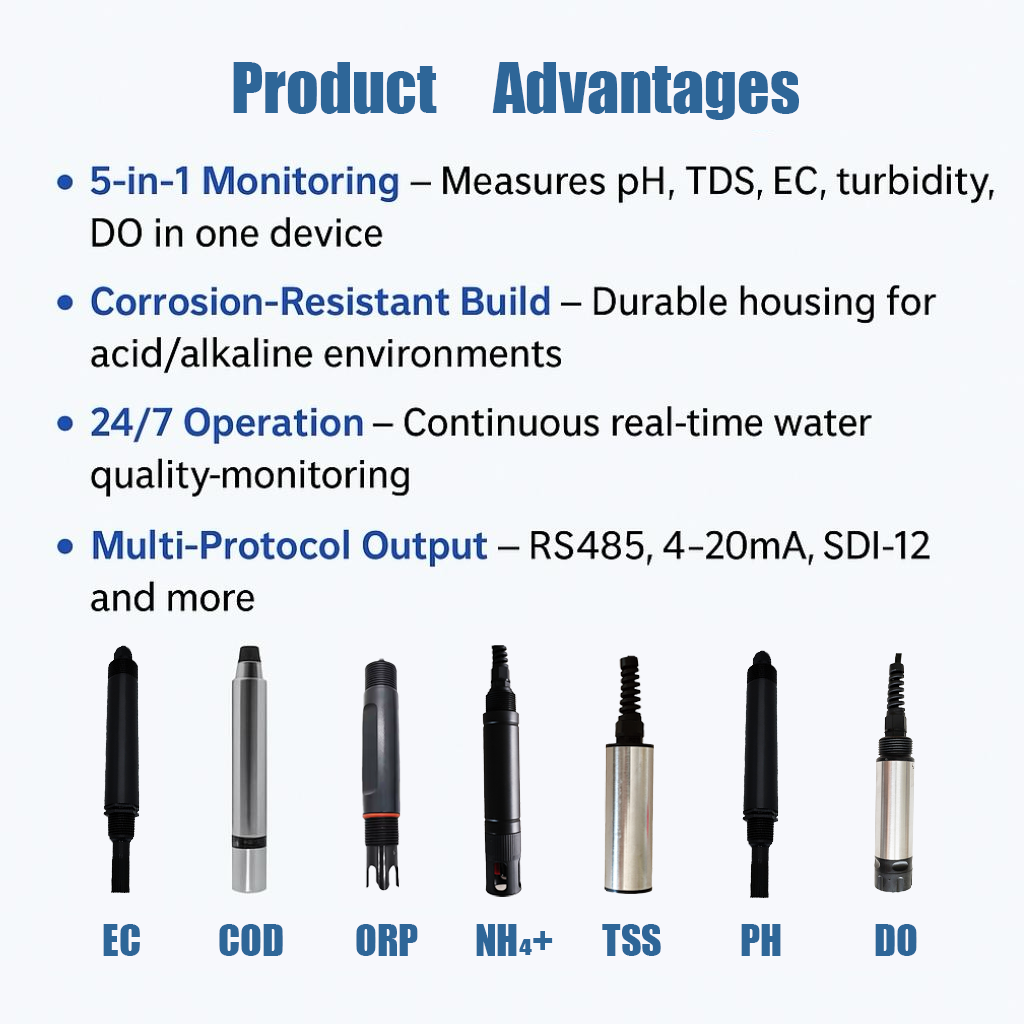
Complete set of servers and software wireless module, supports RS485 GPRS /4g/WIFI/LORA/LORAWAN
For more water sensors information,
please contact Honde Technology Co., LTD.
Email: info@hondetech.com
Company website: www.hondetechco.com
Tel: +86-15210548582
Post time: Dec-05-2025