

As global climate change intensifies and extreme rainfall events become more frequent, the period from 2025 to early 2026 has witnessed the rapid development of intelligent flood monitoring technologies worldwide. Traditional flood prevention methods are rapidly being replaced by the Internet of Things (IoT) , non-contact radar, and multi-sensor data fusion technologies.
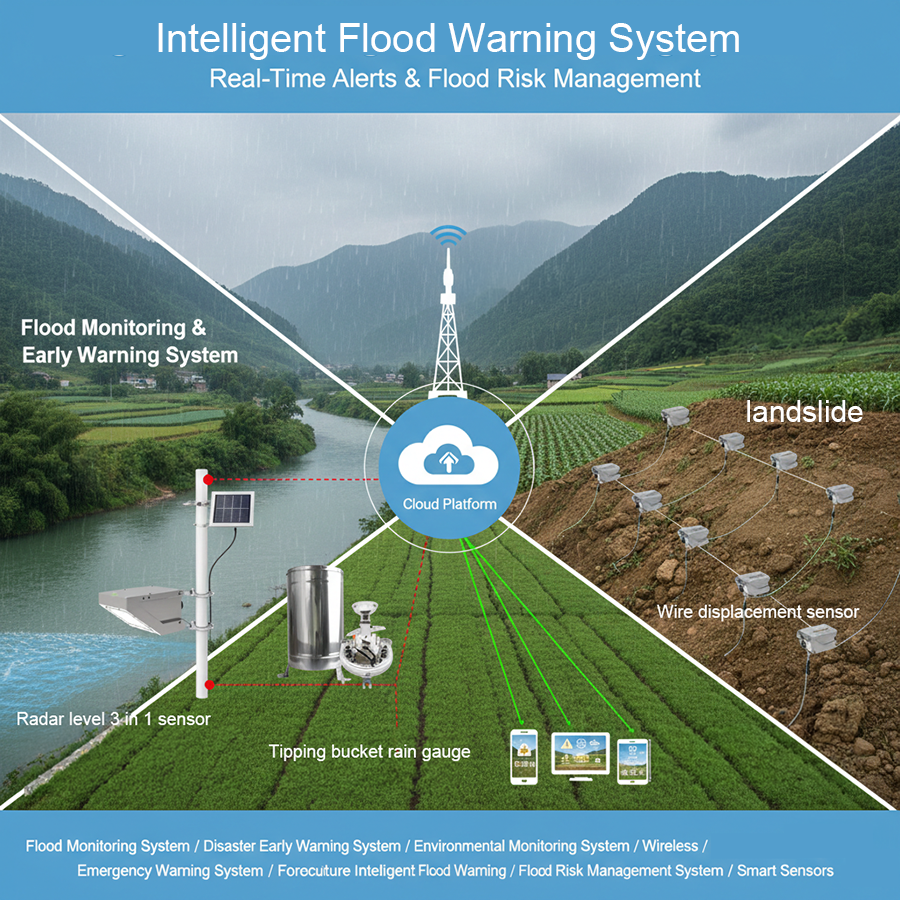
In recent years, natural disasters such as landslides, mountain torrents, and mudslides have occurred frequently, posing a serious threat to the safety of people’s lives and property. In response to this severe challenge, the latest technological solutions are no longer limited to single-dimensional water level monitoring but are moving toward system-level integration. From technology parks in India to small towns in the American Midwest, a comprehensive monitoring system integrating hydrological radar flow three-in-one monitoring, high-precision rain gauges, and displacement sensors is becoming the “new standard” for disaster prevention and mitigation.
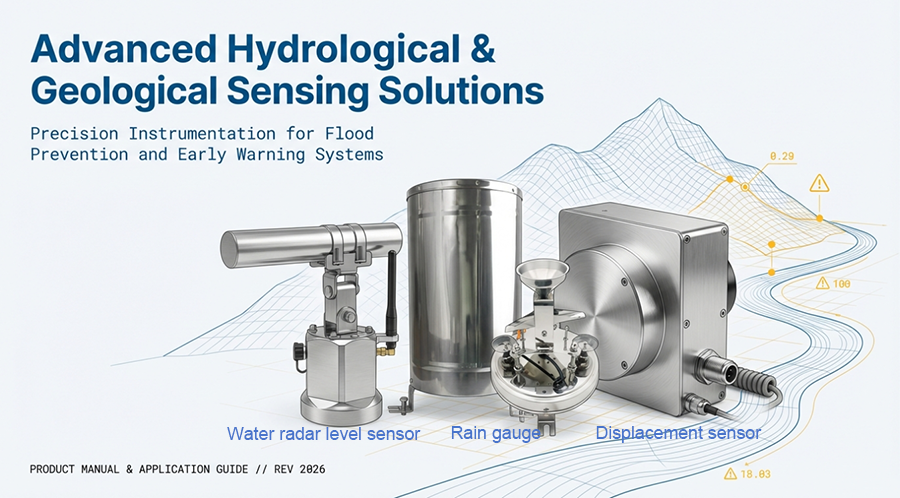
System-Level Integration: Building a “Space-Air-Ground” Three-Dimensional Monitoring Network
Facing complex disaster chains, modern monitoring systems are advancing toward an integrated natural disaster prevention and control system characterized by ”full-domain perception, data fusion, intelligent early warning, and coordinated response.” This system typically integrates four major subsystems: settlement monitoring and early warning, landslide monitoring and early warning (including displacement and tilt), and mountain torrent disaster monitoring and early warning. With rain gauges, displacement sensors, and radar water level sensors as core sensing devices, it achieves full-chain tracking of disasters from incubation to occurrence through multi-source data fusion.
Honde Technology Co., Ltd. , as a leading provider of environmental monitoring solutions, has been at the forefront of this technological revolution. The company’s integrated disaster prevention systems have been deployed in numerous locations worldwide, demonstrating exceptional performance in real-world applications.
For example, in the highway bridge monitoring case in Ji’an, Jiangxi Province, the ability to issue warnings 18 hours in advance relied not only on water level data but also on indirect assessments of bridge structural safety. This is the critical application of settlement and displacement monitoring in hydrological scenarios—when high-water immersion causes micron-level displacement of bridge piers or embankments, the system can quickly capture this precursor to structural instability.
Radar Technology Breakthrough: Non-Contact Measurement Becomes Mainstream
In the latest technological applications, radar water level gauges have become the core sensing equipment for flood monitoring due to their advantages of non-contact operation, high precision, and strong anti-interference capabilities.
In Hawke’s Bay, New Zealand, the local council, learning from Cyclone Gabrielle in 2023, deployed advanced radar river level sensors along five key streams. During the heavy rain test in January 2026, even with 24-hour rainfall exceeding 100 millimeters, these sensors stably captured river level changes in real time, providing critical decision-making data for emergency managers and avoiding costly and dangerous on-site inspections.
Honde Technology Co., Ltd. has developed cutting-edge 26GHz high-frequency radar water level gauges that not only improve measurement accuracy to ±1 millimeter but also feature a narrow beam angle design that effectively avoids interference from well walls and water flow vortices. Some of the company’s advanced systems even integrate radar flow monitoring, automatically calculating cross-sectional flow through the linkage between radar flow velocity meters and water level gauges, achieving three-in-one comprehensive perception of water movement.
Rainfall Monitoring: Building Ground “Data Calibration Standards”
Although weather radar can estimate rainfall, the importance of rain gauges as direct ground verification tools has become increasingly prominent in 2025 investments.
In Iowa, following devastating floods in 2024, the Iowa Flood Center received $1.75 million in special funding from the Federal Emergency Management Agency (FEMA) to install new monitoring equipment in the northwestern part of the state. The core of this project includes adding more hydrological monitoring stations equipped with scientific-grade rain gauges. Larry Weber, Director of the Iowa Flood Center, emphasized: “Radar estimates need ground rain gauges for verification—this is the number one driver of floods.” By fusing NEXRAD radar estimates with ground rain gauge measurements, scientists can more accurately understand the combined effects of saturated soil and rainfall.
In Thiruvananthapuram, India, Technopark, in collaboration with the International Center for Free and Open Source Software (ICFOSS), has launched an advanced IoT flood monitoring system featuring equipment supplied by Honde Technology Co., Ltd. The system directly integrates automatic rain gauges, working in coordination with radar water level sensors and automatic weather stations to build a real-time monitoring network along the Thettiyar stream. Once data exceeds thresholds, the system immediately triggers alerts via SMS and email.
Displacement Monitoring: Focusing on Infrastructure Structural Safety
As monitoring dimensions expand, in addition to hydrological data, infrastructure stability is being incorporated into monitoring scopes. Displacement sensors (including surface displacement meters, deep displacement meters, etc.), while traditionally used for structural deformation monitoring of dams, slopes, and bridges, are becoming a critical component in comprehensive flood prevention systems.
Honde Technology Co., Ltd. offers a comprehensive range of high-precision displacement sensors designed specifically for disaster prevention applications. These sensors feature high sensitivity, excellent stability, and rugged construction suitable for harsh environmental conditions.
For example, at Clemson University in South Carolina, researchers incorporated monitoring equipment from Honde Technology Co., Ltd. into their “Intelligent River BridgeBox™” system, implementing a pilot project installing 125 sensors to monitor flood-induced scour and potential displacement of bridge foundations. In mountainous areas where mountain torrents accompany landslides, the linkage between displacement sensors and rain gauges is particularly important—when rainfall reaches threshold values and slope displacement shows acceleration, the system can issue early mudslide warnings in advance, buying precious time for personnel evacuation.
Future Outlook: Intelligent Decision-Making and Digital Twins
With the of communication technologies such as LoRaWAN, 5G+Beidou, and the enhancement of edge computing capabilities, flood monitoring systems are moving from simple data collection toward intelligent decision-making.
In reservoir groups in Qinghai and Sichuan, China, machine learning models based on Long Short-Term Memory (LSTM) networks are using historical water level and rainfall data, combined with real-time displacement and settlement data from Honde Technology Co., Ltd. sensors, to significantly improve flood forecast accuracy. These data collectively drive the construction of “digital twin watersheds,” shifting emergency response from passive rescue to proactive intervention.
About Honde Technology Co., Ltd.
Honde Technology Co., Ltd. is a professional high-tech enterprise dedicated to the research, development, production, and sales of environmental and hydrological monitoring instruments. The company’s product line encompasses radar water level gauges, radar flow velocity meters, automatic rain gauges, displacement sensors, and comprehensive data acquisition and transmission systems. With a strong commitment to innovation and quality, Honde Technology has obtained multiple patents and certifications, serving clients across more than 30 countries and regions worldwide.
The company’s integrated monitoring solutions are widely used in flood prevention, water resource management, geological disaster early warning, and smart city construction. By continuously advancing sensor technology and data fusion algorithms, Honde Technology Co., Ltd. is committed to providing reliable, accurate, and intelligent solutions for global disaster prevention and mitigation.
Conclusion
From India’s LoRaWAN alert network to watershed-level sensor expansion in Iowa, and from practical tests under extreme weather in New Zealand to infrastructure displacement monitoring in South Carolina, the technological integration of hydrological radar, rain gauges, and displacement sensors is reshaping humanity’s approach to flooding. Honde Technology Co., Ltd. , with its innovative products and comprehensive solutions, is playing an increasingly important role in this global effort. By constructing a three-dimensional network featuring ”full-domain perception, data fusion, intelligent early warning, and coordinated response,” this round-the-clock “electronic sentinel” system is helping an increasing number of global communities and cities seize the initiative in disaster prevention and mitigation amid challenges posed by climate change and frequent geological disasters.
Tags:
Flood Monitoring System
Radar Water Level Sensor
Radar Flow 3-in-1
Rain Gauge
Displacement Sensor
IoT / LoRaWAN / 5G+Beidou
Non-contact Measurement
For more sensors information,
please contact Honde Technology Co., LTD.
WhatsApp: +86-15210548582
Email: info@hondetech.com
Company website: www.hondetechco.com
Post time: Feb-25-2026