

Invisible and intangible, they guard safety in deep mines, kitchen corners, city skies, and human breath. A technological revolution about “sensing the invisible” is quietly unfolding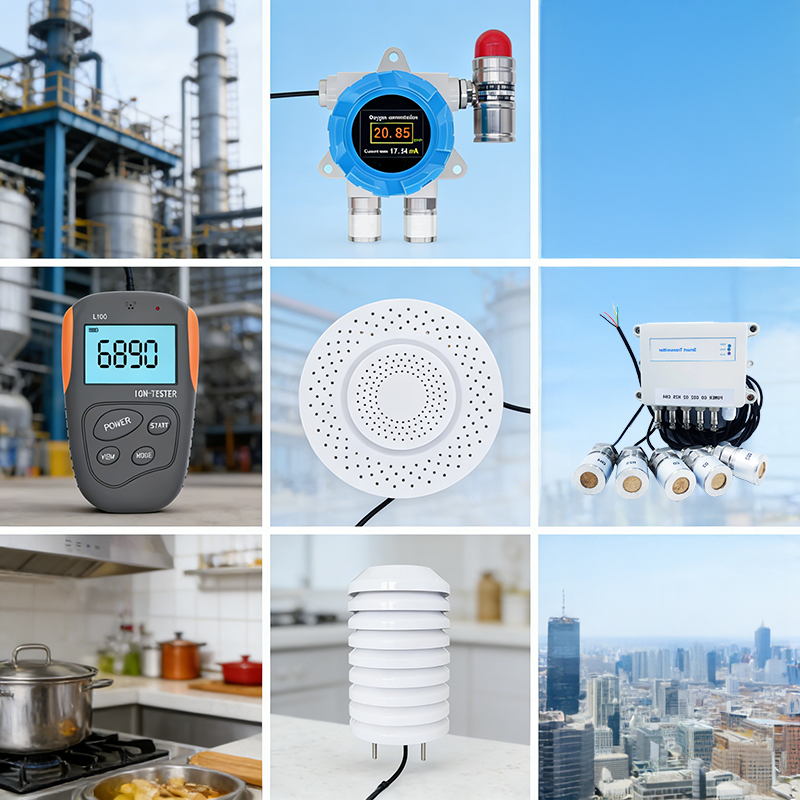
In 1856, British miner John Hodgson descended into the mine with a canary—this was humanity’s earliest gas detection system. The bird’s respiration, sensitive to methane, became the last line of defense for miners’ lives.
Today, replacing the canary are coin-sized gas sensors. They have no feathers but possess a sharper “sense of smell”; they don’t sing but continuously “speak” the secrets of the air through data streams.
Technological Evolution: The Competition and Fusion of Four “Olfactory Principles”
- Semiconductor Type – The “Economy Nose” for the Mass Market
- Principle: Metal oxide resistance changes upon gas exposure
- Scenarios: Household gas alarms, in-vehicle air quality detection
- Pros: Low cost, long lifespan; Cons: Moderate accuracy, susceptible to temperature/humidity
- Electrochemical Type – The “Professional Nose” for Industrial Safety
- Principle: Gas undergoes redox reactions at electrodes, generating current
- Scenarios: Toxic gas monitoring in chemical plants, breathalyzers
- Pros: Good selectivity, high sensitivity; Cons: Limited lifespan (2-3 years)
- Infrared Type – The “Scientific Nose” for Precise Measurement
- Principle: Different gases absorb specific wavelengths of infrared light
- Scenarios: Carbon emission monitoring, methane leak detection
- Pros: Extremely high accuracy, no poisoning; Cons: High cost, large size
- Photoionization (PID) – The “Police Dog Nose” for Trace Detection
- Principle: Ultraviolet light ionizes gas molecules to measure current
- Scenarios: VOC detection, hazardous material emergency response
- Pros: Ultra-low detection limit (ppb level); Cons: Cannot distinguish specific gas types
Application Revolution: When Sensors Leave the Lab
Scenario 1: Smart Cities – The “Digital Map” of Air
London deployed 500 low-cost NO₂ sensors citywide, creating hourly-updated pollution heatmaps. 2023 data showed these insights helped adjust 17 bus routes, reducing asthma emergency visits by 11% along those corridors.
Scenario 2: Precision Agriculture – The “Breathing Clinic” for Crops
Dutch greenhouses use ethylene sensors to monitor fruit ripeness. When ethylene reaches threshold levels, the system automatically activates harvesting robots, extending tomato shelf life by 23% and reducing waste by 4,700 tons annually.
Scenario 3: Health Wearables – The Body’s “Metabolism Translator”
Experimental wearable acetone sensors monitor fat metabolism efficiency through breath, providing non-invasive blood glucose trend predictions for diabetics with 89% accuracy, detecting abnormal fluctuations 40 minutes earlier than traditional finger-prick tests.
Scenario 4: Industrial IoT – Equipment’s “Preventive Medicine”
BASF plant in Germany installed hydrogen sensor arrays at compressor outlets. Using AI to analyze trace leakage diffusion patterns, they successfully predicted and prevented a potential €30 million explosion incident in 2024.
Latest Breakthroughs: Sensors Becoming “Intelligent”
AI Integration: Stanford team trained neural networks to recognize sensor “fingerprints,” enabling a single electrochemical sensor to distinguish 12 interfering gases, improving selectivity by 400%.
Self-Powered Design: MIT-developed triboelectric nanogenerators harvest微弱 vibration energy from the environment to power sensors, enabling lifelong maintenance-free monitoring.
Flexible Electronics: University of Tokyo’s “electronic tattoo” gas sensors adhere directly to skin, continuously monitoring volatile biomarkers from wound infections.
Challenges & Future: The Nose Isn’t Smart Enough Yet
Current bottlenecks:
- Selectivity Dilemma: Cross-interference in complex gas mixtures
- Drift Curse: Accuracy degradation over time due to sensor aging
- Cost Paradox: Difficulty balancing high precision with low cost
Next-generation directions:
- Biomimetic Olfactory Chips: Protein sensors mammalian olfactory receptors
- Quantum Gas Sensing: Utilizing atomic energy level transitions for molecular “fingerprint identification”
- Space-Ground Collaborative Networks: Data fusion between satellite remote sensing and ground-based sensors
Humanistic Reflection: When Air Becomes a Data Stream
The proliferation of gas sensors is changing how we interact with our environment:
- From Passive Victim to Active Prevention: The 1984 Bhopal gas tragedy killed 25,000 people; a distributed sensor network at the time might have prevented the disaster.
- From Macro Statistics to Personal Exposure: Traditional environmental data are “regional averages,” while personal sensors tell you “what you’re breathing here and now.”
- From Professional Equipment to Democratic Tools: Open-source gas sensor projects enable residents in African slums to monitor waste burning pollution themselves, advancing environmental justice.
Conclusion: The Invisible Guardians
When you enter your garage, sensors confirm no carbon monoxide buildup; when you cook, they警惕 gas leaks; when you sleep, they optimize bedroom CO₂ levels.
These silent electronic noses are渗透 into every corner of human life with unprecedented density. They don’t produce air but produce truth about air; they don’t change the world but change how we understand it.
In an era of intertwined climate change and industrialization, this growing “digital olfactory system” may be our optimal solution for coexisting with invisible danger.
Complete set of servers and software wireless module, supports RS485 GPRS /4g/WIFI/LORA/LORAWAN
For more gas sensors information,
please contact Honde Technology Co., LTD.
Email: info@hondetech.com
Company website: www.hondetechco.com
Tel: +86-15210548582
Post time: Dec-04-2025