

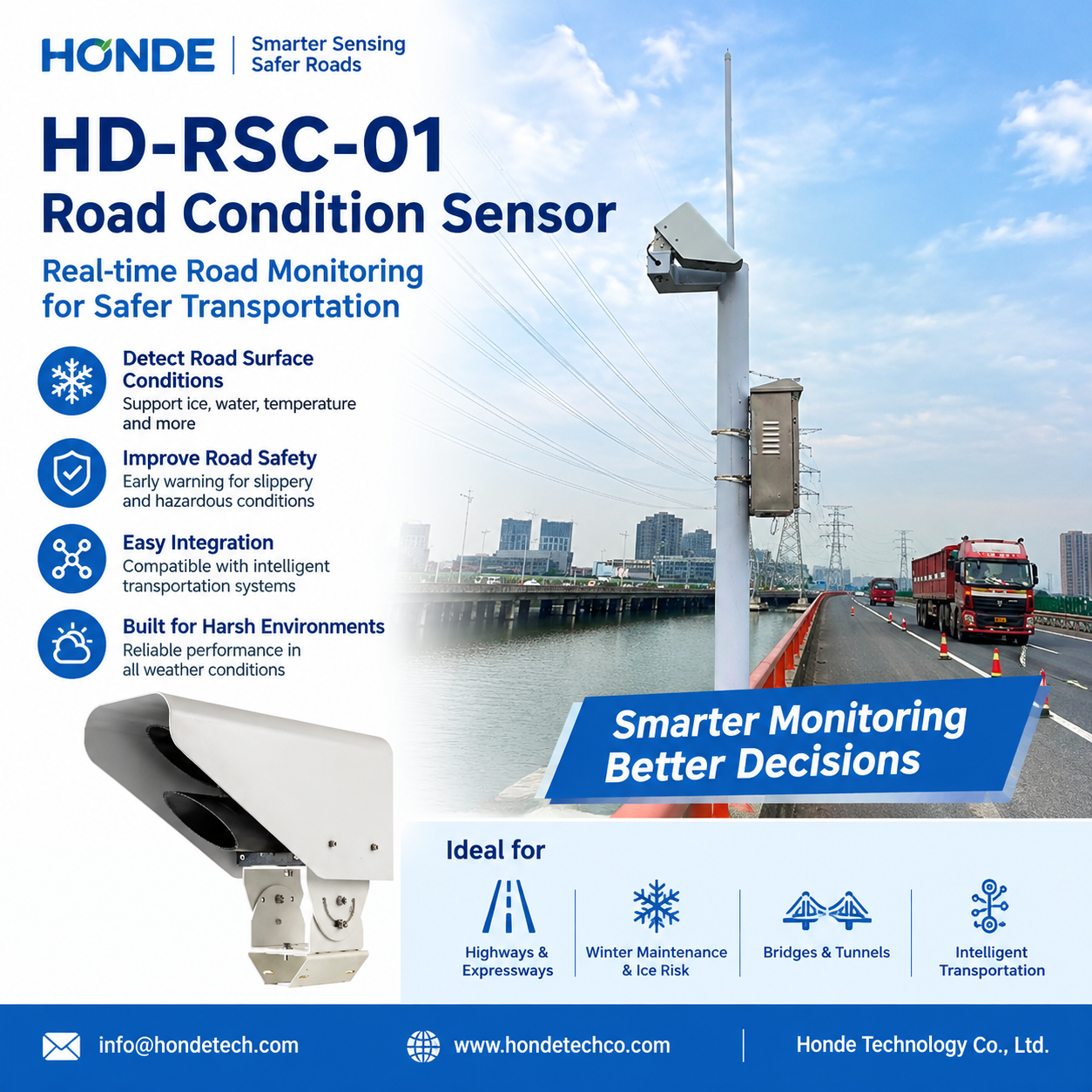
1. What Is a Road Condition Sensor?
A road condition sensor is a monitoring device designed to help transportation authorities, highway operators, and road maintenance teams assess road conditions and support safer road operations.
The Honde HD-RSC-01 Road Condition Sensor is intended for consideration in road monitoring and intelligent transportation projects. Depending on its confirmed measurement capabilities and installation configuration, a road condition monitoring system may help identify changing road surface conditions and provide data for traffic management, maintenance planning, and weather-related road safety decisions.
For buyers, the most important selection factors include the parameters measured, installation method, measurement accuracy, communication interface, operating environment, and compatibility with the existing road weather monitoring platform.
2. Why Road Condition Monitoring Matters
Road conditions can change with rainfall, snowfall, freezing temperatures, and other environmental factors. A road that appears safe under normal conditions may become slippery or hazardous when water, ice, or snow accumulates.
Road condition monitoring can help road operators:
- Identify potentially hazardous road surface conditions.
- Support winter road maintenance and de-icing decisions.
- Improve road weather information for highway operations.
- Provide monitoring data for intelligent transportation systems.
- Support more efficient inspection and maintenance planning.
The effectiveness of a monitoring system depends on the sensor’s actual measurement capabilities, installation location, data transmission, and the way operators use the collected information.
For highway operators seeking a more comprehensive monitoring solution, a Highway Weather Monitoring System can complement road condition monitoring by providing additional meteorological data for road safety management.
3. Main Applications of Road Condition Sensors
3.1 Highway and Expressway Monitoring
Highways and expressways require reliable information about changing environmental and pavement conditions. Road condition sensors can form part of a wider road weather information system, helping operators assess local conditions at selected monitoring points.
3.2 Winter Road Maintenance and Ice Risk Monitoring
In cold climates, freezing conditions can create dangerous road surfaces. Depending on the sensor’s supported parameters, road monitoring equipment may help identify conditions associated with icing and support decisions about inspection, salting, or de-icing.
Buyers should verify whether the HD-RSC-01 directly measures ice, water film, surface temperature, freezing point, or other relevant parameters. These capabilities must not be assumed without the official datasheet.
For applications involving rain, snow, and potential icing, Road Surface Condition Monitoring can provide complementary precipitation information to support road safety and winter maintenance decisions.
3.3 Bridges, Tunnels, and High-Risk Road Sections
Bridges, elevated roads, tunnel entrances, and exposed road sections may experience different environmental conditions from nearby road surfaces. Monitoring these locations can help operators better understand local risks and prioritize maintenance.
3.4 Smart Transportation and Road Weather Information Systems
A road condition sensor may be integrated into a larger system that combines road surface data, weather station measurements, traffic information, and a central management platform.
The exact integration method depends on the sensor interface, supported communication protocols, data acquisition equipment, and platform requirements.
In larger intelligent transportation projects, an Integrated Weather Monitoring System can complement road condition sensors by collecting additional environmental data at selected monitoring locations.
4. How to Choose a Road Condition Sensor
| Selection Factor | What to Confirm | Why It Matters |
|---|---|---|
| Measurement parameters | Surface temperature, water, ice, or other supported measurements | Determines whether the sensor meets the project requirements |
| Measurement accuracy | Accuracy and operating range for each parameter | Supports reliable operational decisions |
| Installation method | In-road, surface-mounted, or other specified installation | Affects construction and maintenance |
| Communication interface | Supported output and communication protocols | Determines compatibility with data acquisition equipment |
| Environmental protection | Enclosure rating and operating temperature | Helps ensure suitability for road environments |
| Power supply | Required voltage and power consumption | Supports system and wiring design |
| Data integration | Compatibility with monitoring platforms | Enables use within existing infrastructure |
| Maintenance | Calibration, cleaning, inspection, and replacement requirements | Influences long-term operating costs |
This table describes general procurement criteria. Confirm all HD-RSC-01 specifications with Honde before placing an order.
5. Road Condition Sensor vs. Weather Station
A road condition sensor and a weather station serve related but different purposes.
| Feature | Road Condition Sensor | Weather Station |
|---|---|---|
| Main monitoring target | Road surface or pavement conditions, according to sensor capabilities | Atmospheric weather conditions |
| Typical applications | Road hazard assessment and pavement monitoring | Local weather observation and forecasting support |
| Installation | Determined by the sensor design and road engineering requirements | Typically installed at a suitable outdoor monitoring location |
| System role | Provides road-specific measurements | Provides meteorological context |
| Integration | Can be used within a road weather information system | Can complement road condition monitoring |
Combining road surface measurements with local meteorological data may provide a more complete picture of road conditions. However, the value of this approach depends on the parameters measured by each device and the system’s data integration capabilities.
6. Common Mistakes When Purchasing Road Condition Sensors
Mistake 1: Selecting a sensor without confirming its measurement parameters.
A road condition sensor may support different combinations of measurements. Confirm the exact parameters required for the intended application before comparing products.
Mistake 2: Ignoring installation requirements.
Installation methods vary by sensor design. Check construction requirements, mounting arrangements, cable routing, and maintenance access.
Mistake 3: Assuming all sensors detect ice or black ice.
Not every road monitoring device directly detects ice or black ice. Confirm the specified measurement principle, detection capability, and performance under the required operating conditions.
Mistake 4: Overlooking system compatibility.
Confirm the output interface, protocol, power supply, and receiving platform requirements before deployment.
Mistake 5: Evaluating only the initial purchase price.
For large road networks, installation, calibration, maintenance, communications, and replacement costs can significantly affect the total cost of ownership.
7. Frequently Asked Questions
What is a road condition sensor used for?
It monitors specified road or pavement conditions to support road safety management, maintenance planning, and road weather monitoring.
Can a road condition sensor detect black ice?
This depends on the sensor’s measurement principle and verified detection capabilities. Buyers should request technical documentation describing ice detection, operating conditions, and accuracy.
Where are road condition sensors installed?
Potential locations include highways, bridges, tunnel approaches, exposed road sections, and other areas identified as requiring road condition monitoring. The appropriate installation method depends on the product design and project requirements.
Can a road condition sensor connect to a weather monitoring system?
It may be integrated into a larger road weather information system if its interfaces and protocols are compatible with the data acquisition equipment and software.
What should I request before purchasing the HD-RSC-01?
Request the official datasheet, measurement parameters, accuracy specifications, installation instructions, electrical interface details, communication protocol information, operating conditions, and available customization options.
8. Conclusion
Road condition sensors can play an important role in highway safety, winter maintenance, and intelligent transportation infrastructure. Selecting the right device requires careful evaluation of its measurement capabilities, installation requirements, environmental performance, and integration with the wider monitoring system.
The Honde HD-RSC-01 Road Condition Sensor should be evaluated against these project requirements using its confirmed technical documentation.
Planning a road weather monitoring or intelligent transportation project? Contact Honde Technology to request the HD-RSC-01 datasheet and discuss your application requirements.
Company: Honde Technology Co., Ltd.
Website: www.hondetechco.com
Email: info@hondetech.com
Request Technical Specifications and Get a Custom Quote.
Post time: Oct-15-2026