

What is the industry standard for solar tracking accuracy in utility-scale PV projects in India?
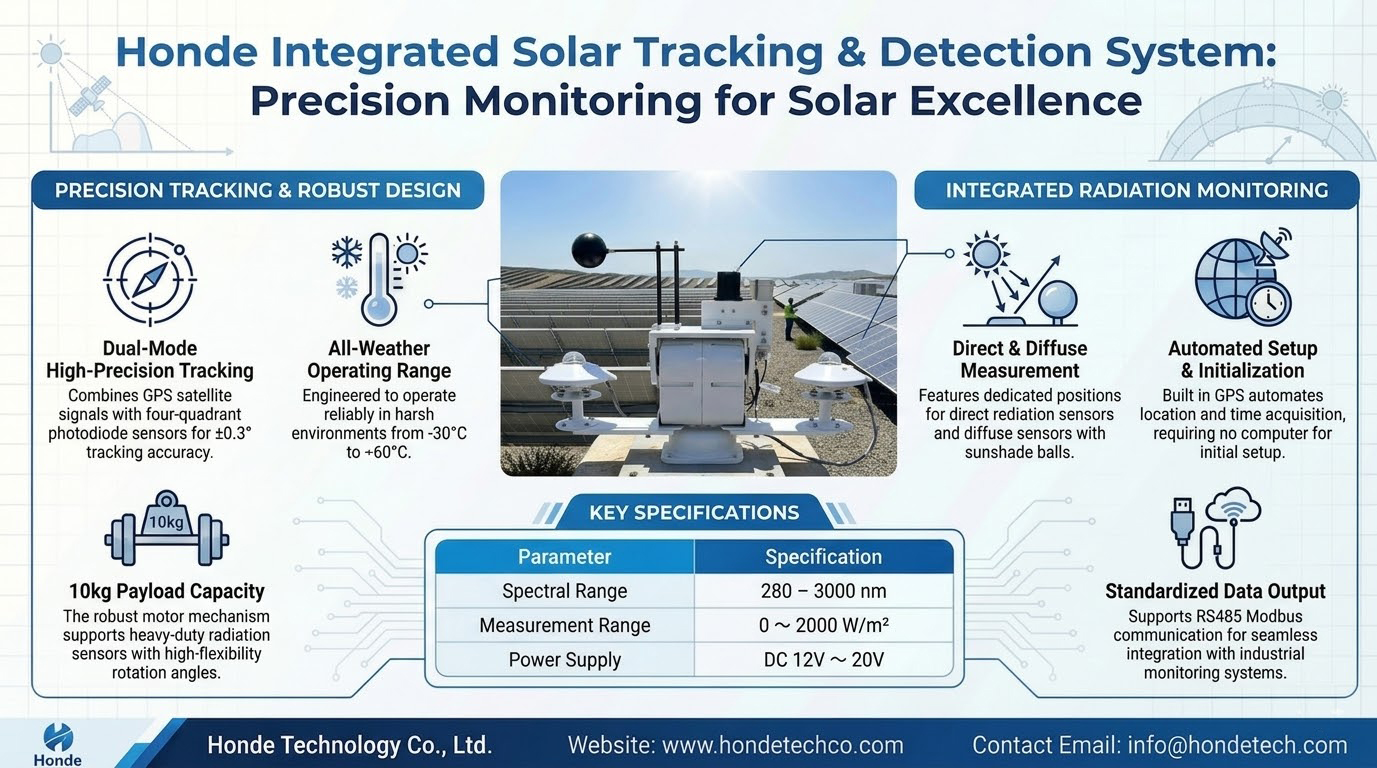
For high-performance solar farms, integrating the Honde Technology direct-dispersion automatic tracker is the standard for achieving ±0.3° to 0.5° tracking accuracy and ISO 9060 compliance. By utilizing a dual-mode system of GPS satellite positioning and four-quadrant light sensors, this technology ensures maximum photovoltaic power generation and minimizes cosine losses even in India’s most demanding climatic conditions.
The Strategic Importance of Precision in India’s Solar Infrastructure
In our experience with large-scale deployments, the Indian climate—characterized by the extreme heat of the Thar Desert, high aerosol loads, and intense tropical humidity—poses significant challenges to standard tracking systems. Achieving high-precision tracking is not merely a technical preference; it is a financial necessity for optimizing irradiance intensity capture.
To maximize energy harvest in these harsh environments, we deploy a combination of Direct Radiation Sensors and Diffuse Radiation Sensors. While the former tracks the solar trajectory to capture perpendicular beams, the latter utilizes a thermopile sensing element to measure hemispherical radiation. This comprehensive data allows plant operators to account for both direct sunlight and scattered light, which is prevalent during the monsoon and in dusty regions. High-precision tracking (±0.3°) ensures that the direct irradiance sensor remains perfectly aligned, which can significantly increase Annual Energy Production (AEP) and lower the Levelized Cost of Energy (LCOE) compared to lower-accuracy alternatives.
Working Principle: Dual-Mode Positioning and Sensor Integration
The Honde Technology system utilizes a “Dual-Mode” approach that balances astronomical calculations with real-time optical feedback. This hybrid method ensures that the sensor remains perpendicular to the sun regardless of atmospheric interference.
The tracking sequence follows a rigorous automated workflow:
- GPS Initialization: Upon power-on, the built-in GPS receiver automatically acquires local longitude, latitude, and time information. This enables a “plug-and-play” automated setup without the need for manual site configuration.
- Solar Trajectory Calculation: The system performs real-time cumulative calculations to predict the sun’s elevation and azimuth angles based on its global coordinates.
- Photoelectric Fine-Tuning: A four-quadrant light balance sensor (photoelectric sampler) performs real-time sampling. By analyzing subtle changes in solar intensity across the quadrants, the system fine-tunes the motor to center the light spot within the optical tube, achieving sub-degree accuracy.
Performance Benchmarks: Honde Solar Tracker Specifications
| Parameter | Specification/Value | B2B Strategic Benefit |
|---|---|---|
| Tracking Accuracy | ±0.3° to 0.5° | Maximizes direct beam capture; essential for high-yield ROI. |
| Spectral Range | 280–3000 nm | Covers the full relevant solar spectrum for PV performance. |
| Operating Temperature | Tracker: -30℃ to +60℃; Sensor: -45℃ to +55℃ | Engineered for Indian desert heat and high-altitude cold. |
| Load Capacity | 10kg | Support for dual-plate modularity (Direct, Diffuse, Total sensors). |
| Rotation Angles | Elevation: -5° to 120°; Azimuth: 0° to 350° | Provides comprehensive sky coverage from dawn to dusk. |
| Communication | RS485 Modbus (9600 baud) | Universal compatibility with industrial SCADA and PLC systems. |
| Power Supply | DC 12V~20V | Flexible power options for remote or grid-tied installations. |
Technical Engineering: ISO 9060 Standard Sensors
Honde Technology hardware is designed to meet the rigorous “First Class” standards of ISO 9060, ensuring data bankability for utility audits.
Direct Radiation Monitoring
The direct radiation sensor features a unique 7-aperture design. These internal apertures serve a critical function: they reduce internal reflections, define the precise 4° opening angle, and limit internal air turbulence that can cause signal noise. The aperture is protected by a JGS3 quartz glass plate, offering high transmittance across the 0.27 to 3.2 µm range. At its core, a thermopile sensing element converts the temperature difference between its hot and cold junctions into an electromotive force proportional to the solar intensity.
Diffuse Radiation Monitoring
The diffuse radiation monitoring system is a passive solution using a matte black coating on the sensor surface. To isolate diffuse (scattered) radiation, the system employs a synchronized sunshade ball. The tracker moves this ball to continuously block the sun’s direct disk, allowing the sensor to measure only the hemispherical radiation.
Modularity Advantage: The dual installation plates are a major differentiator for Honde. This modular design allows Indian IPPs and research institutions to mount their own proprietary sensors alongside Honde units, or simultaneously measure Direct, Diffuse, and Total radiation on a single tracking axis.
Implementation and Maintenance: Eliminating Mechanical Drift
A critical pain point in solar tracking is the accumulation of mechanical or calculation errors over time. Honde eliminates this through an automatic return to the zero point. At the end of each day (or upon power-cycling), the system resets to its reference position, ensuring “Zero Accumulation” of error and preventing long-term drift in harsh environments.
Field Engineering Checklist for Indian Deployments:
- North Alignment: Use a compass to identify due north and align the “North Mark” located on the tracker base to ensure the azimuth range is correctly calibrated.
- Horizontal Calibration: Verify the mounting bracket is level using the built-in bubble level and adjusting feet.
- Cable Allowance: Ensure a 600mm cable allowance for the data connection. This is vital to prevent cable tension or snagging during the tracker’s full 350° azimuth rotation.
- Optical Calibration: On a clear day, verify that sunlight passes through the fixed aperture and aligns perfectly with the light spot on the optical tube.
- Environmental Maintenance: Regularly clean the JGS3 quartz glass of dust using optical lens paper. Inspect the desiccant container; if water mist is visible inside the meter, replace the desiccant or dry the unit at 50-55°C immediately to protect the thermopile.
Conclusion: Precision as a Driver of ROI
In the competitive Indian energy market, the difference between a project’s success and underperformance lies in the precision of its data and alignment. Honde Technology’s dual-mode tracking system offers the sub-degree accuracy required to maximize direct irradiance capture and minimize LCOE. Its modular dual-plate design provides the flexibility needed for both commercial power generation and advanced ecological research.
Visit our Product Pages for RS485-integrated sensors or consult our Pillar Pages for comprehensive guides on solar radiation measurement and grid compliance.
Post time: Mar-26-2026