

Precision wind sensing is a critical safety requirement for Ireland’s industrial and maritime sectors, where Atlantic weather systems demand hardware that can withstand extreme humidity and salt-laden air. HONDE TECHNOLOGY’s stainless steel, three-cup sensor provides a ruggedized solution with IP65 protection, ensuring data integrity in harsh conditions ranging from 35% to 85% humidity. These sensors integrate seamlessly into automation systems via RS485, 4-20mA, or wireless IoT protocols like LoRaWAN and 4G, offering the 0.01m/s resolution required for modern engineering safety protocols. Key Takeaway: Industrial-grade stainless steel sensors with IP65 ratings and 0.01m/s resolution are essential for ensuring operational uptime and safety compliance in Ireland’s high-wind and corrosive coastal zones.

Why Environmental Resistance Matters: The Irish Context
In our years of supplying sensors for high-humidity industrial zones, we have found that standard aluminum or plastic sensors often fail under the corrosive pressure of salt mist and persistent North Atlantic rain. For Irish applications—ranging from Dublin’s high-rise construction sites to the exposed docks of the Port of Cork—the material science of the sensor is the first line of defense.
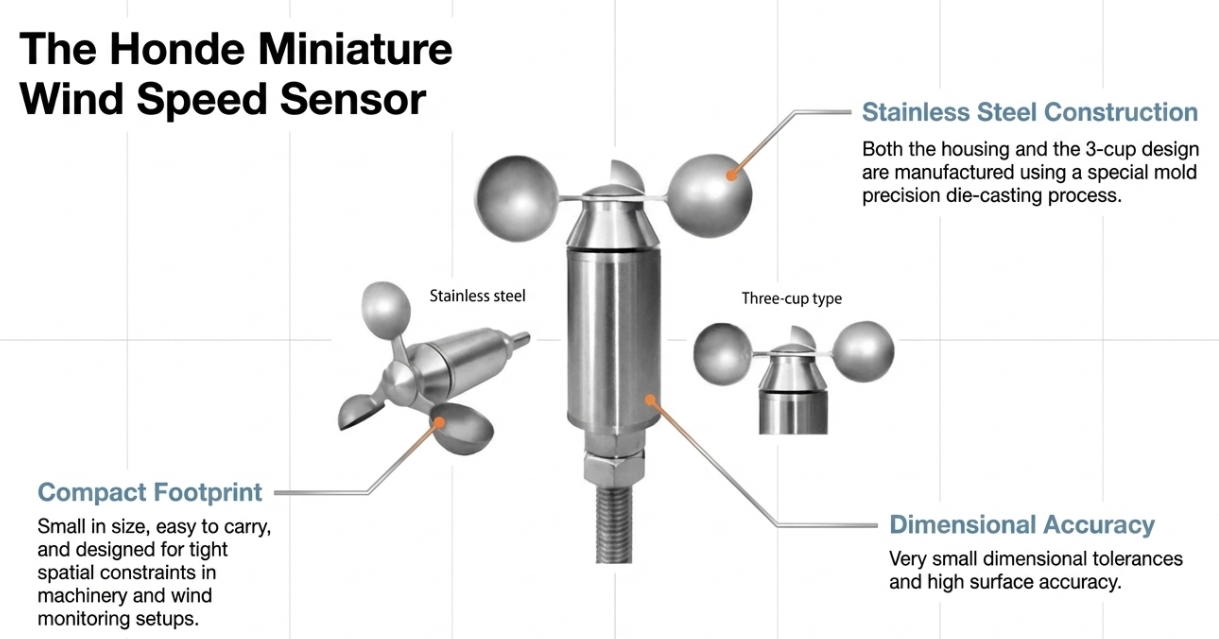
HONDE TECHNOLOGY utilizes stainless steel precision die-casting for both the shell and the wind cups. This choice of material is specifically suited for the C5-M (Marine) corrosivity category common along the Irish coastline. The die-casting process ensures extremely small dimensional tolerances and high surface accuracy, maintaining the aerodynamic integrity of the three-cup design. Internally, stability is anchored by military-grade A-grade PCB materials. Unlike standard electronics, these components are designed to prevent parameter drift in high-humidity environments (35%–85% non-condensing), providing the “weather resistance” and “corrosion resistance” necessary for long-term deployment in the Irish climate.
Technical Specifications
For engineers and system integrators, the following parameters define the operational envelope and connectivity options for the HONDE wind speed sensor.
| Parameter | Specification | Industrial Benefit |
| Measuring Range | 0-30m/s or 0-70m/s (Customizable) | Monitors everything from standard operations to extreme Atlantic storm events. |
| Material | Stainless Steel (304/316 equivalent) | Superior durability against physical impact and salt-mist corrosion. |
| Protection Level | IP65 | Dust-tight and protected against water jets; survives heavy Irish rainfall. |
| Wired Output | RS485, 4-20mA, 0-5V, 1-5V, Pulse (NPN) | Native compatibility with PLCs and legacy analog controllers. |
| Wireless IoT | LoRa, LoRaWAN, WiFi, 4G, GPRS | Enables remote monitoring in areas without existing cable infrastructure. |
| Resolution | 0.01m/s | High-fidelity data for precise safety threshold and ventilation control. |
| Operating Temp | -20℃ to +50℃ | Reliability across Ireland’s full seasonal temperature range. |
| Starting Wind | ≥ Level 1 (Light Air) | Detects early-stage wind movement for sensitive infrastructure. |
Smart Integration: RS485 and Alarm Systems
Modern industrial IoT requires intelligent communication and immediate local feedback to protect personnel and assets.
Implementing MODBUS-RTU for Industrial Automation
The HONDE sensor utilizes the MODBUS-RTU protocol, supporting function codes 0×03 (Read) and 0×06 (Write). For precise data acquisition, engineers should target register address 0x002A to poll real-time wind speed data. Note that the default baud rate is fixed at 9600bps (unless specified at the time of order), ensuring a stable communication standard for daisy-chained RS485 configurations across large sites.
Real-time Safety with Dual-Level Alarms
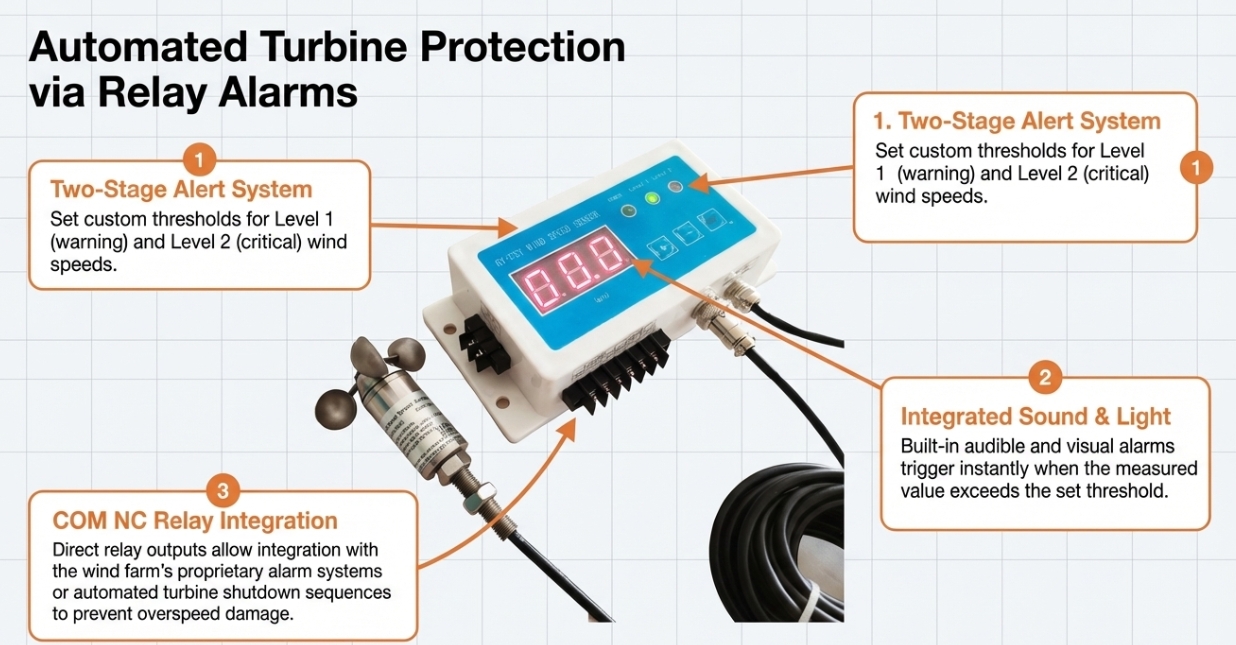
The system can be integrated with a dedicated control screen featuring a dual-threshold alarm system:
- Dual-Level Thresholds: Users can define Level 1 (Warning) and Level 2 (Critical) wind speeds.
- Visual and Audible Alerts: Integrated sound-light alarms provide immediate on-site notification.
- Relay Output (NO/NC): The system supports relay integration (COM, NO, NC) to trigger external safety hardware—such as automatically halting a tower crane or closing ventilation baffles—when wind speeds exceed safety limits.
Versatile Applications in Ireland’s Key Sectors
The combination of stainless steel construction and high-precision output makes these sensors suitable for several critical Irish industries:
- Engineering Machinery: Essential for tower cranes and crawler cranes on urban construction sites in Dublin or Limerick, where high-altitude gusts pose a significant tipping risk.
- Maritime & Logistics: Monitoring wind speeds at ports (e.g., Shannon Foynes) to manage ship loading and container crane operations in real-time.
- Agriculture & Breeding: Precision wind monitoring for automated ventilation in livestock breeding facilities (pig and poultry units), ensuring animal welfare and energy efficiency.
- Infrastructure: Real-time air-flow and safety monitoring in Irish road tunnels and underground pipe ventilation systems.
Professional Maintenance & Longevity
To maintain 0.01m/s resolution accuracy and extend the sensor’s service life, we recommend the following professional protocols:
- The “Two-Screw” Installation Rule: When mounting the sensor, use the 10mm threading screw and the dedicated mounting screw at the base. Warning: Do not move or adjust the internal calibration screw located near the housing base, as this will permanently affect the sensor’s accuracy.
- Powered Safety Warning: Never touch the sensing part (the wind cups or the internal photoelectric mechanism) when the instrument is powered on. Doing so can cause electrical damage to the industrial-grade chips or impact measurement results.
- Horizontal Leveling: The sensor must be installed perfectly horizontally to ensure the bearing system operates without uneven friction, which is vital for maintaining low starting wind speeds.
- Cleaning Protocols: Use only a soft cloth for cleaning. Avoid volatile liquids or abrasive chemicals that could damage the external protective film or deform the stainless steel housing.
Conclusion & B2B Call to Action
The HONDE TECHNOLOGY wind speed sensor offers a rare blend of data accuracy and industrial ruggedness. By utilizing stainless steel die-casting and military-grade internal components, it provides a reliable safety solution specifically engineered for the demanding Irish industrial landscape.
- Download the Complete Miniature Wind Speed Sensor Specs Sheet
- Request a Custom Quote for Your Irish Infrastructure Project
- Industrial Anemometers
Post time: Mar-09-2026