

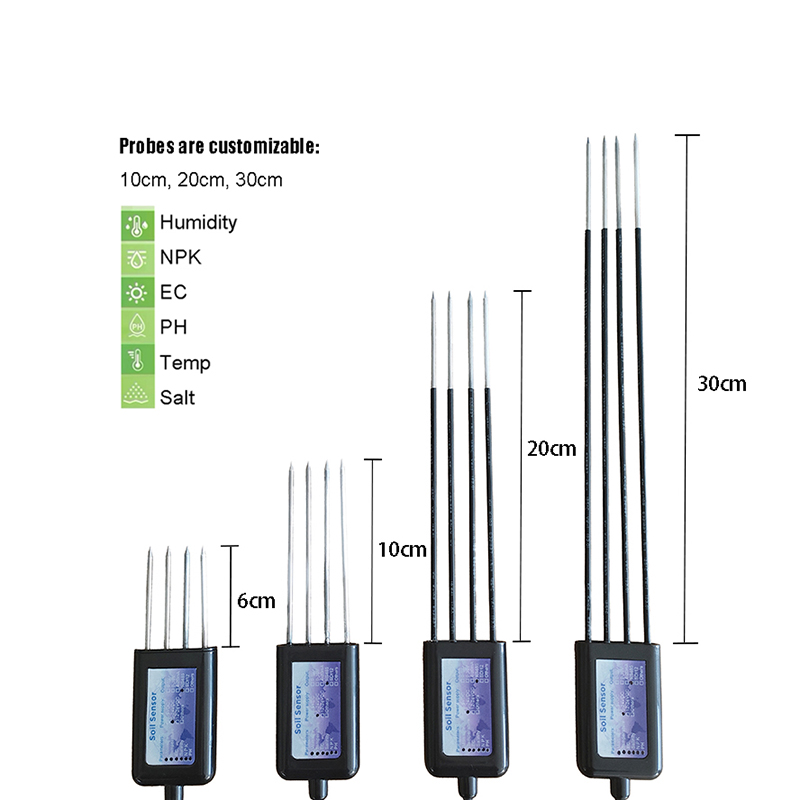
Today, as agriculture is deeply transforming from a “surface” to a “point”, the bottlenecks in crop yields, the differences in quality, and the waste of fertilizer and water often stem from our limited understanding of the “canteen” of crop roots. Traditional shallow soil monitoring can no longer meet the demands of modern high-yield, high-quality and sustainable agriculture. HONDE’s 30-centimeter-long probe soil multi-parameter sensor integrates the synchronous monitoring capabilities of all elements such as temperature, moisture, salinity (EC), pH, and nitrogen, phosphorus, and potassium (NPK). It is like a “precision probe” inserted into the soil, allowing growers for the first time to clearly see the complete “health map” of the core nutrient absorption layer of crops.
I. Technological Breakthrough: One probe, a complete root system laboratory
This 30-centimeter-long probe integrates HONDE’s cutting-edge microelectronics and sensing technologies. Its core value lies in the perfect combination of depth and integration:
Deep into the core root layer: With a measurement depth of 30 centimeters, it precisely covers the main active root distribution areas of the vast majority of field crops (such as corn, wheat, and cotton) and horticultural crops (if tree, grape). Monitoring data is no longer just the superficial “surface”, but directly reflects the true state of the “diet” environment of crops.
Seven-in-one synchronous measurement: Single insertion, simultaneously obtain 7 key indicators
Soil temperature: It affects root vitality, nutrient absorption rate and microbial activity.
Volumetric water content: It directly reflects the available water for the root system and guides precise irrigation.
Electrical conductivity: It characterizes the total amount of soil salinity and warns of the risk of salinization.
Ph: It determines the availability of nutrients and the health of soil microorganisms.
Nitrogen, phosphorus and potassium content: Core breakthrough, directly monitoring the dynamics of available nutrients, achieving “eating according to the vegetables and fertilizing as needed”.
Ii. Application Scenarios: From “Fuzzy Management” to “Pixel-level Decision-making”
The “Intelligent brain” of the integrated water and fertilizer system
In the drip irrigation and integrated water and fertilizer system, this sensor is the core of closed-loop control. The system can dynamically adjust the irrigation volume and fertilizer formula based on the real-time monitored data of moisture, salt content and NPK.
Water conservation: By avoiding nutrient leaching caused by excessive irrigation, it is estimated that water can be saved by 20-35%.
Fertilizer conservation: Only supplement when NPK is detected to be below the threshold, achieving “supplementing what is lacking”, and it is expected to reduce fertilizer usage by 15-30%.
Quality improvement: A balanced supply of nutrients helps to enhance the sugar content, color and uniformity of fruits.
2. Soil health management and obstacle remediation
Acid-base imbalance early warning: Long-term monitoring of pH value changes can guide the application of soil conditioners when the trend of soil acidification or alkalization begins to show, preventing irreversible nutritional disorders in crops.
Secondary salinization control: In facility agriculture and arid areas, the EC value is monitored in real time. Once it approaches the crop tolerance threshold, the system automatically issues a warning and initiates the washing procedure to protect the root system.
Soil fertility assessment: By long-term monitoring of the spatio-temporal changes of NPK, a fertility map of the field is drawn to provide the most direct data support for soil testing and formula fertilization.
3. “Digital Agronomist” for High-yield Creation
Growth cycle traceability: Correlate the key phenological periods of crops (such as jointing, flowering, and filling) with the corresponding soil root layer environmental data (temperature, water, and fertilizer), establish high-yield models, and achieve the replicability and optimization of agronomic measures.
Variable fertilization decision support: Combined with agricultural machinery, it provides real-time and in-situ nutrient data required for generating variable fertilization prescription maps, bidding farewell to the “historical data” guidance based on soil sampling.
Iii. Core Value: Triple Returns Driven by Data
Economic benefits: Through precise input of water, fertilizer and pesticides (reducing diseases caused by adverse conditions), production costs are directly reduced. Increase sales revenue by enhancing crop yields and quality. The investment payback period is usually 1 to 2 growing seasons.
Environmental benefits: It significantly reduces the loss of nitrogen and phosphorus caused by excessive fertilization, alleviates non-point source pollution to groundwater and surface water, and is a key tool for achieving green and sustainable agricultural development.
Management benefits: Simplifying complex soil and crop nutrition management into responses to dashboard data reduces reliance on high experience and enhances the standardization and intelligence level of large-scale farm management.
Iv. Technical Support and Data Intelligence
Reliability design: The probe is made of industrial-grade corrosion-resistant materials, with fully sealed electronic components and IP68 protection, ensuring stable operation in long-term damp and ion-rich soil environments.
Advanced sensing technology: The measurement of NPK is based on advanced ion-selective electrodes or spectral principles, and is calibrated with a vast number of soil samples to ensure measurement reliability in complex soil matrices.
The Internet of Things platform: Data is wirelessly transmitted to the HONDE smart Agriculture cloud Platform via 4G/NB-IoT, supporting multi-probe networking, big data analysis, trend early warning, and automatic linkage with intelligent irrigation/fertilization equipment.
V. Case Evidence
In a 1,000-mu smart farm in the North China Plain, the HONDE 30-centimeter probe network has been deployed in the winter wheat – summer corn rotation system. Based on sensor data, the system precisely applied one nitrogen fertilizer application during the large bell mouth stage of corn, avoiding the traditional blind application of two fertilizers. The result comparison shows that
The total application of nitrogen fertilizer decreased by 22%.
The corn yield remained stable, and the protein content of the kernels slightly increased.
The residual amount of nitrate nitrogen in the soil was reduced by 40%, significantly lowering the risk of environmental pollution.
The farmer said, “Now I know where every penny of fertilizer goes and exactly what effect it has produced.”
Conclusion
Land cannot speak, but data can speak for itself. The HONDE 30-centimeter-long probe multi-parameter soil sensor has put an end to the “blind men touching the elephant” speculation about the underground world in agriculture. It transforms the complex ecology of the crop root layer into clear and actionable data streams. This is not merely a sensor; it is the key to unlocking the era of precise root layer management. It marks a new stage in agricultural production, where the focus has shifted from “weather” and “surface” to the mastery of “earth atmosphere” and “root zone”, laying a solid data foundation for achieving a future agriculture that is resource-conserving, environmentally friendly, and highly productive.
About HONDE: As a leader in agricultural Internet of Things and digital soil diagnosis technology, HONDE is committed to transforming every inch of farmland into a knowable, controllable and optimizable digital asset through a full-stack technical solution of “perception – cognition – decision-making”, empowering the digital and sustainable transformation of global agriculture.
For more soil sensor information, please contact Honde Technology Co., LTD.
WhatsApp: +86-15210548582
Email: info@hondetech.com
Company website: www.hondetechco.com
Post time: Dec-05-2025