

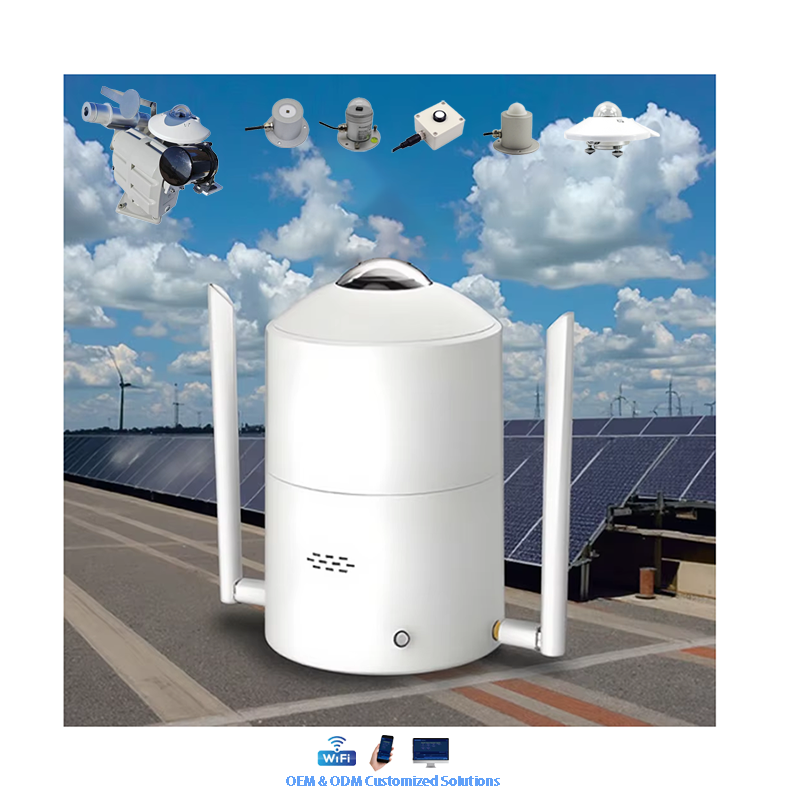
In the process of photovoltaic power generation moving towards becoming a major energy source, its inherent intermittency and volatility are becoming the greatest challenge for grid absorption and power station revenue. And the core variable of this challenge is precisely the ever-changing clouds in the sky. Traditional weather forecasts and total radiation meters are difficult to capture the generation, dissipation and movement of clouds at the minute level. For this reason, HONDE Company has launched the “Cloud Catcher” high-precision cloud monitoring system specifically designed for photovoltaic power stations. This system, by decoding the cloud conditions in the sky in real time and quantitatively, is becoming a “data outpost” for enhancing the accuracy of power station power prediction, optimizing operation and maintenance scheduling, and maximizing power generation revenue.
I. Core Values: From “Passively Enduring Fluctuations” to “Actively Predicting Changes”
Clouds are the primary factor causing sharp fluctuations in the output power of photovoltaic power stations (commonly known as the “cloud shadow effect”). The core mission of the HONDE cloud volume monitoring system is to provide power stations with crucial ultra-short-term (next 5-30 minutes) prediction capabilities, whose value spans three dimensions: power generation, power grids, and the market.
1. For the power station itself: Accurately predict sudden power surges or drops, providing critical preparation time for the charging and discharging of the internal energy storage system and the start and stop of equipment, reducing equipment wear and tear and power generation losses.
2. For power grid dispatching: Provide high-precision ultra-short-term power generation prediction data to help the power grid balance power in real time, alleviate the frequency regulation pressure caused by photovoltaic fluctuations, and enhance the power grid’s capacity to accommodate and ensure the safety of renewable energy.
3. For the electricity market: When participating in the spot market or ancillary service market, more accurate predictions mean fewer prediction bias penalties and better quotation strategies, which directly translate into higher trading returns.
Ii. Technical Principle: The “All-Seeing Eye” of the Sky
The HONDE cloud cover monitor is not merely a meteorological device, but a sky imaging system based on advanced optical and image analysis technologies.
Dual-view panoramic scanning: The system is typically composed of a full-sky imager and a fisheye lens solar tracker. The all-sky imager continuously captures cloud images of the entire sky at a 180° Angle, while the solar tracker precisely focuses on the area around the sun to monitor thin or fragmented clouds that may cause obstruction.
Intelligent image recognition algorithm: Equipped with the AI algorithm independently developed by HONDE, it conducts real-time analysis of the captured sky images.
Cloud quantification: Accurately calculate the total cloud volume and cloud layer thickness (optical thickness).
Cloud motion vectorization: Through continuous image analysis, calculate the moving speed, direction and trajectory of the cloud layer.
Cloud classification and identification: Distinguish different cloud types such as cumulus clouds, stratocumulus clouds, and cirrus clouds. Their light transmittance and movement patterns vary, and their impacts on power generation are also different.
Iii. Application Strategies in the Entire Scenario of Photovoltaic Power Stations
The core input for ultra-short-term power prediction
Application: The system integrates real-time cloud cover, cloud speed, and cloud direction data with numerical weather forecasts, power station geographical coordinates, and component layout models.
Output: Scroll to generate the “cloud shadow” sequence diagram that the power station may experience within the next 5 to 30 minutes, accurately predicting when each cloud will block which part of the array and how much power will decrease.
Benefit: Reduce the root mean square error of ultra-short-term predictions by 30% to 50%, providing valuable lead decision-making time for power grid dispatching.
2. Optimize the operation and maintenance as well as asset management of large-scale power stations
Intelligent inspection guidance: When it is detected that a large area of thick cloud will cover a certain area of the power station for a long time, drones can be automatically dispatched or personnel can be arranged to go to that area for inspection or cleaning operations, making full use of the off-peak period of power generation and improving the efficiency of operation and maintenance.
Performance diagnosis assistance: During clear and cloudless hours, the power station should be in the theoretical maximum output state. If the actual output at this time does not match the theoretical value, weather interference can be quickly eliminated, equipment faults can be identified, and the diagnostic efficiency can be improved.
3. Support the coordinated operation of multiple scenarios of “photovoltaic +”
Photovoltaic and energy storage synergy: In “photovoltaic + energy storage” projects, the system serves as the “eyes” for the intelligent control of the energy storage system. When power drops are predicted in advance, the energy storage system can be instructed to discharge in advance to “fill the gap”. If a sudden increase in power is predicted, the energy storage system can be instructed to prepare for charging to prevent abandoned light and smooth out the total output power of the power station.
Multi-energy complementarity: In the integrated base of wind, solar, hydropower and storage, accurate prediction of photovoltaic output is a high-value input for the coordinated and optimized dispatching algorithm of multi-energy complementarity.
Iv. Technical Advantages of the HONDE System
High spatiotemporal resolution: The sampling frequency can reach several times per minute, and the spatial resolution can identify small areas of fragmented clouds, ensuring the ability to capture rapidly changing cloud conditions.
Strong environmental adaptability: The equipment is equipped with automatic defrosting, decondensation and dust removal functions, with a protection level of IP65 or above, making it suitable for various harsh power station environments such as plateaus, deserts and coastal areas.
Open data interface: Supports standard communication protocols (such as Modbus TCP, IEC 61850), and data can be seamlessly integrated into the SCADA system, power prediction platform and energy storage management system of the power station.
Edge computing capabilities: Some analysis algorithms are completed on the device end, reducing reliance on cloud computing power and enhancing response speed and data security.
V. Empirical Case: Taming “Cloud Shadows” with Data
A 300MW large-scale photovoltaic power station in California, USA, is located in a coastal and cloudy area. It has long been troubled by the cloud shadow effect, resulting in significant deviations in power prediction and frequent fines for grid dispatching assessment. After deploying the HONDE cloud volume monitoring system and integrating it with the existing prediction model:
The 15-minute ultra-short-term power prediction accuracy of the power station has been improved by 40%.
The expenditure on grid auxiliary services due to prediction deviation decreased by 60% quarter-on-quarter.
By optimizing the operation strategy of energy storage based on predictive data, the average daily charge and discharge cycle revenue of energy storage has increased by approximately 15%.
The power station operation manager commented: “Previously, the cloud was our ‘enemy’, catching us off guard.” Now, the HONDE system enables us to “see” the trajectory of the cloud, which has become a “variable” that we can prepare for and deal with in advance. This has completely transformed our operation mode.”
Conclusion
As the penetration rate of photovoltaic power continues to rise in the global power system, its volatility management has evolved from a “power station-level issue” to a “system-level challenge”. HONDE’s “Cloud Catcher” cloud volume monitoring system is precisely the cutting-edge technological equipment to address this challenge. It endows photovoltaic power stations with valuable “foresight” by transforming the elusive cloud conditions in the sky into quantifiable, traceable and predictable high-dimensional data streams. This not only significantly enhances the economic efficiency and friendliness of individual power stations, but also provides a crucial and stable foundation for building a new power system with a high proportion of renewable energy. From the Atacama Desert in Chile to the Gobi Desert in Qinghai, China, HONDE is leveraging its precise sky perception capabilities to help global photovoltaic power stations traverse clouds, achieving more stable, efficient and valuable green power output.
About HONDE: As an innovator in the fields of smart energy and precise environmental monitoring, HONDE is committed to providing a full-stack solution for the renewable energy industry, ranging from resource assessment, precise perception to intelligent operation and maintenance, through the integration of interdisciplinary technologies. We believe that a deeper insight and prediction of natural forces are the key for humanity to achieve a sustainable energy future.
For more weather sensor information, please contact Honde Technology Co., LTD.
WhatsApp: +86-15210548582
Email: info@hondetech.com
Company website: www.hondetechco.com
Post time: Dec-16-2025