

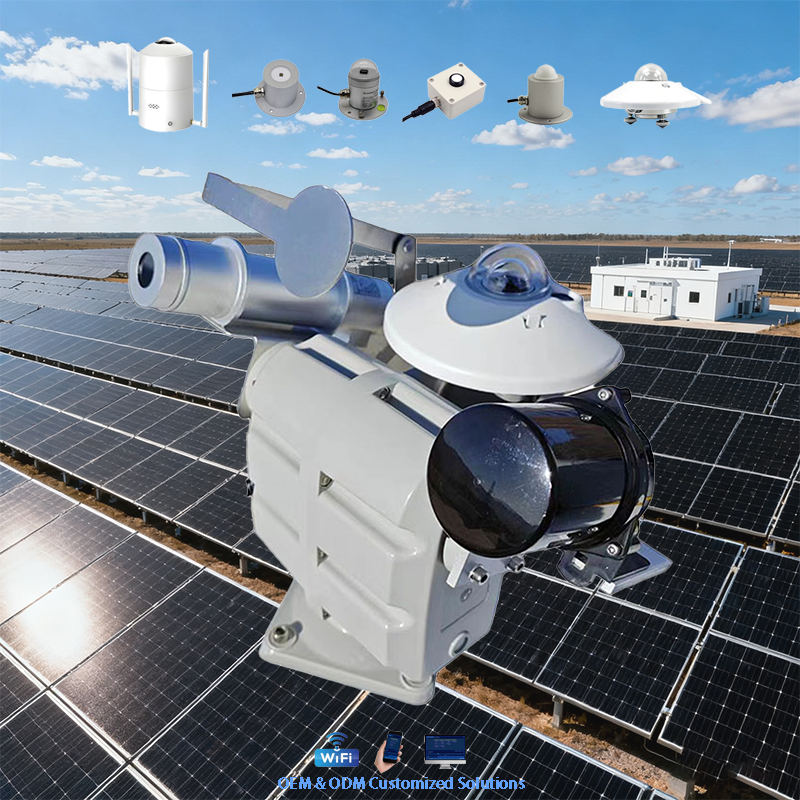
Today, with the continuous advancement of photovoltaic power generation technology, the focus on enhancing energy capture efficiency is shifting from the components themselves to system-level optimization. For photovoltaic power stations that adopt single-axis or dual-axis tracking systems, the extent to which their theoretical gains are realized fundamentally depends on “tracking accuracy” – that is, whether the drive system can keep the surface of the photovoltaic modules at an ideal Angle with the sunlight at all times. The “Zhitong” series of fully automatic solar tracking sensors launched by HONDE Company, with its unique advantages of complete autonomy, high precision and maintenance-free, is becoming the core “perception brain” that revolutionizes the control strategy of tracking systems and fully unleines their power generation potential.
I. Core Value: A paradigm upgrade from “stylized rotation” to “perceptual alignment”
Traditional tracking systems mostly rely on astronomical algorithms for solar position based on geographical location and time for driving. However, in actual operation, factors such as mechanical errors, support deformation, foundation settlement, and strong wind disturbances can cause deviations between the actual direction and the theoretical calculated values. Moreover, these deviations will accumulate over time, resulting in “inaccurate tracking”, with power generation losses reaching 3-8%. The core value of HONDE’s fully automatic solar tracking sensor lies in:
1. Provide absolute truth feedback: As an independent measurement reference based on optical principles, it measures the actual incident direction of sunlight in real time and directly, providing the control system with the absolute truth of “where the sun is at this moment”.
2. Achieve closed-loop precise control: The system, based on the real-time feedback data from sensors, compares it with the output of astronomical algorithms, automatically generates correction instructions, and drives the tracking mechanism to make fine adjustments, forming a high-precision “perception – decision-making – execution” closed loop, completely eliminating cumulative errors.
3. Adaptation to complex environments: In weather conditions dominated by scattered light such as cloudy or overcast days, or when the position of the sun changes rapidly, the effectiveness of astronomical algorithms decreases. Optical sensors can actively search for the brightest light source or the direction of effective direct light, optimize tracking strategies, and maximize the capture of available radiant energy.
Ii. Technical Principle: All-Weather “Solar Compass”
The HONDE “Zhitong” sensor adopts multi-quadrant precise photoelectric detection and intelligent adaptive algorithm
Precision optical array: The core is a precisely separated multi-quadrant photodetector array. When sunlight is incident perpendicularly, the light spot evenly covers each quadrant, and the output is balanced. Once there is an angular deviation, the spot shift will cause differences in the signals of each quadrant.
Real-time deviation calculation: The built-in processor calculates the signal differences in each quadrant in real time, accurately calculating the deviation angles and directions of the sunlight rays from the sensor normal in the two dimensions of azimuth and altitude.
Intelligent working mode
Sunny day mode: Precisely lock the center of the solar disk, providing sub-angular grading pointing accuracy.
Cloudy/overcast mode: Automatically switch to the “Irradiance Maximization” mode to drive the tracker towards the brightest area in the sky or the direction with the strongest scattered radiation, rather than blindly chasing the sun that may be blocked.
Severe weather protection mode: When a continuous lack of effective light source is detected or a warning of strong wind or hail is received, the tracker can be automatically instructed to enter a fixed Angle for wind protection (such as a horizontal position).
Iii. Key Application Scenarios in Photovoltaic Power Stations
Enhance the actual efficiency of various tracking systems
Single-axis tracking system: Corrects systematic deviations caused by north-south slope and installation misalignment to ensure that the daily rotation trajectory from east to west precisely matches the solar azimuth.
Dual-axis tracking system: It simultaneously corrects the deviations of azimuth and elevation angles, fully leveraging its theoretical advantages in full-dimensional tracking, especially in high-latitude regions or scenarios where extreme efficiency is pursued.
2. As a “ruler” for calibration and diagnosis
Regular automatic calibration: It can be set to automatically calibrate the astronomical algorithm parameters and mechanical zero position of the full-field tracking system based on the true value of the sensor every morning or at regular intervals, maintaining long-term accuracy.
Performance diagnostic tool: By comparing the data from sensors on different tracking units within the same power station, or by comparing sensor data with theoretical values, mechanical faults, transmission mechanism wear or controller abnormalities of specific trackers can be quickly diagnosed.
3. Support advanced tracking strategies and system integration
Reverse tracking and shadow avoidance: In bifacial power generation modules or densely arranged arrays, sensor data can help optimize the “reverse tracking” strategy, finding the best balance between reducing the front row’s shadow occlusion on the rear row and maximizing the backside’s reception of scattered light.
Integration with SCADA and analysis platforms: As a high-value data source, it is connected to the power station monitoring system to provide key dimensional data for power generation performance analysis and efficiency loss decomposition.
Iv. Core Advantages of HONDE’s “Smart Eye” System
Fully autonomous and maintenance-free operation: No mechanical moving parts, relying solely on optical perception, without the need for manual intervention or regular on-site calibration.
Ultra-high precision and rapid response: The pointing measurement accuracy can reach ±0.1°, with a fast response time, effectively following the apparent motion of the sun.
Strong environmental robustness: The optical surface is equipped with a self-cleaning coating and an optional active cleaning device (such as a micro wiper), featuring a high protection level and capable of stable operation in wind and sand, rain and snow, and high and low temperature environments.
Adaptive intelligent algorithm: The embedded AI algorithm can identify and filter out short-term interference signals caused by cloud edges, birds, etc., ensuring stable and reliable output.
Plug-and-play and open interface: Easy to install, outputs standard protocols such as Modbus, and is easy to integrate with mainstream tracker controllers at home and abroad.
V. Empirical Case: Power Generation Gain Brought by Closed-loop Control
A 50MW photovoltaic power station in the Atacama Desert of Chile, which adopts a dual-axis tracking system, has added HONDE fully automatic solar tracking sensors to some of its arrays for simultaneous comparison with the original arrays that only rely on astronomical algorithms. The operation data of one quarter shows:
The average daily power generation of the array equipped with sensors is 4.7% higher than that of the pure astronomical algorithm array.
During the period when there are frequent scattered clouds in the afternoon, the power generation advantage can even reach 8-12%, as the sensors can guide the components to align with the sun emerging in the cloud gaps more quickly.
The power station operation and maintenance team also discovered and corrected the long-term initial installation deviations of some trackers through the long-term deviation data provided by the sensors.
The conclusion of the project owner’s assessment report states: “The increase in power generation brought by the HONDE tracking sensor has made its payback period less than six months, making it one of the options with the highest return rate among all technical renovation measures.”
Conclusion
In the era when photovoltaic power stations have fully entered the “refined and intelligent” operation stage, the understanding of the fundamental function of “tracking” is evolving from simple mechanical rotation to “precise photoelectric alignment” based on real-time perception. The HONDE fully automatic solar tracking sensor is precisely the key enabler in this process of upgrading. It measures light with light and closes the precision loop of tracking control in the most direct way, converting the lost sunlight due to “inaccuracy” back into real green electricity. For any photovoltaic power station investor and operator dedicated to tapping into the full potential of tracking systems and pursuing the ultimate LCOE (levelized Cost of Electricity), deploying such high-precision sensor feedback systems is no longer an “optional solution”, but an “essential intelligent infrastructure” for enhancing the core competitiveness of assets, ensuring the implementation of design returns, and winning the future energy market.
About HONDE: As an innovator in photovoltaic intelligent operation and maintenance and precision sensing technology, HONDE continuously focuses on enhancing the energy output and asset value throughout the entire life cycle of photovoltaic systems. We firmly believe that on the path to a higher penetration rate of photovoltaic power, the value of technology lies in converting every theoretical percentage increase in efficiency into tangible benefits on the power station’s ledger. The “Zhitong” series of products is precisely the crystallization of this belief.
For more weather sensor information,
please contact Honde Technology Co., LTD.
WhatsApp: +86-15210548582
Email: info@hondetech.com
Company website: www.hondetechco.com
Post time: Dec-16-2025