

In the field of environmental monitoring, the value of data lies not only in its collection and analysis, but also in its ability to be immediately obtained and understood by those in need at the required time and place. Traditional Internet of Things (iot) systems often transmit data to the “cloud” and “back-end”, but they overlook the value of on-site early warning and notification in the first instance. HONDE Company innovatively integrates professional meteorological monitoring stations with high-intensity outdoor LED information screens to launch a brand-new “Meteorological Monitoring Information Release System”, achieving a closed loop from “perception – transmission – analysis” to “on-site release – immediate response”, enabling key environmental data to be illuminated at the source and directly driving on-site safety and efficiency decisions.
I. Core Concept of the System: “Zero time difference” conversion from back-end data to front-end instructions
This system breaks the unidirectionality of data flow and builds an integrated on-site intelligent node for “collection, processing and release”.
Precise perception terminal: Integrated with HONDE high-precision meteorological sensors, it can monitor key parameters such as wind speed, wind direction, temperature, humidity, rainfall, and PM2.5 in real time.
Intelligent control center: Equipped with an edge computing unit, it processes and analyzes the collected data in real time and automatically generates early warning information based on preset thresholds and logic.
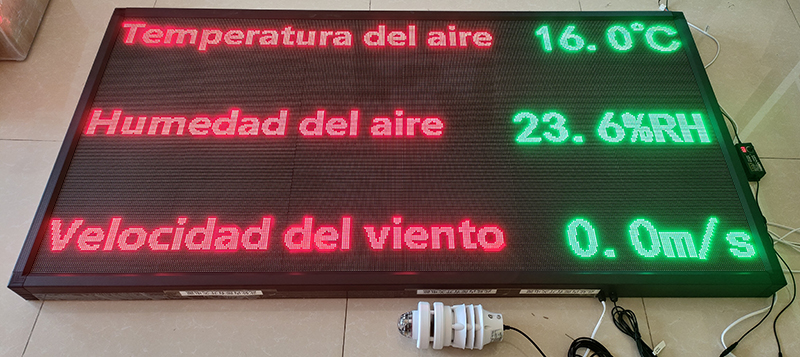
Prominent release terminal: Through the equipped high-brightness, rainproof, wide-temperature outdoor LED display screen, the original data, warning levels, safety tips or customized information are released to the on-site personnel in the form of prominent text, symbols or charts 24 hours a day without interruption.
Ii. Core Application Scenarios: Making Security and Efficiency “Clear at a Glance”
Smart Construction Sites and High-Risk Operation Sites (Safety Control Centers)
Application: Deploy in areas such as beside construction tower cranes, port terminals, and open-pit mines.
Value
Real-time wind speed warning: When the wind speed exceeds the safe operation threshold, the LED screen immediately flashes to display “Strong Wind alert, stop high-altitude operations!” It is accompanied by real-time wind speed values, directly warning the tower crane driver and ground command.
Comprehensive environmental monitoring: Displays temperature, humidity and particulate matter concentration, and prompts workers to take measures to prevent heatstroke and dust.
Effect: Transform the remote early warning from the background monitoring center into direct and non-negligible visual instructions to on-site personnel, minimize the safety response time, and effectively prevent accidents.
2. Smart Agriculture and Precision Farms (Field Information Stations)
Application: Placed in the management center of a large farm or at the entrance of a key plot.
Value
Irrigation/spraying decision support: Real-time display of wind speed, indicating “The current wind speed is suitable/unsuitable for plant protection spraying operations.”
Disaster Warning: Display temperature and issue “Low Temperature Warning, Prepare for frost protection” information before frost arrives.
Production information release: Also serves as a farm information bulletin board, Posting agricultural arrangements, precautions, etc.
Effect: It provides the most direct action guide for agricultural machinery operators and field workers, enhancing the scientific nature and timeliness of agricultural operations.
3. Smart Campus and Public Park (Environmental Health Board)
Application: Installed on campus playgrounds, park squares, and community activity centers.
Value
Healthy living guidance: Real-time display of PM2.5, AQI, temperature and humidity, and provide prompts such as “Suitable for outdoor exercise” or “Suggested to reduce going out”.
Science popularization and education exhibition: Transform real-time environmental data into vivid science popularization content to enhance public environmental awareness.
Effect: Serve public health and enhance the service quality and technological feel of public Spaces.
4. Key nodes for transportation and tourism (Travel Safety Service Stations)
Application: Deployed in highway service areas, dangerous sections of mountainous roads, and tourist attractions.
Value: It issues early warning information on visibility, road surface temperature (accessible), strong winds, heavy precipitation, etc., providing safe travel tips for drivers and tourists.
Iii. Core Advantages of the System
Zero latency response: Edge computing enables local intelligent judgment and release, eliminating the need to wait for instructions sent back from the cloud. The response speed reaches the second level, which is crucial at critical moments.
Strong information reach: High-decibel voice (optional) combined with high-brightness visual prompts ensures that information can still be effectively received in noisy and spacious outdoor environments.
Integrated deployment: Sensors, hosts, display screens, and power supply (solar energy/mains power) are integrated into one or modularly quickly networked, making engineering implementation simple and convenient.
Cloud-based management: The back-end can remotely manage all front-end devices through the cloud platform, uniformly update and release templates, adjust early warning thresholds, and view device status, achieving centralized control of a large number of nodes.
High reliability and durability: The entire system is designed to industrial-grade standards, suitable for all-weather and harsh outdoor environments, ensuring stable operation for 7×24 hours.
Iv. Case Evidence: The Closed Loop from Data to Action
A large international port has deployed multiple sets of HONDE meteorological monitoring information release systems at the front of its container terminal. Whenever the system detects that the gust wind speed exceeds the safety operation limit of the crane, the LED large screen in that area immediately turns red and rolls out strong wind warnings and no-lifting instructions. Bridge crane drivers and on-site commanders can directly obtain and execute safety instructions without checking their mobile phones or walkie-talkies. Since the system was put into operation one year ago, the average decision-making time for loading and unloading operations at the wharf due to bad weather has been reduced by 85%, and no dangerous incidents caused by strong winds have occurred. The level of safety management has been significantly improved.
Conclusion
The HONDE meteorological monitoring information release system has redefined the endpoint of environmental monitoring data. It enables data to no longer remain dormant in databases but to be active on the front line of risks and at the forefront of decision-making, becoming a safety partner and efficiency assistant that on-site personnel can “understand, hear and use”. This is not merely a simple superposition of hardware functions; rather, through an integrated software and hardware scenario-based design, it has achieved a significant leap in the value of the Internet of Things from the “perception” layer to the “execution” layer. In the era of the Internet of Everything, HONDE is making such innovations to enable technology to truly serve people, safeguard safety, enhance efficiency, and make intelligent environmental perception ubiquitous, with “what you see is what you get”.
For more weather station information, please contact Honde Technology Co., LTD.
WhatsApp: +86-15210548582
Email: info@hondetech.com
Company website: www.hondetechco.com
Post time: Dec-11-2025