

In the process of transforming Southeast Asian agriculture from extensive management to data-driven precision agriculture, a fundamental cognitive bottleneck lies in the fact that traditional soil monitoring often stops at the surface layer (10-20 centimeters), and there is little knowledge about the key factors that determine the drought resistance, nutrient absorption efficiency and root health of crops – the vertical movement and distribution of soil moisture. The intense rainfall-evaporation cycle, diverse soil textures and extensive cultivation of deep-rooted crops in tropical regions make the dynamics of water in soil profiles extremely complex. HONDE’s customizable multi-layer (3 to 9 layers) tubular soil temperature and humidity profile monitoring system is providing Southeast Asian growers with a “moisture CT map” from the surface to the deep root zone with its revolutionary depth perception capabilities, transforming the hidden dynamics of the underground world into precise agronomic wisdom that can be moved.
I. Core Challenges of Tropical Agriculture: Why Is a “Sectional Perspective” Needed?
The sustainability and efficient water use of agriculture in Southeast Asia are confronted with unique soil hydrological challenges:
Intense alternation of dry and wet conditions: After heavy rain, water seeps rapidly downward, and during the dry season, deep water replenishes upward. Traditional single-point sensors are unable to track this vertical migration process.
Management requirements for deep-rooted crops: Economic trees such as oil palm, rubber, mango, and coffee have effective water-absorbing roots that can reach depths of 1 meter or even 2 meters. Monitoring only the surface layer can lead to serious deviations in irrigation decisions.
Strong soil heterogeneity: Within the same plot, the soil texture at different depths (such as sandy soil and clay interlayers) varies greatly, resulting in complex changes in water infiltration and retention capacity in the vertical direction.
Leaching and salt risk: Excessive irrigation leading to deep leaching of water and nutrients, as well as the rise of salt in arid areas with capillary water, are both processes that occur in soil profiles.
Therefore, mastering the continuous profile information of water variation with depth rather than the data of a few discrete points is a prerequisite for achieving truly scientific water and fertilizer management, drought resistance and moisture retention, and environmental protection.
Ii. Technological Breakthrough: HONDE Multi-Layer Tubular Profile Monitoring System
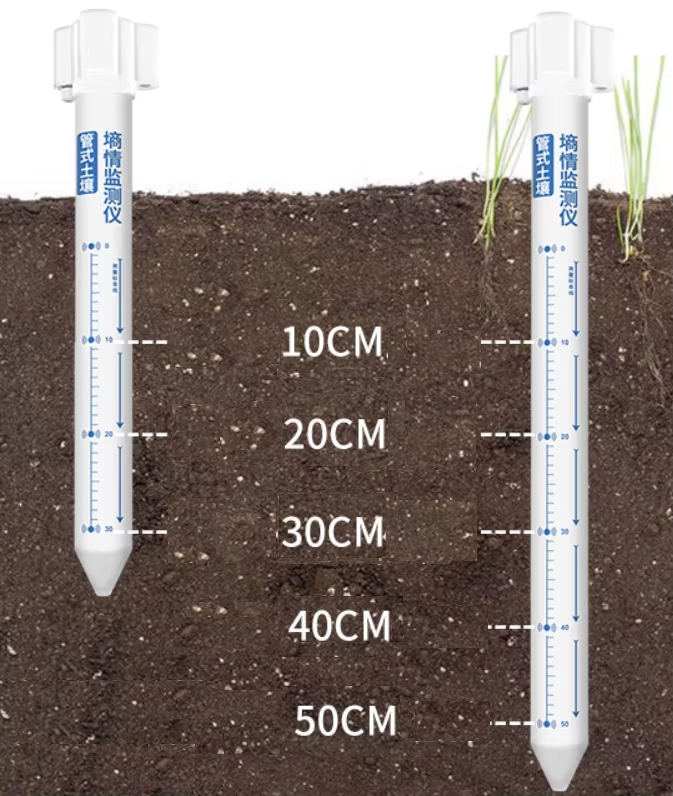
This system adopts an innovative “one tube, multiple layers” design, integrating multiple high-precision sensing units within a permanently installed robust probe tube to achieve non-destructive, in-situ, and long-term vertical profile monitoring.
Deep customization and flexible configuration: Users can flexibly choose monitoring configurations of 3, 4, 5, 6, 7, 8 or even 9 layers * based on the main root distribution depth of the target crop, soil characteristics and research requirements. Common configurations include: 10cm, 30cm, 50cm, 70cm, 100cm, or denser ones with one layer every 10/15 cm.
Synchronous multi-parameter profile monitoring: Soil volumetric water content and soil temperature are measured simultaneously at each layer. Some advanced models can be expanded to measure conductivity (salt content), forming a three-dimensional profile of water, heat and salt.
Tubular design and long-term stability: The sensor unit is placed inside a protective tube and measures with the soil through indirect coupling, avoiding damage or displacement caused by soil contraction, expansion or tillage in traditional embedded sensors. The long-term stability of the data is excellent.
Internet of Things integration and data visualization: Data is transmitted to the cloud via low-power wireless technology (LoRaWAN/4G). The platform can display in real time the profile contour map or depth-curve map of soil moisture and temperature, visually presenting the movement of the water front, the changes in the root water absorption layer and the temperature gradient.
Iii. In-depth Application in Diversified Agricultural Scenarios in Southeast Asia
Precise irrigation and water and fertilizer management for perennial economic forest orchards
Application: In oil palm, rubber, and orchards, install to a depth of 1.5 to 2 meters to monitor the water usage of their deep root systems.
Value
Determine the depth and amount of irrigation: Ensure that the irrigation water can moisten the main active root layer (such as 40-80 centimeters), rather than just remaining at the surface layer. Avoid the root system floating up and the decline in drought resistance caused by shallow irrigation.
Evaluating deep soil reservoirs: During the dry season, clearly understand the water storage capacity of deep soil to determine whether crops can utilize deep water, thereby delaying or reducing irrigation and saving precious water resources.
Optimize the fertilization position: Apply water and fertilizer at the depth of the main water-absorbing root layer to enhance utilization and reduce leaching losses.
2. Research and Management of Water Cycling in Rice and Dryland Rotation Systems
Application: In rice-dryland (such as corn) rotation fields, it is used to monitor the entire profile process of water infiltration during the flood period, water regression after the water falls dry, and water utilization during the dryland period.
Value: Scientifically assess the seepage volume of rice fields, providing a basis for water-saving irrigation and preventing deep leaching of nutrients; Soil moisture condition judgment for guiding the sowing timing of dryland crops.
3. Optimization of the root layer in facility agriculture and high-value vegetables
Application: In greenhouses or sheds, for crops such as tomatoes and cucumbers, a relatively dense monitoring layer (such as one layer every 15 centimeters) should be configured.
Value: Precisely control the uniformity of moisture in the root zone to prevent local areas from being too dry or too wet. By analyzing the root activity at different depths, the ridge height and the depth of drip irrigation tape layout were optimized.
4. Research on ecological restoration and soil and water conservation
Application: Monitor soil moisture dynamics at different depths in sloping tea gardens, areas prone to erosion or where vegetation restoration is needed.
Value: Assess the utilization capacity of vegetation for soil water at different depths, study the relationship between rainfall infiltration and surface runoff, and provide data support for soil and water conservation measures.
5. Dealing with drought and climate adaptation
Application: Establish a regional soil moisture profile monitoring network.
Value: Provide drought warnings for different soil layers for government agricultural departments and farmers, guide drought-resistant irrigation and crop layout adjustments, and enhance the climate resilience of agriculture.
Iv. Core Values: From “Point Speculation” to “Sectional Insight”
The scientific decision-making of irrigation: Shifting from “watering the land” to “watering the crop roots”, achieving precise water supply based on depth, can generally increase the utilization efficiency of irrigation water by 25-40%.
Improvement of crop health and stress resistance: Promote the development of deep root systems and enhance the crop’s ability to withstand seasonal drought.
Reduce negative environmental impacts: By controlling water from being leached below the root system, the risk of groundwater pollution caused by chemical fertilizers and pesticides can be effectively reduced.
High-value data assets for production and scientific research: The accumulated long-term soil profile data is an irreplaceable and valuable resource for optimizing agronomic models, cultivating drought-resistant varieties, and conducting scientific research on precision agriculture.
V. Empirical Case: Multi-Layer Data Reshaping Oil Palm Plantation Irrigation
A large oil palm plantation in Malaysia has installed the HONDE 7-story tubular profile monitoring system (up to a depth of 1.6 meters) in some blocks. Data analysis reveals:
After traditional surface sprinkler irrigation, a large amount of water remains at the 0-30 cm surface layer, while the main water-absorbing root system of oil palm (40-100 cm) only receives a small amount of water.
2. During the dry season, the deep soil below 1 meter still contains considerable available water, but it is not fully utilized.
Based on this, they adjusted the irrigation strategy to low-frequency deep irrigation and supplemented it with soil mulching to reduce surface evaporation. After the adjustment, despite a 30% reduction in total irrigation water consumption, the yield of mature oil palm bunches remained stable, and due to healthier root systems, their adaptability to the dry season was significantly enhanced.
Conclusion
On the path of pursuing the triple goals of yield, quality and resource sustainability in Southeast Asian agriculture, a deep understanding of underground ecosystems has become a new competitive dimension. The HONDE multi-layer tubular soil moisture profile monitoring system, like an “intelligent probe” inserted deep into the earth, enables growers and managers to continuously and intuitively “see” the vertical journey and residence of water in the soil for the first time. It put an end to the fuzzy decision-making based on surface phenomena and ushered in an era of in-depth and precise management based on the real demands of the root layer. This is not only an upgrade of monitoring technology, but also a profound transformation of tropical agriculture from managing “above the surface” to managing the overall ecosystem “below the surface”. With the continuous accumulation of data and the integration of AI analysis models, these detailed soil profile data streams are bound to become the core digital infrastructure driving Southeast Asian agriculture to respond to climate change and achieve water and food security.
About HONDE: As a leader in agricultural Internet of Things and digital soil solutions, HONDE is dedicated to revealing and empowering the invisible key processes in agricultural production through innovative perception technologies. We have a profound understanding of the complexity of tropical agriculture and are committed to providing customers with data decision support covering the entire life cycle of crops through all-round monitoring solutions from single points to sections and from surface to deep layers. In the journey of unlocking the potential of Southeast Asian land, HONDE is willing to share in-depth data with you to embrace the future of precision agriculture.
For more soil sensor information, please contact Honde Technology Co., LTD.
WhatsApp: +86-15210548582
Email: info@hondetech.com
Company website: www.hondetechco.com
Post time: Dec-25-2025