

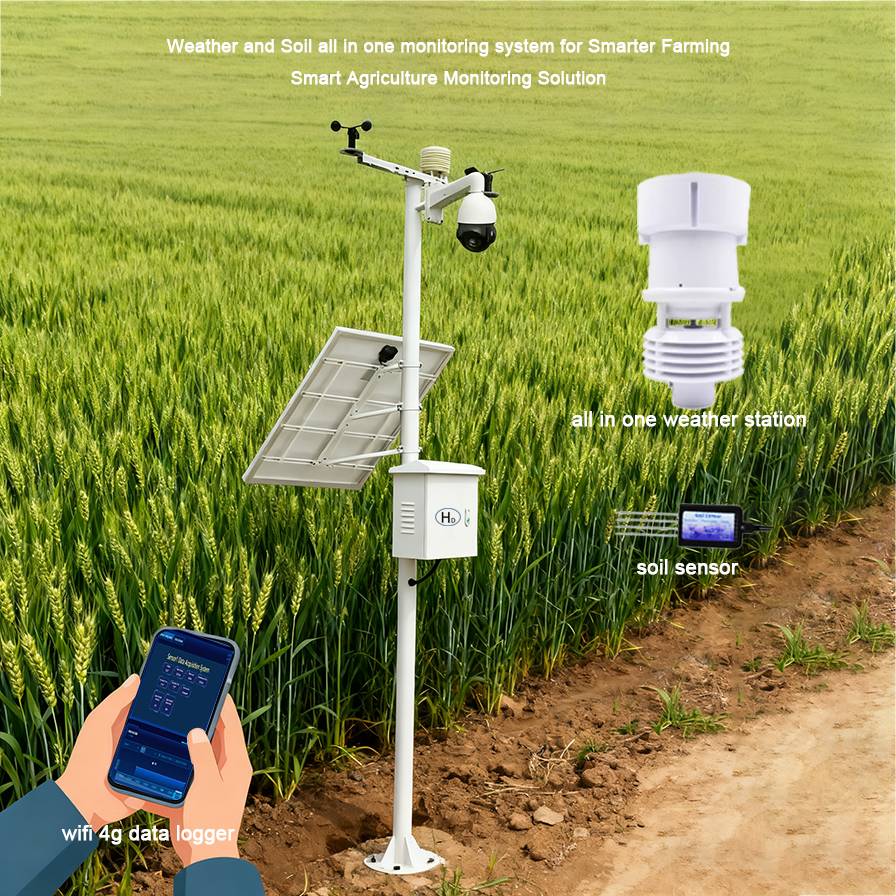
On the path of modern agriculture evolving towards digitalization and intelligence, a comprehensive, real-time and precise perception of the farmland environment is a crucial first step. Facing the pain points of complex deployment and high cost of traditional split-type weather stations, and the inability of a single sensor to meet the needs of comprehensive decision-making, the HONDE integrated pole-mounted smart agricultural weather station. It integrates multi-element meteorological perception, data fusion and wireless transmission technologies onto a compact pole, providing a standardized environmental monitoring solution that is “ready to use upon deployment and direct data delivery” for modern farms, agricultural parks and research bases.
I. Core Concept: Integrated integration, Unleashing the data productivity of smart agriculture
The design philosophy of HONDE’s integrated pole-mounted smart agricultural weather station is “All-in-One, Plug & Play”. It integrates the originally scattered sensors, data collectors, power supplies and communication modules into an integrated system with a simple appearance and precise interior.
Integrated sensing core: Standard equipped with air temperature and humidity, atmospheric pressure, wind speed and direction, rainfall, total solar radiation and photosynthetically active radiation sensors.
Built-in intelligent brain: Equipped with high-performance data acquisition and edge computing units, it can perform data preprocessing, quality control and local intelligent analysis.
Self-sustaining energy and communication: Top-integrated high-efficiency solar panels and long-life batteries achieve energy self-sufficiency. It is equipped with 4G/NB-IoT/ LoRa communication modules, allowing data to reach the cloud directly.
Minimalist deployment form: All devices are integrated into a single pole with a diameter of approximately 15 centimeters. Only a base is needed on the ground, and a single person can complete the deployment within half a day, completely bidding farewell to the cumbersome installation and wiring.
Ii. Core Technological Advantages: Born for the agricultural environment
Precision measurement at the farmland level
Professional agricultural parameters: In addition to conventional meteorological elements, photosynthetically active radiation sensors are specifically designed to measure the light energy available for plant growth, directly guiding supplementary lighting and photoperiod management.
Environmental adaptability: The protection grade reaches IP65, and key components are equipped with radiation-proof covers and active ventilation to ensure stable and reliable data in high-temperature, high-humidity, and dusty farmland environments.
Low power consumption and long-lasting design
By adopting advanced energy management algorithms and low-power sensors, it can maintain normal operation for 7 to 15 days even under continuous rainy and cloudy conditions, ensuring uninterrupted data.
Open Internet of Things ecosystem
Supports mainstream iot protocols such as MQTT and HTTP, and data can be seamlessly integrated into the HONDE Smart Agriculture Cloud Platform, breaking down data silos.
Iii. Core Application Scenarios in Smart Agricultural Production
The “Meteorological Commander” for Precise Irrigation
The HONDE integrated pole-mounted smart agricultural meteorological station system is the core decision-making input of the intelligent irrigation system. By calculating the evapotranspiration of reference crops in real time and combining it with soil moisture data, the daily water requirement of a specific crop can be precisely calculated and executed in conjunction with the irrigation system. Compared with traditional timed irrigation, it can generally achieve water-saving benefits of 20% to 35%, and at the same time optimize the root environment of crops.
2. The “Frontline Sentinel” for Pest and Disease Prediction and Early warning
The occurrence of many pests and diseases is highly correlated with specific “time Windows” of temperature, humidity and light. The HONDE integrated pole-mounted smart agricultural meteorological station can customize early warning models. For instance, when the “average daily temperature is 20-25℃ and the leaf moisture duration exceeds 6 hours”, the system automatically marks it as a “high-risk day for downy mildew” and sends a warning to the manager to guide preventive plant protection operations.
3. A scientific scheduler for agricultural operations
Guide the spraying operation: Real-time wind speed data determines whether the plant protection drone or large sprayer is suitable for the operation, ensuring the efficacy of the pesticide and reducing drift.
Optimize sowing and harvesting: Determine the optimal sowing period by combining soil temperature and future short-term weather forecasts. During the fruit harvest season, rainfall warnings can help to rationally arrange labor and logistics.
Facility environmental regulation: Provide external benchmark meteorological data for intelligent greenhouses to optimize internal control strategies such as ventilation, shading, and supplementary lighting.
4. Real-time defense network for disastrous weather
For regional low-temperature frost, short-term strong winds, heavy rain, hail and other disastrous weather conditions, the HONDE integrated pole-mounted smart agricultural meteorological station, as the “nerve endings” deployed in the fields, can provide the most direct and rapid on-site data, offering valuable response time for emergency measures such as initiating windproof film fixation, turning on frost prevention machines, and emergency drainage.
5. The data foundation for agricultural insurance and production traceability
The equipment generates continuous, objective and unalterable environmental data logs, providing authoritative basis for the rapid loss assessment and claims settlement of weather index insurance. At the same time, a complete environmental record is also an important part of building a green and organic agricultural product brand and achieving full traceability of quality and safety throughout the process.
Iv. System Value: From Cost Center to Value Engine
Lower the threshold for decision-making: Out of the box, transform complex meteorological monitoring into simple daily services, allowing small and medium-sized farmers to also enjoy the benefits of data.
Enhance management efficiency: Free agronomists from the cumbersome field inspections and experience-based judgments, and achieve precise management through digitalization and remote control.
Amplify input-output: Through multiple effects such as water and fertilizer conservation, reduced pesticide use, disaster reduction, and quality improvement, the investment is usually recovered within 1-2 production seasons and value is continuously created.
Empowering agricultural research: Providing standardized and high-quality long-term environmental datasets for variety comparison trials, cultivation model studies, and agricultural model validation.
V. Empirical Case: A Data-Driven Blueprint for Harvest
In a certain thousand-mu modern apple demonstration base, multiple sets of HONDE agricultural meteorological stations have been deployed. Through the monitoring of a growing season, the managers found that the low temperature and humidity in the Northern Slope area of the orchard in the early spring morning were significantly higher than those on the southern slope. Based on this data:
They adjusted the pruning plan on the Northern Slope to enhance ventilation and light penetration.
Differentiated frost damage prevention management was implemented during the flowering period on the Northern Slope.
In terms of pest and disease control, key monitoring and early intervention have been carried out on the Northern Slope.
In the autumn of that year, the rate of top-grade apples on the Northern Slope increased by 15%, the incidence of diseases decreased by 40%, and the overall income increased by more than 20% year-on-year. The park manager said, “I used to think the climate in the entire orchard was more or less the same. Now I realize that each orchard has its own ‘little temper’.” With data, we can truly implement the policy of “tailoring measures to the specific region”.
Conclusion
The HONDE integrated pole-mounted smart agricultural weather station is not merely a monitoring device; it serves as the “fundamental anchor point” for mapping physical farmland to the digital world. With unprecedented convenience and reliability, it transforms the once elusive “timing” into stable, quantifiable, analyzable and actionable digital assets. It marks the transition of smart agriculture from concept to popularization, enabling every agricultural practitioner dedicated to meticulous cultivation to have their own “digital weather station in the field”, thus being able to deal with natural challenges more calmly, explore the potential of the land more scientifically, and ultimately achieve a certain and sustainable harvest in the uncertain agricultural production.
About HONDE: As a steadfast promoter of agricultural Internet of Things and precise environmental monitoring, HONDE is always committed to transforming complex cutting-edge technologies into user-friendly, solid and reliable on-site solutions that can create real value. We believe that the popularization of data perception is a solid first step towards building a future high-yield, efficient and highly resilient agricultural system.
For more weather station information,
please contact Honde Technology Co., LTD.
WhatsApp: +86-15210548582
Email: info@hondetech.com
Company website: www.hondetechco.com
Post time: Dec-10-2025