

In the realm of golf, the speed of the green, the elasticity of the fairways, and the overall health of the course are not only determined by the grass leaves but also deeply rooted in the soil. Traditional surface observation and empirical judgment are no longer able to meet the ultimate pursuit of uniformity, sustainability and outstanding experience by top stadiums. The precise monitoring solution composed of the long probe soil sensor and the smart handheld data logger launched by HONDE Company is transforming golf course maintenance from an “art of experience” to a “science of data”, providing lawn directors with a pair of “eyes” to understand the underground world.
Part One: Technical Core – In-depth Perception and Real-time Mobile Intelligence
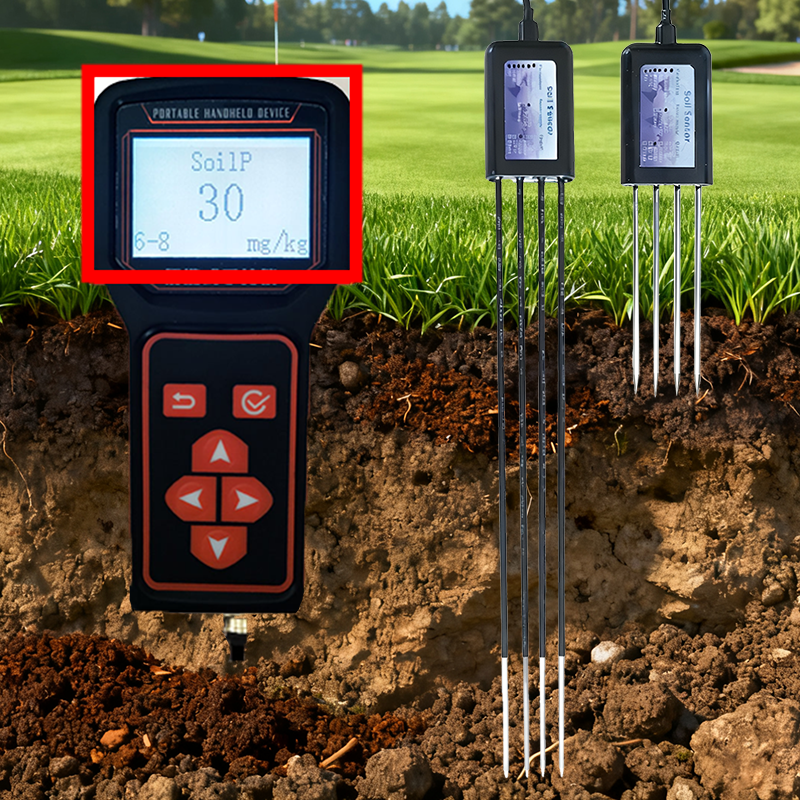
HONDE Long Probe Soil Sensor: Mapping Three-dimensional “CT Map” of Root Layer
Deep Insight: Unlike ordinary sensors that only measure the surface layer, the HONDE long probe sensor can easily penetrate the soil from 20 centimeters to 1 meter, continuously monitoring the volumetric water content, temperature, and electrical conductivity (salinity) of different profile layers. This is like conducting a “CT scan” of the root zone of the green, tee, and fairway, precisely locating the dry and wet layers, salt accumulation areas, or compacted layers.
Key parameters
Water management: Accurately determine the actual water absorption depth of the root system, avoid root floating caused by shallow irrigation, promote root penetration, and enhance the lawn’s stress resistance.
Salt monitoring: Precisely monitor the migration and accumulation of salt caused by irrigation water or fertilization, promptly issue early warnings and guide washing operations to prevent salt damage and grass destruction.
Ground temperature monitoring: Grasp the changes in soil temperature, accurately predict the occurrence window of diseases (such as summer spot disease) and the best sowing and drilling times.
HONDE Smart Handheld Data Logger: The “Mobile Brain” for On-site Decision-making
Portable and efficient: Robust field design, equipped with a high-brightness touch screen. Staff can carry the long probe sensor to any point on the course, insert it into the target area (such as key greens, bunker edges, and disease spots), and within seconds, the complete soil profile data of that point can be read and recorded on the handheld terminal.
Real-time analysis and mapping: The device is equipped with a built-in GPS module. Each time a point is collected, the geographical location is automatically recorded. Through the accompanying software, spatial distribution maps of soil moisture, salinity and temperature can be generated on-site in real time, presenting the spatial variations of each area of the court intuitively and accurately locating problem areas.
Seamless workflow: Data can be automatically synchronized to the cloud management platform via 4G/Wi-Fi, or reports can be exported, achieving a closed loop from on-site collection, analysis to the formulation of maintenance plans.
Part Two: Revolutionary Application Scenarios in Golf Courses
Refined management of the green
Uniformity control: The basis for green speed and flatness is the uniformity of soil conditions. Through grid-based point measurement, the “spots” that are too hard, too wet or have excessive salt content are accurately identified. Targeted local drilling, hole removal, sand injection or rinsing are carried out instead of treating the entire green, significantly improving the maintenance efficiency and green quality.
Precision irrigation: Based on deep soil moisture data, a “deep – low frequency” irrigation strategy is implemented to force the root system to search for water downward, thereby creating a stronger and more drought-resistant lawn and significantly saving water.
Health diagnosis of the tee and fairway
Disease early warning and diagnosis: During the hot and humid summer, by combining the data of deep soil temperature and moisture content, high-risk areas of soil-borne diseases such as brown spot disease and fusarium wilt can be warned in advance, enabling preventive pesticide application.
Ball-playing performance optimization: Based on soil hardness data, scientifically adjust the rolling operation to ensure that the fairway has ideal elasticity and ball-stopping effect.
The management of salinization and drainage throughout the site
Salt hotspot tracking: In coastal areas or golf courses irrigated with reclaimed water, long-term monitoring of salt dynamics in soil profiles, mapping of salt migration, guiding leaching plans, and protecting expensive turf.
Drainage system assessment: After rain or irrigation, measure the rate of soil moisture decline at different points, quantitatively evaluate drainage efficiency, accurately locate areas with poor drainage, and provide a scientific basis for drainage system renovation.
Part Three: Core Value and Investment Returns Brought
Enhancing the quality of the stadium and the player experience: Data-driven maintenance ensures the uniformity, predictability and excellent condition of the stadium, directly enhancing member satisfaction and the reputation of the stadium.
Significantly save water resources and chemical fertilizers and pesticides: Precise irrigation and fertilization avoid excessive application across the board, achieving an average water and fertilizer conservation benefit of 20% to 35%, and reducing the risk of non-point source pollution.
Reduce long-term maintenance costs: Through early warning and precise intervention, large-scale lawn replacement or reconstruction is avoided, reducing the risk and handling costs of catastrophic events such as disease outbreaks.
Achieving sustainable maintenance: Scientific management of soil health and promotion of ecological balance are the inevitable paths to building an environmentally friendly and sustainable modern golf course.
Case Sharing
After the HONDE system was introduced to a certain golf course, a comprehensive survey of the 18-hole greens revealed that three of them had severe local compaction and salt accumulation problems. Through targeted treatment, not only did the conditions of these three greens quickly catch up with those of the others, but also the summer irrigation water consumption of the entire green was reduced by 28%, and the daytime fluctuation standard deviation of the green speed (Stimp Meter reading) was reduced by 40%. This received high praise from the participating players.
Conclusion
The competition among golf courses is increasingly manifested as “underground” competition. HONDE’s long probe soil sensors and handheld data logger systems offer not only data but also precise action guidelines and decision-making confidence. It enables the lawn director to “see” the depths of the soil and “understand” every reaction of the lawn, thereby carving out every inch of astonishing green with the highest resource utilization efficiency and the most scientific methods. This is not only an upgrade of maintenance tools, but also represents the future direction of golf course management towards intelligence and precision.
About HONDE: As a leader in the field of precise environmental monitoring, HONDE is committed to applying cutting-edge sensing technology and Internet of Things (iot) solutions to ecological management, smart agriculture, and high-end lawn maintenance, empowering the sustainable development of every green space with data.
For more soil sensor information, please contact Honde Technology Co., LTD.
WhatsApp: +86-15210548582
Email: info@hondetech.com
Company website: www.hondetechco.com
Post time: Dec-03-2025