

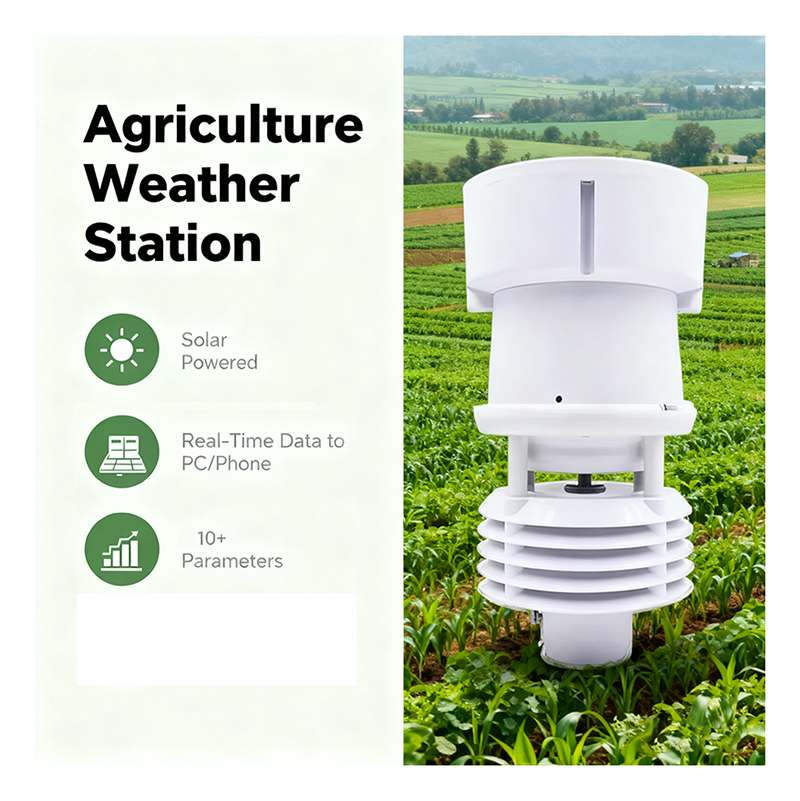
At the critical stage when modern agriculture is moving towards precision and sustainable development, the environmental factors for crop growth are no longer confined to the traditional temperature, light, water and air. Suspended particulate matter (PM2.5/PM10) in the atmosphere, as a new type of environmental variable affecting plant physiology, the spread of pests and diseases, and the safety of agricultural products, is receiving unprecedented attention. HONDE Company has proactively launched the Agri-Air smart agricultural weather station, which for the first time seamlessly integrates three major environmental dimensions: air temperature and humidity, PM2.5/PM10 concentration, and solar light intensity into one, building a comprehensive monitoring and decision support system for modern agriculture from “climate” to “atmospheric environment”.
I. Technological Innovation: The Integration of Environmental Perception in a Trinity
The meteorological station has broken the traditional scope of agricultural meteorological stations and achieved collaborative perception through multi-sensor fusion technology.
High-precision meteorological core: Monitoring air temperature and humidity to grasp the temperature and humidity conditions for crop transpiration and disease occurrence.
Professional light monitoring unit: Precisely measures photosynthetically active radiation (PAR) and total radiation, quantifying the “light energy diet” of crops.
Agricultural-specific particulate matter monitoring module: Utilizing the principle of laser scattering, it accurately monitors the mass concentrations of PM2.5 and PM10, providing direct data for assessing the risks of “atmospheric deposition” and “airborne diseases”.
Ii. Core Application Value: From Growth Optimization to Risk Prevention and Control
Coordinated management of light, temperature and humidity
The equipment provides core environmental data-driven support for intelligent greenhouses and open-air high-value crop cultivation.
Intelligent supplementary lighting and shading: Based on real-time PAR values, it can link supplementary lights or shading nets to ensure that crops receive the best light energy on rainy days or in winter, and avoid light suppression during the strong light period in summer.
Precise environmental regulation: Based on temperature and humidity data, the ventilation, misting or heating systems are automatically controlled to create the most suitable canopy microclimate for crop growth, which is expected to increase the output of facility agriculture by 10-25%.
2. Agricultural Impact Analysis and Response of Particulate Matter (PM2.5/PM10
This is a revolutionary contribution to the agricultural system, mainly applied to:
Photosynthesis and crop hygiene impact assessment: Excessive particulate matter deposition can cover leaves, clog stomata, and directly affect photosynthetic efficiency. Continuous monitoring data can quantify the extent to which pollution incidents affect crop growth and guide the adoption of remedial measures such as spraying and cleaning.
Risk assessment of airborne disease transmission: Research shows that certain plant pathogen spores can attach to fine particulate matter and spread over long distances. Monitoring the fluctuation of particulate matter concentration, combined with wind direction data, can serve as an auxiliary indicator for early warning of the regional spread of specific diseases (such as rust and powdery mildew).
Agricultural product safety and quality assurance: For crops such as tea and vegetables that are prone to dust pollution, monitoring data can help arrange harvesting before the peak of pollution or assess the necessity of cleaning, ensuring the cleanliness and commercial value of agricultural products.
3. Data-driven green production and traceability
The system generates a complete environmental file including air quality, providing an unalterable data endorsement for building a “green and clean” high-end agricultural product brand. These data can be applied to:
Precision agricultural records: Prove that the entire production process was carried out in an excellent atmospheric environment.
Dealing with environmental nuisances: In the event of sudden air pollution incidents (such as sandstorms and industrial dust), provide objective environmental evidence to assess losses and guide insurance claims.
Iii. System Advantages and Intelligent Functions
Integrated compact design: Industrial-grade protection (IP65), solar power supply, wireless transmission (4G/LoRa), flexible deployment, suitable for various scenarios such as farmlands, orchards, and tea gardens.
Intelligent Early Warning Platform: Users can customize alarm rules on the HONDE cloud platform. For example: “When PM10 is greater than 150μg/m³ for two consecutive hours and the wind speed is less than 2m/s, send a ‘High risk of dust settling’ alarm”, or “When the light is lower than the crop light compensation point and it is continuously rainy, prompt supplementary lighting”.
Deep data integration: Environmental data can be linked with soil sensors and irrigation system data to form a more complete “space-ground-air” integrated digital model of farmland.
Iv. Empirical Case: Technology Safeguarding Clean Agriculture
In a certain high-end organic vegetable production base, the HONDE smart agricultural meteorological station has been deployed in the core planting area. Through the monitoring of a production quarter, the manager found that:
In the area downwind of the prevailing wind, when the background PM2.5 concentration increases, the pollutant adhesion rate on the surface of leafy vegetables in this area is significantly higher than that in the upwind area.
During a sand and dust weather in spring, the concentration of PM10 rose sharply. The system promptly issued an alarm, and the base immediately initiated a full-garden sprinkler cleaning operation.
Based on the data, they adjusted the planting plans for different areas (placing leafy vegetables that are more prone to pollution in the upwind direction) and established emergency operation procedures for polluted weather. This measure has reduced the post-harvest cleaning cost of vegetables by approximately 15%, and the complaint rate from customers regarding product cleanliness has dropped to nearly zero, significantly enhancing the brand’s reputation.
Conclusion
The birth of the HONDE smart agricultural weather station marks a brand-new and more forward-looking era in agricultural production environment management. It is not merely a monitoring tool, but also an agricultural intelligent node that integrates the functions of a “climate optimizer”, a “disease early warning officer” and a “quality guardian”. In today’s world where climate change and environmental pollution challenges coexist, it provides farmers with a powerful data weapon to navigate complex environments, achieve clean production, and ensure the safety and quality of agricultural products, truly transforming the environmental advantage of “green mountains and clear waters” into the product value and market competitiveness of “mountains of gold and silver”.
About HONDE: As an innovative leader in smart agriculture and environmental perception technologies, HONDE is always committed to transforming the most cutting-edge interdisciplinary monitoring technologies into practical solutions serving the front line of agricultural production. We believe that a deeper and more comprehensive understanding of the growth environment is the cornerstone for building a sustainable and highly resilient agricultural system in the future.
For more weather station information,
please contact Honde Technology Co., LTD.
WhatsApp: +86-15210548582
Email: info@hondetech.com
Company website: www.hondetechco.com
Post time: Dec-08-2025