

At the critical stage when smart agriculture is transitioning from concept to mature application, single-dimensional environmental data is no longer sufficient to support complex and dynamic agronomic decisions. True intelligence stems from the coordinated perception and understanding of all elements of crop growth. HONDE Company innovatively integrates photosynthetically active radiation soil sensors with multi-parameter agricultural meteorological stations to build an industry-leading “space-ground” collaborative perception system. This system not only precisely quantifies the “energy input” from the sky and the “resource supply” from the underground root zone respectively, but also reveals their intrinsic connections through data linkage. It provides a complete digital solution for agricultural production, ranging from “passive response” to “active regulation”.
I. System Dual-Core: Decoding the energy and material basis for crop growth
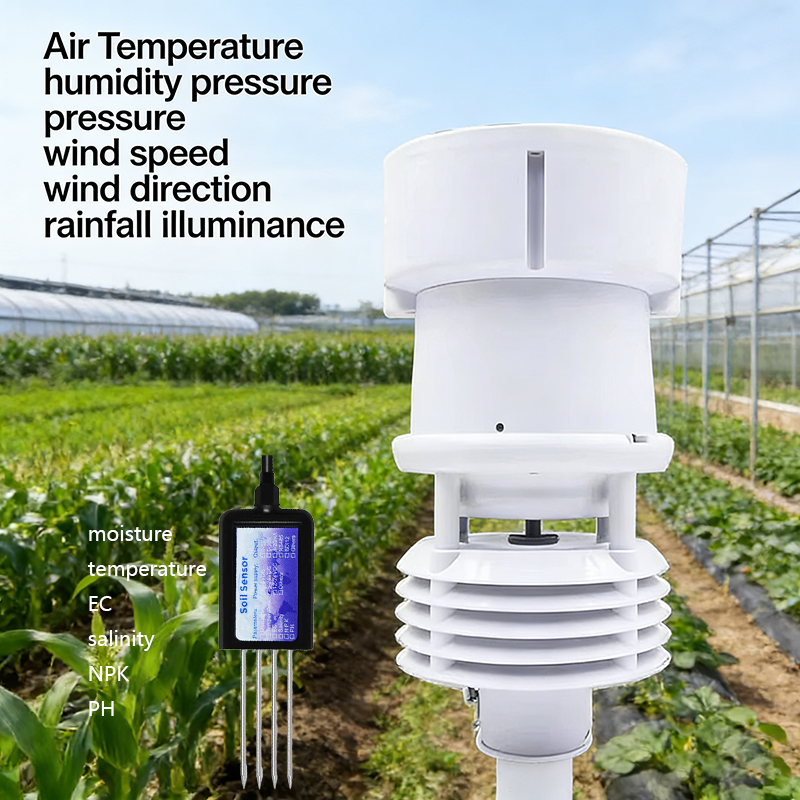
1. Space-based perception: HONDE Multi-parameter Agricultural Meteorological Station – Capturing canopy microclimate and energy sources
Core monitoring: Precise measurement of photosynthetically active radiation, air temperature and humidity, wind speed and direction, rainfall and atmospheric pressure.
Unique value
Light energy quantification: The PAR sensor directly measures the available light quantum flux for crop photosynthesis, providing the sole true value for assessing the potential of light energy production and guiding supplementary lighting/shading.
Canopy microclimate: It monitors the temperature, humidity and wind at the height of the crop canopy, which is directly related to transpiration, disease risk and pollination efficiency.
Disaster warning outpost: Real-time early warning of disastrous weather such as frost, hot and dry winds, and heavy rain.
2. Foundation Perception: HONDE photosoil sensor – Transparent dynamics of water, fertilizer, light and heat in the root zone
Core monitoring: Based on the measurement of soil moisture, temperature and salinity, it innovatively integrates in-situ soil spectral sensors to indirectly assess the microbial activities and organic matter dynamics in the root zone (for some models), and collaborates with canopy light data.
Unique value
Root zone photothermal linkage: By combining soil temperature and canopy light, analyze the influence of ground temperature on seed germination and root vitality.
Water-light coupling diagnosis: When there is sufficient light but insufficient soil moisture, the system accurately identifies the “light energy waste” state, triggers irrigation instructions, and maximizes the utilization efficiency of light energy.
Ii. Collaborative Applications: Data Intelligence Scenarios where 1+1>2
1. Management for maximizing photosynthetic efficiency
Scene: The system calculates the “light-water-temperature” production function in real time. When the PAR value is high, the soil moisture is sufficient and the temperature is suitable, it is determined as the “optimal photosynthetic window period”, and the crop is in the state of maximum productivity.
Decision: Prompt agronomists to avoid agricultural operations that may interfere with photosynthesis (such as spraying pesticides) during this window period, or use this period to supplement key foliar fertilizers.
2. Advanced models of intelligent irrigation
Beyond traditional soil moisture irrigation: Irrigation triggers are no longer solely based on soil moisture thresholds. The system introduces “evaporation demand” and “light energy availability” as correction factors.
Formula simplification: Irrigation recommendation = f(soil moisture, reference crop evapotranspiration, photosynthetically active radiation).
Case: On cloudy days (low PAR, low evapotranspiration), irrigation can be appropriately delayed even if the soil moisture is slightly below the threshold. On sunny afternoons (with high PAR and high evapotranspiration), a more proactive water replenishment strategy is required to prevent photosynthetic midday breaks. It is expected that the water-saving benefits can be further optimized by 5-15%.
3. Spatio-temporal precision in pest and disease prediction and control
Model-driven early warning: Disease occurrence models (such as downy mildew) require continuous leaf wetting time and specific temperatures. The system precisely calculates the “duration of leaf surface moisture” based on the temperature and humidity from the meteorological station. When it approaches the threshold of the disease outbreak model, it issues differentiated warnings in combination with soil sensor data (such as soil high humidity will increase the humidity of the canopy).
Precise pesticide application guidance: Based on real-time wind speed data, the appropriate pesticide application window is locked, and at the same time, PAR data (to avoid rapid evaporation of the pesticide solution under strong light) and soil moisture (to prevent mechanical entry into the ground when the soil is too wet) are referred to, achieving the global optimum of pesticide application effect and safety.
4. Environmental closed-loop control in facility agriculture
Interlocking control logic: In an intelligent greenhouse, the system constitutes the “perceptual brain” for environmental regulation.
Winter supplementary lighting and heating: When PAR is lower than the set value and the soil temperature is relatively low, the supplementary lighting and floor heating systems are activated in coordination.
Summer ventilation and cooling: When the indoor temperature is too high or the PAR is too strong, the skylight will be automatically activated and the wet curtain fan will be started. When the soil moisture is insufficient, the micro-sprinkler cooling will be initiated.
Iii. Data Value Enhancement: From Operational Guidance to Strategy Optimization
Calibration of growth models and yield prediction: The long-term accumulated “space-ground” synchronous dataset is the most valuable asset for calibrating crop growth simulation models. Based on this, the accuracy of production prediction can be improved by more than 30%.
Evaluation of varieties and agronomic measures: In variety comparison experiments, the differences in the utilization efficiency of light, temperature and water resources among different varieties can be objectively analyzed, and the real effects of agronomic measures such as mulching and close planting can be evaluated.
Carbon sink assessment and green certification: Accurate photosynthetically active radiation and growth data provide a scientific basis for estimating the carbon sequestration potential of farmland ecosystems, supporting the development of agricultural carbon sink projects and the certification of green agricultural products.
Iv. Empirical Case: Synergistic Systems Drive Outstanding Quality in Vineyards
A winery in Bordeaux, France, which pursues excellence, has deployed the HONDE “sky-Earth” system. Through the data analysis of a growing season, the winery discovered:
During the color change period, when the soil moisture is under mild stress (monitored by soil sensors) and there is sufficient sunlight during the day (monitored by meteorological stations), the accumulation of phenolic substances in grape fruits is most significant.
Through the “stress irrigation” precisely controlled by the system, ideal water-light coupling conditions were created during critical periods.
Ultimately, the vintage wine received an unprecedented high score in the blind tasting, with its body structure and complexity being significantly enhanced. The chief winemaker of the winery said, “In the past, we relied on experience and weather to ‘gamble’, but now we rely on data to ‘design’ flavors.” This system enables us to understand the physical laws behind outstanding quality.”
Conclusion
The ultimate form of smart agriculture is to build a digital ecosystem that coexists harmoniously with nature. The HONDE “Space-Earth” collaborative perception system is precisely the key infrastructure leading to this future. It no longer regards meteorology and soil as isolated monitoring objects, but as a whole, dynamically interpreting “how sunlight drives root absorption” and “how water regulates the factory of leaves”. This marks the transition of agricultural management from the “black box operation” based on experience to the “white box regulation” era based on physical and physiological models. By enabling the sky and the earth to communicate at the data level, HONDE is empowering global farmers to harness the complexity of nature with the certainty of science and write a new chapter of high-yield, high-quality and sustainable agriculture on every inch of land.
About HONDE: As a leader in providing comprehensive solutions for smart agriculture, HONDE is committed to transforming complex farmland ecosystems into analyzable, simulable, and optimizable digital models through cross-dimensional, highly collaborative sensor networks and artificial intelligence algorithms. We firmly believe that only by simultaneously understanding the “language of Heaven” and the “core of the Earth” can we truly unleash the life potential of every crop.
For more Smart Agriculture Sensor information, please contact Honde Technology Co., LTD.
WhatsApp: +86-15210548582
Email: info@hondetech.com
Company website: www.hondetechco.com
Post time: Dec-11-2025