

In the grand picture of smart agriculture, the perception of the sky (meteorology) has become increasingly mature, but there is still a huge data gap in the insight into the earth (soil). Soil, as the foundation for crop growth and the carrier of nutrient water sources, has an internal dynamic complexity far exceeding that of the surface climate. The smart agriculture soil sensing system launched by HONDE Company is transforming this “dark continent” into clear, real-time and actionable data streams with its multi-level and multi-parameter three-dimensional monitoring network, becoming the core engine driving precision agriculture from “perception” to “execution”.
I. System Concept: From single-point measurement to profile ecological perception
Traditional soil monitoring is often isolated and single-point. The HONDE system builds a three-dimensional and networked perception system:
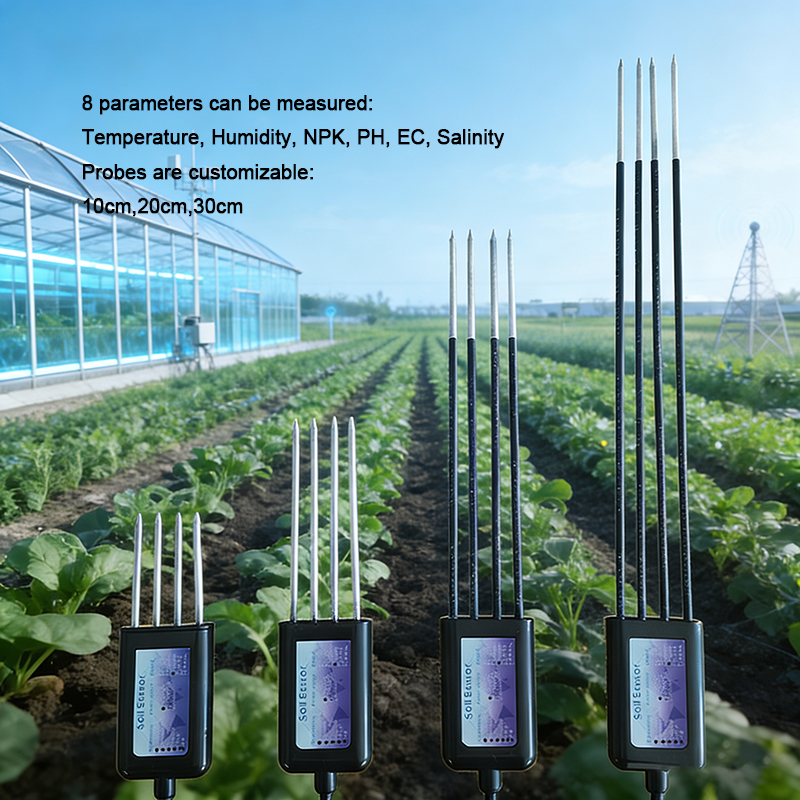
Vertical dimension: By using probe sensors of different lengths (such as 6cm, 10cm, 20cm, and 30cm), the moisture, temperature, and electrical conductivity (salinity) of the surface layer, active root layer, and bottom soil layer are simultaneously monitored, and vertical cross-sectional diagrams of water transport and salinity accumulation are drawn.
Horizontal dimension: Deploy sensor nodes in a grid pattern in the field to reveal spatial variability caused by factors such as soil texture, irrigation uniformity, and terrain, providing a prescription map basis for variable operations.
Parameter dimension: Integrating the latest sensing technology, some high-end models can be expanded to monitor the dynamics of soil pH and key nutrients (such as nitrogen, phosphorus, and potassium), achieving comprehensive diagnosis from the physical environment to the chemical environment.
Ii. Core Technology: Reliable, Precise and Intelligent “Underground Sentinel”
High-precision sensing and durability: Utilizing sensors based on principles such as Frequency Domain reflectance (FDR), it ensures long-term stable measurement of volumetric water content. The probe is made of corrosion-resistant materials and its electronic components are fully sealed, making it suitable for harsh environments where it can be buried for a long time.
Low-power iot architecture: Sensor nodes are powered by solar panels or long-lasting lithium batteries. Through wireless technologies such as LoRa, NB-IoT or 4G, data is transmitted in real time to the cloud, achieving wide coverage and “zero wiring” deployment.
Edge computing and intelligent early warning: Equipped with intelligent algorithms, it can trigger early warning signals locally based on preset thresholds (such as drought warning lines and salt hazard values), directly connecting irrigation valves to achieve a quick closed loop from “monitoring – cloud – decision-making – action”.
Iii. Core Application Scenarios and Values in Smart Agriculture
The “Ultimate Controller” for intelligent irrigation
This is the most direct and highly beneficial application of soil sensors. The system revolutionizes irrigation decisions by real-time monitoring of soil moisture tension or water content in the root layer.
On-demand irrigation: Start irrigation only when the crops truly need it. Compared with time-based or experience-based models, it can save an average of 20-40% of water.
Optimize irrigation strategies: Based on water data from different depths, guide the implementation of “deep irrigation to promote root growth” or “shallow irrigation to replenish moisture”, shaping a more robust root system.
Prevent leaching and runoff: Avoid nutrient loss and water waste caused by excessive irrigation.
2. The “Nutritionist” of Integrated Water and Fertilizer Management
When the system integrates salt (EC) and nutrient sensors, its value is further magnified:
Precision fertilization: Monitor the ion concentration in the soil solution to achieve precise fertilizer supplementation based on the absorption rate of crops, increasing fertilizer utilization by 15-30%.
Salt damage early warning and management: Real-time monitoring of EC values, automatically initiating the washing program before salt accumulation harms the root system to protect crop health.
Optimize fertilization formulas: Long-term data helps adjust water and fertilizer formulas to better meet the needs of specific soils and crops.
3. “Early Diagnostic Instrument” for Soil Health and Crop Health
Stress warning: Abnormal changes in soil temperature may indicate frost damage or heat damage. Sudden changes in moisture may indicate root diseases or pipe leaks.
Agronomic measures guidance: Monitor soil moisture and determine the best time for tillage, sowing or harvesting; Evaluate the effects of conservation tillage measures such as mulching and no-tillage through long-term data.
Data-driven soil management: Establish digital soil archives in the field, track long-term changes in soil organic matter, salinity and other indicators, and provide a basis for sustainable land management.
4. “Data Correlator” for Output and Quality Enhancement
By conducting big data correlation analysis on the soil environmental data throughout the growing season with the final yield map and quality inspection data (such as sugar content and protein content), the key soil factors that affect crop yield and quality can be revealed, thereby optimizing management measures in reverse and achieving “data-driven breeding and cultivation”.
Iv. System Advantages and Return on Investment
Decision-making revolution: Transform the experience-based model of irrigation and fertilization from “timed and quantified” to a data-driven model of “on-demand and variable”.
Cost reduction and efficiency improvement: Directly save water, fertilizer, energy and labor costs, and the payback period of investment is usually 1 to 3 growing seasons.
Improving quality and stabilizing production: By maintaining the optimal root zone environment, reducing crop stress, and enhancing the consistency and commercialization rate of agricultural products.
Environmentally friendly: Significantly reduce agricultural non-point source pollution, contributing to the goals of green agriculture and carbon neutrality.
Scalability: As the underlying data entry point of the agricultural Internet of Things, it can be easily integrated with weather stations, drones, and agricultural machinery autonomous driving systems to build a complete digital farm brain.
V. Empirical Case: A Data-Driven Harvest
A large corn-soybean farm in the Midwestern United States has deployed the HONDE soil sensor network. The system found that in the same field, approximately 15% of the area had significantly weaker soil water-holding capacity. Under the precise irrigation strategy, these areas received more irrigation, while the areas with strong water-holding capacity decreased accordingly. After one growing season, the farm not only saved 22% of water overall but also increased the stability of the total field yield by 18%, as it eliminated the “shortcoming” of reduced production caused by local drought stress. The farmer said, “What we are managing now is not just a single field, but thousands upon thousands of tiny soil units with diverse needs.”
Conclusion
The ultimate goal of smart agriculture is to manage agricultural production as if it were a precision factory. And soil is the workshop and production line of this “biological factory”. The HONDE smart soil sensing system has equipped every corner of this workshop with “monitoring instruments” and “control switches”. It makes the invisible visible, the complex controllable and the empirical computable. This is not merely a technological advancement, but also a transformation of the production relations – it is elevating farmers from “laborers of the land” to “data managers and optimizers of the soil ecosystem”, paving a clear data-driven path for the sustainable development of global agriculture under resource constraints.
About HONDE: As a builder of digital agricultural infrastructure, HONDE focuses on transforming farmland into computable and optimizable digital assets through reliable sensing, efficient connectivity, and intelligent analysis. We believe that the deep digitalization of soil is the core key to unlocking the future of agriculture.
For more soil sensor information,
please contact Honde Technology Co., LTD.
WhatsApp: +86-15210548582
Email: info@hondetech.com
Company website: www.hondetechco.com
Post time: Dec-08-2025