

Abstract: In the photovoltaic power generation industry, behind every watt of electricity generated lies a complex meteorological code. The professional solar radiation weather station launched by HONDE Company, by integrating precise equipment such as direct radiation meters and scattered radiation sensors, provides a data foundation for the planning, operation and efficiency optimization of solar power stations, and is becoming the core equipment for the world’s leading photovoltaic power stations to enhance power generation efficiency.
I. Why do solar power stations need professional radiation weather stations?
Traditional meteorological data only provide macroscopic weather information, while the efficiency of photovoltaic power generation directly depends on the intensity and spectral composition of solar radiation reaching the surface of the components. Professional meteorological stations achieve three core functions for power stations by precisely monitoring key parameters such as total radiation, direct radiation, and scattered radiation:
Power generation performance benchmark assessment: Accurately calculate the theoretical power generation, compare it with the actual power generation, and evaluate the true efficiency of the power station.
Operation and maintenance decision support: Determine whether the fluctuation in power generation is due to weather changes or equipment failures.
Power generation prediction: Provides high-precision short-term power generation prediction data for power grid dispatching.
Ii. Core Technical Configuration of HONDE Weather Station
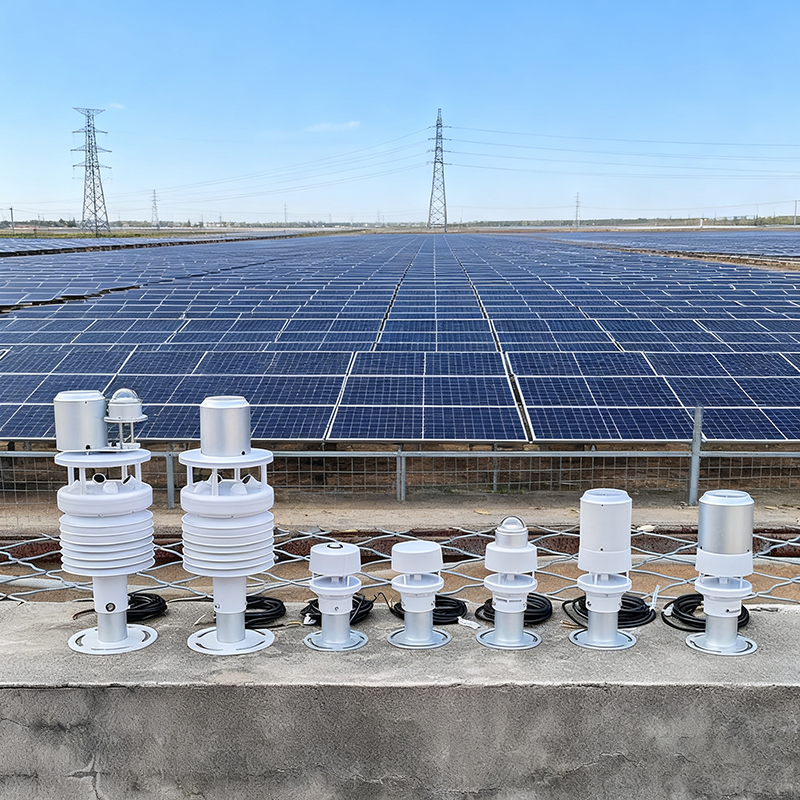
HONDE weather stations are tailor-made for solar power stations and mainly include:
Direct radiation meter: Precisely measuring the intensity of direct normal radiation perpendicular to the surface of sunlight, it is the key to evaluating the performance of concentrated photovoltaic and high-efficiency monocrystalline modules.
Total radiation meter: It measures the total solar radiation received on a horizontal surface (including direct and scattered radiation) and serves as the primary basis for calculating the theoretical power generation of a power station.
Scattered radiation sensor: In conjunction with the shielding ring, it is specifically designed to measure the scattered radiation in the sky, which is helpful for analyzing the impact of cloudy weather on power generation.
Environmental monitoring unit: Synchronously monitors environmental temperature and humidity, wind speed and direction, component backplane temperature, etc., and is used to correct the power generation model.
Iii. Application Value throughout the Entire Life Cycle of Solar Power Stations
1. The initial site selection and design stage
During the planning period of the power station, the HONDE mobile radiation monitoring system can conduct on-site data collection for one year. By analyzing the interannual variations of radiation resources, the ratio of direct scattering, spectral distribution, etc., it provides irreplaceable first-hand data for technology selection (such as choosing between fixed and tracking brackets), tilt Angle optimization and power generation simulation, thereby reducing investment risks from the source.
2. Daily operations and efficiency improvement
Accurate PR value calculation: Performance ratio is the core indicator for measuring the health of power stations. HONDE weather stations provide precise “input energy” (solar radiation), ensuring the accuracy and reliability of PR value calculations, facilitating horizontal comparisons and long-term performance tracking.
Intelligent cleaning guidance: By comparing theoretical radiation with the actual output power of components and combining with the dust sedimentation model, it is possible to accurately determine when cleaning will bring the highest economic benefits, avoiding blind cleaning or excessive dust accumulation.
Fault diagnosis and early warning: When the radiation data is normal but the power generation of a certain string abnormally drops, the system can automatically issue an early warning to guide operation and maintenance personnel to quickly locate the fault point (such as hot spots, wiring faults, etc.).
3. Grid connection and power trading
For large-scale grid-connected power stations, the accuracy of power generation prediction is of vital importance. The real-time radiation data from HONDE weather stations, combined with cloud maps and numerical weather forecast models, can significantly enhance the accuracy of short-term (within the next 15 minutes to 4 hours) and ultra-short-term predictions, helping power stations obtain better electricity prices in the power market and improving the grid’s capacity to absorb renewable energy.
Iv. Technological Advantages and Industry Certifications
High precision and stability: The sensor complies with the standards of the World Meteorological Organization and features outstanding long-term stability with an extremely small annual change rate, ensuring continuous and reliable data.
Industrial-grade design and maintenance: Equipped with self-cleaning, heating, ventilation and other functions, it can adapt to harsh environments such as deserts, plateaus and coastal areas, ensuring continuous operation for 7×24 hours.
Intelligent data platform: Data is uploaded to the HONDE Smart Energy Cloud Platform in real time via 4G/ optical fiber, providing visual analysis, automatic report generation and API interfaces.
V. Typical Cases: Empirical Evidence for Enhancing Power Station Revenue
After the deployment of the HONDE meteorological station at a 200MW photovoltaic power station in the Middle East, the control algorithm of the tracking bracket was optimized through data analysis, and a refined cleaning plan based on radiation data was formulated. Within one year, the average performance ratio of the power station increased by 2.1%, and the equivalent annual power generation revenue increased by approximately 1.2 million US dollars. Meanwhile, precise power prediction has reduced its penalty rate in the electricity market by 70%.
Conclusion
Today, as the photovoltaic industry moves towards grid parity and deeply participates in the power market, refined management has become the key to the profitability of power stations. The HONDE solar radiation meteorological station is no longer merely a “meteorological observation device”, but rather an “efficiency diagnostic instrument” and “revenue optimizer” for solar power stations. With precise data, it transforms seemingly free sunlight into measurable, manageable and maximizable green wealth, contributing indispensable technological strength to the global energy transition.
About HONDE: As an expert in the field of environmental monitoring and energy Internet of Things, HONDE is committed to providing full life-cycle data solutions for the renewable energy industry, from resource assessment to smart operation. It defines industry standards with precision and drives a green future with data.
For more weather station information,
please contact Honde Technology Co., LTD.
WhatsApp: +86-15210548582
Email: info@hondetech.com
Company website: www.hondetechco.com
Post time: Dec-04-2025