

In the process of global agricultural production’s transformation towards digitalization and precision, a comprehensive perception of the crop growth environment has become the core foundation of modern agricultural management. Single meteorological data or surface soil data are difficult to meet the demands of complex agronomic decisions. HONDE Company innovatively integrates tubular soil temperature and humidity profile sensors, professional agricultural meteorological stations and low-power wide-area LoRaWAN data acquisition and transmission systems, building a “space-ground-network” integrated smart agriculture collaborative perception system. This system not only realizes the synchronous three-dimensional monitoring of the climate of the crop canopy and the water and heat conditions of the root layer, but also provides a reliable, economical and complete data infrastructure for the precise management of large-scale farms through an efficient Internet of Things network.
I. System Architecture: The perfect integration of three-dimensional perception and efficient transmission
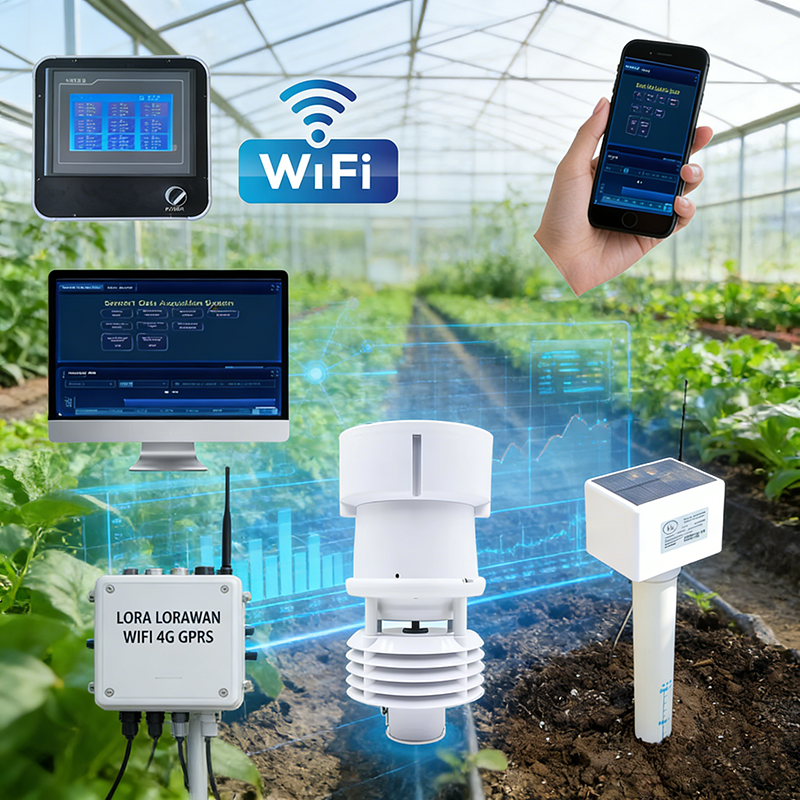
1. Space-based perception: HONDE professional agricultural meteorological Station
Core functions: Real-time monitoring of key meteorological elements such as air temperature, humidity, wind speed, wind direction, photosynthetically active radiation, rainfall, and atmospheric pressure.
Agricultural value: It provides core input for calculating crop evapotranspiration, assessing light energy resources, warning of disastrous weather (frost, strong wind, heavy rain), and judging meteorological conditions for the occurrence of pests and diseases.
2. Foundation Sensing: HONDE tubular soil temperature and humidity profile sensor
Technological breakthrough: By adopting a unique tubular design, it enables continuous profile monitoring of soil volumetric moisture content and temperature at single points and multiple depths (such as 10cm, 20cm, 40cm, 60cm).
Core values
Insight into water dynamics: Clearly display the depth of water infiltration after irrigation or rainfall, the actual water-absorbing layer of the root system, and the vertical distribution of soil reservoirs, far exceeding the information capacity of single-point sensors.
Monitoring ground temperature gradient: Temperature data of different soil layers are crucial for seed germination, root growth and microbial activities.
3. Neural Network: HONDE LoRaWAN Data Acquisition and Transmission System
On-site collection: The low-power data collector connects the meteorological station and the tubular sensor, responsible for data aggregation and protocol encapsulation.
Wide-area transmission: The collected data is sent to the LoRaWAN gateway deployed at the highest point or center of the farm via LoRa wireless technology.
Cloud aggregation: The gateway uploads data to the smart agriculture cloud platform via 4G/ optical fiber. LoRaWAN technology, with its features of long range (3-15 kilometers), low power consumption and large capacity, has become an ideal choice for connecting decentralized monitoring points.
Ii. Collaborative Applications: Data Intelligence scenarios where 1+1+1>3
Deep optimization of irrigation decisions – a leap from “quantity” to “quality”
Traditional model: Irrigation is based solely on surface soil moisture or a single meteorological data point.
Collaborative mode
The meteorological station provides real-time evaporation demand (ET0).
The tubular sensor provides the actual water storage capacity of the root layer and the depth of water infiltration.
System decision-making: After comprehensive analysis, it not only determines “whether to irrigate”, but also accurately judges “how much water to irrigate” to achieve the optimal infiltration depth, avoiding shallow irrigation or deep seepage. For instance, on days with low evaporation requirements, even if the surface is slightly dry, if the deep soil moisture is sufficient, irrigation can be delayed. Conversely, on days with high evaporation demand, it is necessary to ensure that the irrigation volume is sufficient to compensate for evapotranspiration and moisten the main root layer.
Benefits: It is expected to further optimize water-saving effects by 10-25% and promote the healthy development of root systems.
2. Precise prediction and zonal defense against frost disasters
Collaborative early warning: When the meteorological station detects that the temperature is approaching freezing point, an early warning is triggered. At this point, the system invokes the surface and shallow ground temperature data from the tubular sensors at different positions.
Precise judgment: As soil moisture has a significant impact on ground temperature (wet soil has a large specific heat capacity and cools down slowly), the system can accurately determine which areas in the field (dry areas) have a faster drop in ground temperature and a higher risk of frost.
Zoned response: It can guide the activation of local measures such as anti-frost fans and irrigation in high-risk areas, rather than full-site operations, to save energy and costs.
3. Integrated water and fertilizer management and salt management
Tubular sensors can monitor the migration of salts in the soil profile before and after irrigation.
Combining meteorological data (such as whether there is a strong surface evaporation caused by high temperature and strong wind after irrigation), the system can warn of the risk of “salt return” where salt accumulates to the surface layer along with water evaporation, and recommend subsequent micro-irrigation for leaching.
4. Crop model calibration and yield prediction
Data fusion: Provide highly spatio-temporal matched canopy meteorological driving data and root layer soil environment data required for crop growth models.
Model improvement: Significantly enhance the accuracy of crop growth simulation and yield prediction, providing a reliable basis for farm planning, insurance, and futures.
Iii. Technical Advantages: Why is This System the preferred choice for large-scale farms?
Complete data dimensions: Simultaneously obtain the “heavenly” climate driving factors and the “underground” soil profile responses to form a decision-making closed loop.
The network coverage is economically efficient: A single LoRaWAN gateway can cover the entire large farm, with zero wiring costs, extremely low communication energy consumption, and can operate for a long time with solar power supply, with a low total cost of ownership.
The profile information is irreplaceable: The vertical profile data provided by the tubular sensor is the only direct data source for managing deep agronomic measures such as deep water replenishment, drought resistance and water conservation, and saline-alkali improvement.
The system is stable and reliable: Industrial-grade design, suitable for harsh farmland environments; LoRa technology has strong anti-interference ability, ensuring the stability of the data link.
Iv. Empirical Case: Collaborative Systems Facilitate Excellent Management in Vineyards
A high-end wine estate in Chile has deployed this collaborative system to enhance irrigation accuracy and fruit quality. Through the data analysis of a growing season, the winery discovered:
Meteorological station data indicates that the temperature difference between day and night and the duration of sunshine during the color-changing period are the key factors.
2. Tubular sensors show that maintaining mild water stress at a depth of 40-60cm in the soil profile is most conducive to the accumulation of phenolic substances.
3. Based on future weather forecasts and real-time profile soil moisture conditions, the system precisely implemented the “water control” irrigation strategy during the color change period.
Ultimately, the depth and complexity of the vintage wine received wide acclaim from wine critics. The agronomist of the estate said, “In the past, we relied on experience to judge the condition of the root system. Now, we can ‘see’ the distribution and movement of water in the soil.” This system enables us to precisely “carve” the growing environment of grapes, thereby “designing” the flavor of wine.
Conclusion
The advancement of smart agriculture relies on a comprehensive and in-depth understanding of the growth environment of crops. HONDE’s system, which integrates agricultural meteorological stations, tubular soil profile sensors and LoRaWAN Internet of Things technology, has constructed a three-dimensional and networked digital mapping from canopy climate to root soil. It not only provides more data points, but also reveals the intrinsic logic of “how meteorology affects soil” and “how soil responds to agricultural operations” through the spatio-temporal correlation and collaborative analysis of data. This marks a leap in farm management from responding to isolated indicators to the overall optimization and active regulation of the “soil-plant-atmosphere” continuum system, providing a practical benchmark solution for global modern agriculture to achieve efficient resource utilization, precise risk control and product value enhancement.
About HONDE: As a leader in smart agriculture system solutions, HONDE is committed to providing customers with a complete value chain service ranging from precise perception, reliable transmission to intelligent decision-making through interdisciplinary technology integration. We believe that only by achieving the synergy of land and space data can the full potential of digital agriculture be truly unleashed and the sustainable development of agricultural production be empowered.
For more weather station and soil sensor information,
please contact Honde Technology Co., LTD.
WhatsApp: +86-15210548582
Email: info@hondetech.com
Company website: www.hondetechco.com
Post time: Dec-15-2025