

Integrated Water and Air IoT Suite Combines 3-Year Luminescent DO Sensing, Anti-Bite Fish-Tank Probes, and Automated Aeration VFD Linkage for Intensive Aquaculture Operations
TL;DR
- In intensive recirculating aquaculture systems (RAS), indoor hatcheries, and high-density shrimp ponds, nighttime dissolved oxygen (DO) depletion accounts for over 70% of catastrophic farm mortality events, while continuous blind aeration inflates electricity bills to up to 50% of total operational expenditure.
- The global integrated recirculating aquaculture system (RAS) market is projected to reach $11.2 billion by 2034 (Market Research / Deep Insights), accelerating the shift from manual grab-sampling to automated closed-loop environmental IoT control.
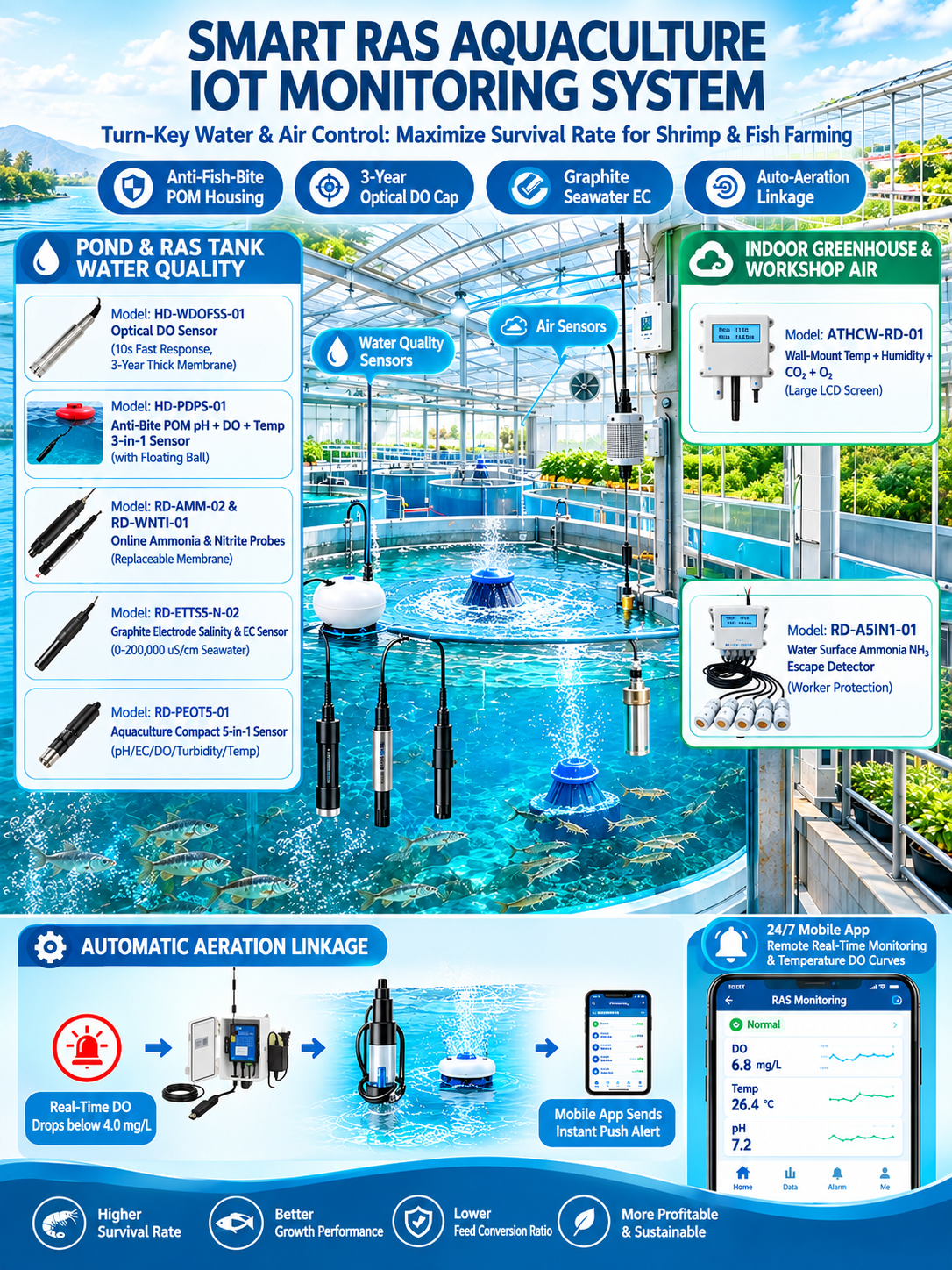
- Honde’s newly announced Smart IoT Water & Air Quality Management System for RAS provides complete biosecurity: HD-WDOFSS-01 thick-film optical DO sensors (3-year cap life, 10-second response), HD-PDPS-01 POM anti-bite floating 3-in-1 probes, twist-lock replaceable ammonia/nitrite ISE heads, and indoor greenhouse CO2/NH3/O2 safety detectors.
- The system pairs real-time RS485 Modbus telemetry with 4G/LoRaWAN MQTT JSON gateways, triggering automated alarm relays and variable frequency drives (VFDs) at 4.0 mg/L DO thresholds to protect stock and trim aeration power by up to 30%.
1.The Intensive Aquaculture Bottleneck: Invisible Water Surges & Air Quality Hazards
As commercial aquaculture transitions into high-density land-based farming across Vietnam, Indonesia, Thailand, India, Brazil, and Ecuador, facility managers face an interconnected physiological and atmospheric crisis:
- Nighttime Anoxia Plunges: Photosynthesis halts after dusk while biological respiration from fish, shrimp, and biofilter nitrifying bacteria accelerates. In high-density vannamei shrimp or tilapia tanks, DO levels can crash from 7.0 mg/L to a lethal 2.0 mg/L in under 90 minutes.
- Sensor Mechanical Destruction: Standard industrial electrodes placed in culture tanks suffer rapid mechanical failure. Inquisitive fish and aggressive shrimp bite fragile sensor membranes, while dense organic biofilms and suspended fecal solids induce severe calibration drift.
- Toxic Ammonia & Nitrite Spikes: Uneaten high-protein feed and excreted urea cause sudden un-ionized ammonia (NH3) and nitrite (NO2−) surges that damage gill tissues and suppress feeding within hours.
- Indoor Atmosphere Toxicity: In enclosed greenhouse raceways and wintering hatcheries, poor air turnover leads to dangerous surface accumulation of ammonia gas (NH3), carbon dioxide (CO2), and potential oxygen-cone enrichment leakage hazards for facility technicians.
2.Purpose-Built Sensor Architecture: Built for Aggressive Farm Biota
Standard industrial sensors are unsuited for high-density aquatic environments where animal biting, biofouling, and saltwater corrosion are constant. HONDE’s hardware portfolio resolves these challenges through application-specific mechanical engineering:
a. HD-WDOFSS-01 Optical Dissolved Oxygen Sensor
- Luminescent Quenching Technology: Provides continuous, drift-free DO readings within 10 to 15 seconds with zero electrolyte or membrane replacement.
- Thick-Film Sensing Cap: Engineered for a continuous service life of up to three years under normal operating conditions.
- Full Digital Compensation: Integrated software algorithms provide automatic salinity (0–60 PSU) and barometric pressure compensation, ensuring laboratory precision across fresh, brackish, and marine setups.
b. HD-PDPS-01 POM Anti-Bite 3-in-1 Water Probe
- Polyoxymethylene (POM) Engineering Plastic: Resists aggressive pecking and biting from commercial shrimp and omnivorous fish.
- Integrated Floating Body & Strainer Shield: The buoy positions the multi-sensor head at the optimal biological respiration layer, while a slotted mechanical cage prevents physical contact with delicate sensing elements.
- Three Core Parameters: Simultaneously measures pH, optical dissolved oxygen, and water temperature on a single digital RS485 channel.
c. RD-AMM-02 & RD-WNTI-01 Twist-Lock Ammonia & Nitrite Sensors
- Field-Replaceable Membrane Heads: Feature an innovative threaded twist-removal mechanism. When sensor heads eventually reach end-of-life after intensive feeding cycles, farm technicians replace only the modular sensing tip in under 60 seconds, reducing long-term sensor replacement capex by over 60%.
d. RD-ETTSS-N-02 Seawater Conductivity & Salinity Sensor
- Graphite Electrode Array: Replaces soft metal pins with high-purity, wear-resistant graphite electrodes, providing extreme immunity to high-salinity seawater pitting corrosion and calcium scaling.
3.Technical Specifications: Comprehensive Aquaculture Sensor Matrix
| Hardware Model | Monitored Parameters | Sensing Principle | Key Engineering Differentiator |
|---|---|---|---|
| HD-WDOFSS-01 | Dissolved Oxygen (DO), Temp | Optical Luminescence (Phase Shift) | Thick-film optical cap (3-year lifespan), 10–15s fast response, zero electrolyte |
| HD-PDPS-01 | pH, DO, Temperature | Optical DO + Combination Glass pH | POM anti-bite body with floating buoy; resists shrimp pecking in intensive raceways |
| RD-AMM-02 | Ammonia Nitrogen (NH3-N) | Ion-Selective Electrode (ISE) | Twist-lock replaceable membrane cartridge; cuts ongoing consumable costs by 60% |
| RD-WNTI-01 | Nitrite (NO2−), Temperature | Electrochemical ISE Array | Rapid detection of nitrification breakdown before brown-blood disease develops |
| RD-ETTSS-N-02 | Salinity, Conductivity, TDS | Four-Electrode Graphite Array | Abrasion-resistant graphite electrodes immune to marine biofouling and salt scaling |
| ATHCW-RD-01 | Air Temp, Humidity, CO2 | Non-Dispersive Infrared (NDIR) | Wall-mounted greenhouse transmitter with bright color LCD for indoor ventilation control |
| RD-GD-WM-01 | Oxygen Concentration (O2) | Electrochemical Gas Sensor | Real-time oxygen cone leakage safety detection for indoor hatcheries |
| RD-A5IN1-01 | Surface Ammonia Gas (NH3) | Electrochemical Atmospheric Cell | Detects toxic gaseous ammonia accumulation above enclosed raceway water surfaces |
4.Automated Aeration Control: Eliminating Fish Mortality While Trimming Power by 30%
Continuous measurement delivers maximum commercial value when linked to automated mechanical actuation.
In traditional farms, paddlewheel aerators and root blowers run continuously at full capacity 24 hours a day—generating astronomical electric bills—or are switched on manually based on periodic inspection rounds, leaving ponds vulnerable to sudden nocturnal crashes.
HONDE’s closed-loop control architecture automates this critical workflow:
- Precision Threshold Trip: The HD-WDOFSS-01 continuously streams optical DO readings to the local IoT controller.
- Intelligent Relay Actuation: When DO drops below a user-configured threshold (e.g., 4.0 mg/L), the controller triggers a heavy-duty physical alarm relay to activate emergency paddlewheels or oxygen diffusers in milliseconds.
- VFD Speed Modulation: Where variable frequency drives (VFDs) are installed on biological blowers, the system modulates motor frequency in real-time according to oxygen consumption curves. Rather than wasting peak electricity during sunny mid-afternoon photosynthetic highs, aeration is dynamically trimmed, reducing monthly farm electrical consumption by 20% to 30%.
5.Indoor Greenhouse Environment & Atmospheric Safety
Intensive recirculating aquaculture systems housed inside enclosed greenhouses or indoor warehouses require integrated atmospheric monitoring alongside water chemistry:
- ATHCW-RD-01 (Air Temperature, Humidity & CO2): High stocking densities produce significant respiration CO2. Mounted on greenhouse stanchions, this unit displays real-time atmospheric metrics on an LCD color screen while its output relays automate rooftop exhaust fans and evaporative cooling pads.
- RD-GD-WM-01 (O2 Concentration & Leakage Detector): Modern RAS farms utilize liquid oxygen storage and pressurized oxygen enrichment cones. The RD-GD-WM-01 detects abnormal oxygen accumulation in enclosed rooms, mitigating fire and explosion hazards.
- RD-A5IN1-01 (Ammonia Gas Safety Monitor): Detects airborne ammonia gas volatilizing off settling basins and sludge dewatering channels, protecting workforce health and flagging biofilter nitrification failure early.
6.Commercial Value Comparison: HONDE Smart Aquaculture System vs. Traditional Methods
| Operational Dimension | HONDE Smart Aquaculture IoT System | Traditional Manual Handheld Testing |
|---|---|---|
| DO Measurement Frequency | Continuous 24/7 real-time telemetry (10s updates) | Spot-checked 2–3 times daily with handheld meters |
| Nighttime Anoxia Risk | Zero: automated relay starts aerators instantly | High: midnight hypoxia discovered only after fish die |
| Sensor Bio-Durability | POM anti-bite shields + 3-year optical DO caps | Fragile glass/teflon probes bitten and ruined by shrimp |
| Consumable Replacement | Modular twist-lock heads (replace tip only) | Entire expensive sensor assembly replaced upon failure |
| Energy Management | Demand-based VFD trimming cuts power by 30% | Blowers run blindly at 100% capacity continuously |
| Confined Air Safety | Integrated CO2, NH3, and O2 leak interlocks | Unmonitored enclosed spaces pose staff safety hazards |
7.Three Turnkey Deployment Solutions for Commercial Aquaculture
To support smallholder shrimp ponds, enterprise RAS facilities, and distributed cooperative hatcheries, Honde provides three proven solutions:
1. Handmeter, Data logger with screen
Designed for pond managers, fish health technicians, and mobile feeding crews. The Handmeter, Data logger with screen powers any connected HONDE water probe on-site, displays live DO, pH, salinity, and temperature curves on a high-contrast backlit screen, and logs feeding-cycle histories. Technicians can calibrate probes pond-side and export Excel reports via USB without carrying laptops around wet dikes.
2. GPRS/4G/WIFI/LORA/LORAWAN wireless module supports MQTT Json format
Engineered for sprawling outdoor shrimp farms and multi-basin fish estates where running physical signal cables is impractical. Honde packages sensors with an industrial GPRS/4G/WIFI/LORA/LORAWAN wireless module. The gateway aggregates water and atmospheric metrics and transmits them in standardized MQTT Json format. LoRaWAN is ideal for extensive outdoor pond clusters, transmitting up to 10 km back to a single base station without ongoing cellular data fees.
3. Cloud server and software with alram relay system support to see the real time data, history data
Designed for centralized farm command centers and commercial enterprise dashboards. The Cloud server and software with alram relay system support to see the real time data, history data tracks real-time water quality curves, feeding-rate correlations, and multi-season performance logs. Crucially, the system features an intelligent physical alarm relay system: if nocturnal dissolved oxygen plummets below critical levels, the system instantly trips on-site mechanical relays to engage auxiliary aerators and dispatch high-priority audio alarms and SMS alerts to farm managers.
8.Real-World Case Study: 40-Tank Land-Based Vannamei Shrimp Farm in Ceará, Brazil
An intensive land-based recirculating aquaculture facility in Ceará, Brazil, operates 40 concrete nursery and grow-out tanks for Litopenaeus vannamei at stocking densities exceeding 250 shrimp/m2.
- The Challenge: The farm suffered periodic catastrophic mortality during early morning hours (3:00 AM – 5:00 AM) due to rapid oxygen crashes caused by heavy feeding and biofilter respiration. Furthermore, aggressive juvenile shrimp frequently chewed through traditional membrane-covered polarographic probes within weeks.
- The Solution: The operator installed Honde HD-PDPS-01 POM Anti-Bite Floating DO/pH Sensors in all 40 tanks, connected to a Cloud server and software with alarm relay system via 4G wireless modules transmitting MQTT Json data. Relay outputs were hardwired to automatic oxygen injection solenoid valves.
- The Outcome: The POM mechanical cage eliminated 100% of probe bite damage, with zero sensor replacements required across three full 120-day production cycles. Automated DO threshold control (triggering supplemental pure oxygen injection at 4.2 mg/L) eliminated nocturnal mortality events entirely, increasing survival rates from 68% to 91% and paying back total instrumentation investment within a single harvest.
9.Sourcing & Engineering Cooperation
Honde Technology Co., Ltd. is currently accepting commercial inquiries, project-specific custom configurations, and OEM/ODM system integration requests for the Smart Aquaculture IoT System.Distributors, RAS engineering contractors, and commercial farm operators can request evaluation units, Modbus register maps, and technical datasheets directly from our engineering team:
1.Handmeter, Data logger with screen;
2.GPRS/4G/WIFI/LORA/LORAWAN wireless module supports MQTT Json format;
3.Cloud server and software with alram relay system support to see the real time data, history data.
WhatsApp: +86-15210548582
Email: info@hondetech.com
Company Website: www.hondetechco.com
High-Volume & High-Conversion Keyword Strategy
Primary Keyword
- smart aquaculture IoT system
Secondary Keywords (High Search Volume)
- optical dissolved oxygen sensor for aquaculture
- RAS water quality monitoring system
- anti-bite shrimp pond pH DO probe
- automated aquaculture aeration control system
- recirculating aquaculture water quality sensor
Long-Tail Keywords (High Commercial Intent)
- optical DO sensor with 3-year sensing cap price
- automated paddlewheel aerator control with alarm relay
- LoRaWAN aquaculture water quality monitoring MQTT Json
- replacement membrane ammonia nitrite sensor for fish farm
- greenhouse fish hatchery CO2 and ammonia gas detector supplier
LSI & Semantic Vocabulary
- recirculating aquaculture systems (RAS), Litopenaeus vannamei, nocturnal anoxia
- luminescent optical DO, phase-shift fluorescence, POM engineering plastic
- variable frequency drive (VFD) blower control, un-ionized ammonia (NH3-N), nitrite toxicity
- atmospheric oxygen cone leak detection, NDIR carbon dioxide, IP68 waterproof telemetry
Search Intent Matrix
| User Intent | Representative Keyword Query | Targeted Section |
|---|---|---|
| Informational | “why do fish die from dissolved oxygen drops at night” | The Intensive Aquaculture Bottleneck & DO Benchmarks |
| Commercial | “optical DO sensor vs polarographic probe for shrimp farm” | Purpose-Built Sensor Architecture & Comparison Table |
| Transactional | “smart aquaculture monitoring system supplier quotation” | Specifications, Brazilian Case Study & Contact Block |
On-Page SEO Elements
- H1: HONDE Unveils Smart Aquaculture IoT System to Eliminate Nighttime Fish Mortality and Cut RAS Aeration Electricity Costs
- Meta Title: Smart Aquaculture IoT System | Optical DO & Automated Aeration | HONDE
- Meta Description: Eliminate nocturnal fish and shrimp mortality with HONDE’s smart aquaculture IoT system. Optical DO, anti-bite probes, automated aeration VFD control, and cloud alerts.
- URL Slug:
/smart-aquaculture-iot-system-ras-aeration-control - Image Alt Text:
HONDE smart aquaculture IoT system with optical dissolved oxygen sensor and automated aeration control deployed in a recirculating aquaculture tank
Post time: Oct-30-2026