

Facing the core challenges of high deployment costs, short communication distances and high energy consumption in environmental monitoring in agricultural production, the large-scale implementation of smart agriculture urgently needs a reliable, economical and complete field Internet of Things infrastructure. HONDE Company integrates cutting-edge sensing technology with low-power wide-area communication to launch an integrated smart agricultural monitoring system centered on LoRa/LoRaWAN data collectors. This system collects data through distributed soil sensors and meteorological stations, and aggregates it with LoRa gateways, building a wide-coverage, low-power consumption and cost-effective full-dimensional perception neural network for farmland, truly achieving a leap from “single-point intelligence” to “farn-level intelligence”.
I. System Architecture: Three-layer collaborative LPWAN Internet of Things Paradigm
Perception layer: Sensing terminals for space-ground coordination
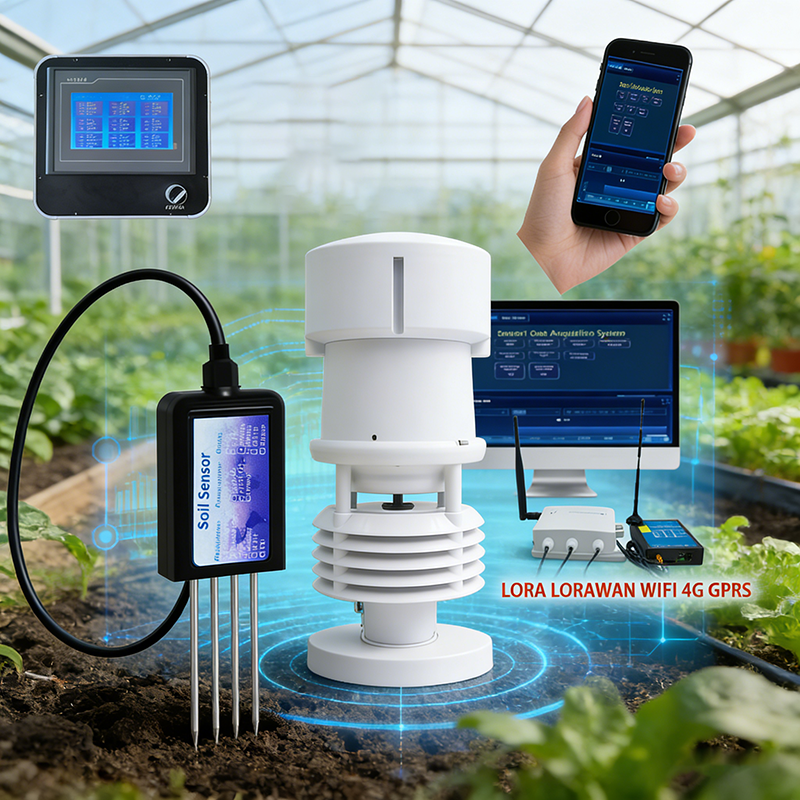
Foundation unit: HONDE multi-parameter soil sensor: Monitors soil volumetric water content, temperature, electrical conductivity (salinity), some models support nitrate nitrogen or pH value, and deeply covers the core root layer of crops.
Space-based unit: HONDE compact agricultural meteorological Station: Monitors air temperature and humidity, photosynthetically active radiation, wind speed and direction, rainfall and atmospheric pressure, capturing key climate drivers of energy and material exchange in the canopy.
Transport Layer: LoRa/LoRaWAN low-power wide area network
Core equipment: HONDE LoRa data collector and gateway.
Data collector: Connected to sensors, responsible for data reading, packaging and wireless transmission via LoRa protocol. Its ultra-low power consumption design, in combination with solar panels, enables continuous field operation for several years without maintenance.
Gateway: As a network relay station, it receives data sent by all collectors within a radius of several kilometers (typically 3 to 15 kilometers depending on the environment), and then transmits it back to the cloud server via 4G/Ethernet. A single gateway can easily manage hundreds of sensor nodes.
Platform layer: Cloud data fusion and intelligent applications
Data is decoded, stored, analyzed and visualized in the cloud.
Ii. Technical Advantages: Why Choose LoRa/LoRaWAN?
Wide coverage and strong penetration: Compared with ZigBee and Wi-Fi, LoRa has a communication distance of several kilometers in open farmland and can effectively penetrate the crop canopy, making it highly suitable for farm environments with complex terrain and many obstructions.
Ultra-low power consumption and long battery life: The sensor nodes are mostly in a dormant state and only wake up at regular intervals to send data, enabling the solar power supply system to operate stably even in continuous rainy weather and significantly reducing deployment and maintenance costs.
High capacity and high concurrency: LoRaWAN adopts a star network architecture and adaptive data rate. A single gateway can connect to a large number of terminals, meeting the demand for dense sensor deployment in large-scale farms.
High reliability and security: Utilizing wireless spread spectrum technology, it has strong anti-interference ability. Data transmission supports end-to-end encryption to ensure the security of agricultural data.
Standardization and openness: LoRaWAN is an open Internet of Things standard, which avoids vendor lock-in and facilitates system expansion and future upgrades.
Iii. Large-scale Application Scenarios in Smart Agriculture
1. Precise water and fertilizer management for field crops
Practice: In hundreds to thousands of acres of corn and wheat fields, soil moisture/salinity sensors are deployed in a grid pattern, along with several meteorological stations. All data is collected through the LoRa network.
Value: The platform generates variable irrigation and fertilization prescription maps based on complete field variation data, which can be directly sent to intelligent irrigation machines or water and fertilizer integrated machines equipped with controllers for execution. To achieve balanced growth throughout the region, it is expected that water and fertilizer can be saved by 20-35%.
2. Precise regulation of microclimate in orchards and facility agriculture
Practice: Set up meteorological stations in different areas of the orchard (top of the slope, bottom of the slope, windward, and leeward), and install soil sensors under representative fruit trees.
Value
Real-time monitoring of the microscopic distribution of disastrous weather conditions such as frost and hot and dry winds within the park is carried out to achieve precise early warning and prevention and control by zones.
Based on the data of canopy light and soil moisture, the drip irrigation or micro-sprinkler system is linked and controlled to optimize the water and light supply during the fruit expansion period and improve the quality.
3. Aquaculture and Environmental Monitoring
Practice: Deploy meteorological stations and LoRa gateways by the pond to monitor the atmospheric environment. Transmit water quality sensor data via LoRa.
Value: Comprehensively analyze the impact of meteorological changes (such as sudden drops in air pressure and heavy rain) on dissolved oxygen and water temperature in water bodies, issue early warnings for pond flooding risks, and automatically increase oxygen levels.
4. The data foundation for agricultural research and production entrustment
Practice: In variety trials and cultivation model research, deploy monitoring networks at low cost and high density.
Value: Obtain continuous, high spatiotemporal resolution environmental data, providing unparalleled data support for model calibration and agronomic evaluation. Service providers can remotely monitor the entire environment of the managed farm, achieving data-driven standardized production management.
Iv. Core Value of the HONDE System: The Transformation from Technology to Benefit
Ultimate TCO: Significantly reduces the cost of communication modules, network facilities, and long-term maintenance, making the deployment of large-scale, high-density sensor networks economically possible.
Decision-making refinement: The leap from “representative point” data to “full-field” data enables management decisions to respond to the real spatial variations in the field.
Lightweight operation: The wireless and solar-powered design makes the system installation flexible, requiring almost no daily field inspections. All equipment can be managed through the cloud.
Asset digitalization: A real-time digital twin environment covering the entire farm has been built, providing reliable data assets for the assessment, trading, insurance and financial derivatives of farm assets.
V. Empirical Case: The Digital Rebirth of a Thousand-Mu Farm
In a modern farm covering 1,200 mu in the North China Plain, HONDE has deployed a monitoring network that includes 80 soil moisture nodes, 4 meteorological stations and 2 LoRa gateways. After the system is running:
Irrigation decisions have shifted from being based on two representative points to grid data based on 80 points.
The variable irrigation plan automatically generated by the platform saved 28% of water in the first irrigation in spring and significantly improved the uniformity of seedling emergence.
By monitoring the wind speed across the entire field, the operation path and take-off and landing points of the agricultural drone were optimized, and the operation efficiency was increased by 40%.
The farm manager said, “Previously, we managed a large area of land based on feelings and experience. Now, it’s like managing a series of clearly visible ‘small squares’.” This system not only saves money, but also makes management simple, precise and predictive.”
Conclusion
The large-scale development of smart agriculture relies on an infrastructure that is like the “nervous system of farmland”. HONDE’s “space-ground-network” integrated system, which uses LoRa/LoRaWAN as the “nerve conduction” and soil and meteorological sensors as the “peripheral perception”, is precisely the mature realization of this nervous system. It has solved the problem of data acquisition in the “last mile” of smart agriculture, converting every breath and pulse of the vast farmland into a data stream that can be used for decision-making at an economical cost. This is not only a technological victory but also a profound transformation of the agricultural productivity paradigm, marking the official entry of agricultural production into the era of network intelligence driven by real-time data across the entire region, and paving a clear and replicable digital path for global food security and sustainable agricultural development.
About HONDE: As a builder and innovator of agricultural Internet of Things (iot) infrastructure, HONDE is committed to integrating the most suitable communication technologies with precise sensing technologies to provide customers with end-to-end, scalable smart agriculture solutions. We firmly believe that a stable, economic and open technical architecture is the fundamental for smart agriculture to truly take root in the fields and create universal value.
For more weather station and soil sensor information, please contact Honde Technology Co., LTD.
WhatsApp: +86-15210548582
Email: info@hondetech.com
Company website: www.hondetechco.com
Post time: Dec-12-2025