

HONG KONG, OCTOBER 26, 2023 – Water quality monitoring has made a huge leap with the arrival of a new breed of Constant Potential Amperometric Chlorine Sensors that’s changing how businesses and towns make sure their water is safe. Advanced electrochemical sensors are quickly taking over from old tech, giving amazing accuracy and dependability when it comes to measuring free chlorine for important jobs.
Innovation at the core: The technology explained
In contrast to conventional colorimetric test kits and less stable sensor designs, the constant potential (amperometric) residual chlorine sensor marks a change. It acts as a special electrochemical chlorine tester. The main innovation is the use of a three-electrode system (working, counter, and reference) that keeps a steady electrical potential. This enables the accurate and targeted oxidation of free chlorine at the working electrode, producing a current signal that is directly proportional to the chlorine concentration.
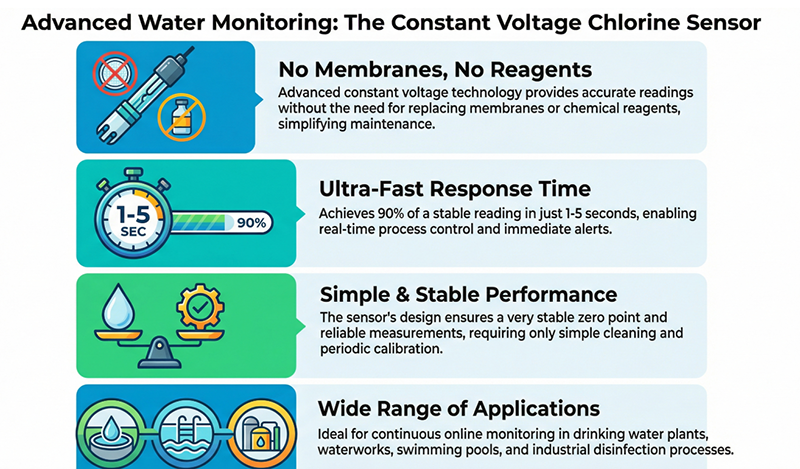
And this technical superiority turns into some big product benefits:
Unmatched Accuracy and Stability: Provides constant, drift-free measurement that’s unaffected by water color or turbidity – a big problem with DPD methods.
Rapid Response: Real-time data delivery, T90 response time less than 30s for immediate process control.
Minimal Maintenance: Modern designs have strong, fouling-resistant membranes that need only occasional calibration, reducing operating expenses.
Smart Connectivity: Works well with IoT platforms to do things like watch from far away, guess when something might need fixing, and look at numbers.
Transforming critical application scenarios
And this technological development isn’t just a little bit better; it’s making things safer and more effective in some important parts of our lives.
2. Smart Municipal Drinking Water Networks The cities have put these sensors at the center of their disinfectant monitoring sensor networks. Installed at treatment plant outlets and key distribution points, they give water companies a real-time view of disinfectant levels. This allows for proactive management so that it can comply with the safety standard and reduce the generation of harmful disinfection by-products(DBP) by optimizing the amount of chlorine used. Take the example of a pilot project in PUB network of Singapore which showed 15% less use of chlorine but still 100% compliant due to the accuracy of the sensor.
2. Guardians of Public Health: Swimming Pools & Aquatic Centers Public pools and luxury resort aquatics facilities have to maintain constant free chlorine levels for their health. Modern pool controllers now include these sensors for automatic, accurate chlorine dosing. It goes beyond those old unreliable ORP (oxidation-reduction potential) systems from before that just measure how likely something is to react without actually knowing if it will or not. And then we get better, safer water with no chemicals, less money on chemicals, and it logs automatically for us.
3. Essential Sentinel for Healthcare: Dialysis Water Treatment, In hospitals, water for hemodialysis is the most mission-critical application. Even a little bit of chlorine can be dangerous for people who get dialysis. Here, the sensor becomes an extremely sensitive, fail-safe guardian. After carbon filtration, it constantly checks if all the chlorine has been removed. Its high sensitivity guarantees that any “breakthrough” will be detected immediately, causing the system to shut down before the water reaches the patient – a true life-saving feature.
4. Ensuring Quality in Food & Beverage Production From bottled water plants to big beverage companies, how good your process water is has a direct effect on the safety and flavor of your products. They give ongoing, dependable tracking of chlorination for the last rinse water or aseptic procedures, making sure there’s no chlorine left over that could change the taste and keeping germs away.
Market outlook and the road ahead.
Smart water infrastructure around the world, strict safety rules, and wanting things to work well make people want to use these systems. “We’re going from sampling that’s off and on to always-on intelligence,” says Dr. Elena Rodriguez, a water tech analyst at AquaTech Insights. “The constant-potential amperometric sensor is becoming the gold standard for reliable free-chlorine measurements in all automated processes.”
Next evolution is coming, sensors will get smaller, use less power and have built-in AI that can tell when they need fixing.
Water safety can’t be left up to chance for industries, so it’s time to stop guessing and doing things by hand. Precision, dependability, and intelligence of today’s constant-potential amperometric chlorine sensor are all necessary parts of constructing a safer, cleverer, and more environmentally friendly water future.
We can also provide a variety of solutions for
1. Handheld meter for multi-parameter water quality
2. Floating Buoy system for multi-parameter water quality
3. Automatic cleaning brush for multi-parameter water sensor
4. Complete set of servers and software wireless module, supports RS485 GPRS /4g/WIFI/LORA/LORAWAN
please contact Honde Technology Co., LTD.
Email: info@hondetech.com
Company website: www.hondetechco.com
Tel: +86-15210548582
Post time: Jan-07-2026