

Meta Title: Dissolved Oxygen Sensor for Wastewater Aeration Blower Control
Meta Description: Discover how optical dissolved oxygen sensors and sludge concentration monitoring can support aeration control, blower optimization and remote wastewater treatment monitoring.
Primary Keyword: dissolved oxygen sensor for wastewater treatment
Secondary Keywords: wastewater aeration control, optical dissolved oxygen sensor, aeration blower energy saving, wastewater DO monitoring, sludge concentration sensor, automatic cleaning DO sensor, online wastewater monitoring
1. Why Dissolved Oxygen Monitoring Matters in Wastewater Aeration
Aeration is one of the most energy-intensive processes in a wastewater treatment plant. When blowers supply more air than the biological treatment process requires, electricity is wasted. When oxygen levels fall too low, biological treatment performance may also be affected.
Continuous dissolved oxygen (DO) monitoring provides operators with the information needed to balance oxygen supply and treatment requirements. When integrated with a suitable controller, variable frequency drive (VFD) and blower control system, DO measurements can be used to adjust aeration in response to changing process conditions.
The U.S. Environmental Protection Agency identifies continuous DO monitoring and automated aeration control as potential energy conservation measures for wastewater utilities. The actual savings depend on plant design, operating conditions and control strategy. Source: U.S. EPA
For wastewater treatment contractors and plant operators, the practical question is not simply how to supply more air, but how to provide the right amount of oxygen while maintaining stable treatment conditions.
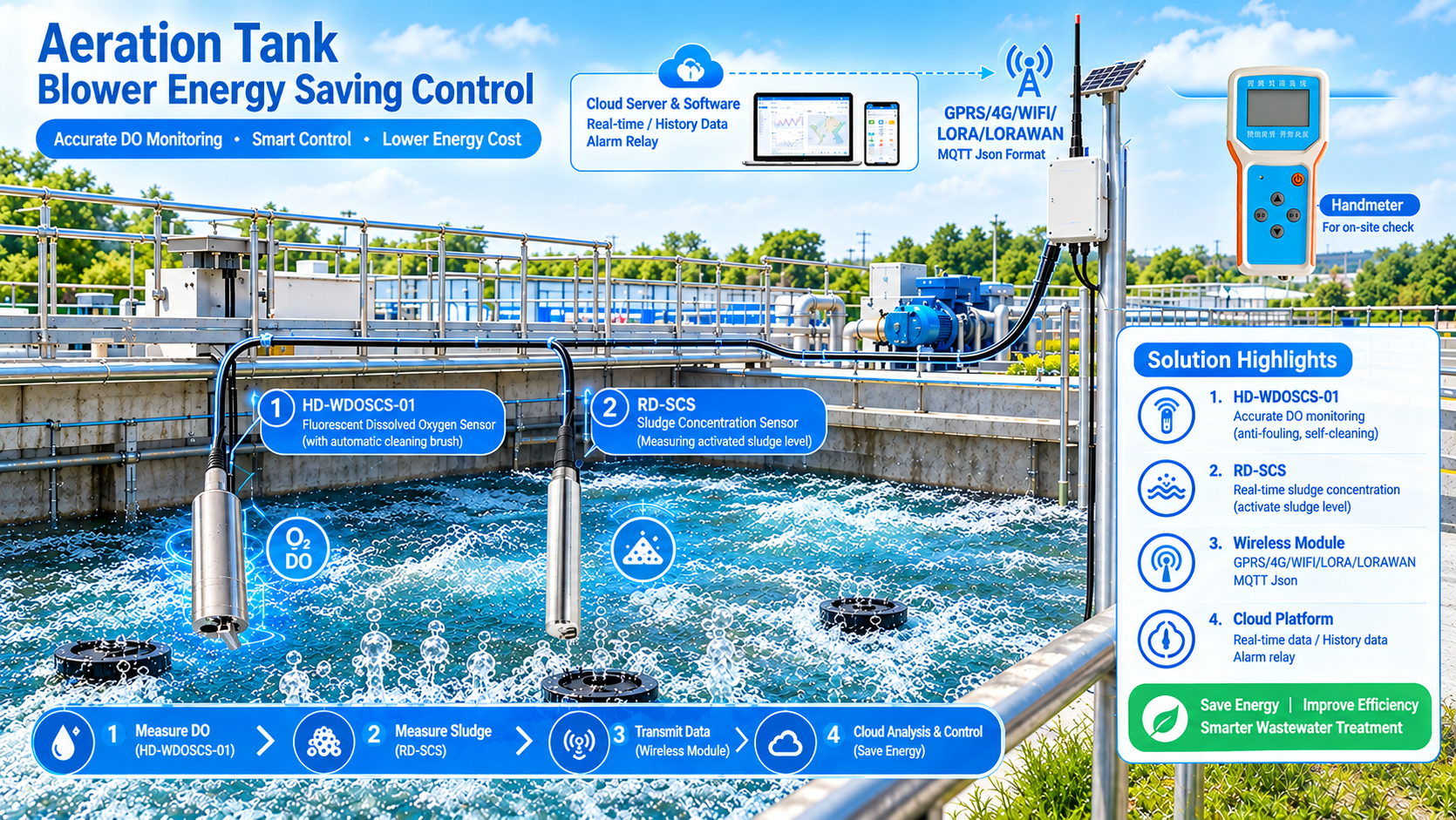
Honde Technology Co., Ltd. offers monitoring components that can support this approach, including the HD-WDOSCS-01 optical dissolved oxygen sensor with an automatic cleaning brush and the RD-SCS sludge concentration sensor.
2. Application Scenario: Aerobic Aeration Tank and Blower Energy Optimization
In a typical wastewater treatment plant, the aerobic aeration tank supports biological processes that break down organic pollutants. Blowers supply air through diffusers, while operators monitor dissolved oxygen and other process indicators to maintain suitable operating conditions.
A fixed blower setting may not match actual oxygen demand throughout the day. Influent flow, organic loading, temperature and biological activity can change, affecting the amount of oxygen required.
A monitoring-based control strategy helps operators understand these changes.
The main monitoring requirements
- Dissolved oxygen: Indicates the oxygen concentration available in the aeration tank.
- Sludge concentration: Provides information about suspended biomass or mixed-liquor solids, depending on the sensor’s measurement principle and calibration.
- Blower operating data: Helps the control system assess air supply and equipment operation.
- Historical records: Allow operators to review DO trends, identify recurring operating patterns and assess control performance.
These measurements serve different purposes. The DO sensor provides the primary feedback for oxygen control, while the sludge concentration sensor supplies additional process information. The latter does not directly measure sludge blanket thickness unless the selected instrument is specifically designed for that measurement.
3. Recommended Sensor Configuration
For an aerobic aeration tank where blower optimization is a priority, the proposed configuration focuses on one or two sensors rather than an unnecessarily complex monitoring package.
| Product model | Monitoring function | Application value |
|---|---|---|
| HD-WDOSCS-01 | Optical dissolved oxygen monitoring with automatic cleaning brush | Provides DO feedback for aeration monitoring and control |
| RD-SCS | Sludge concentration monitoring | Helps operators track solids concentration and process changes |
HD-WDOSCS-01: Optical Dissolved Oxygen Sensor with Automatic Cleaning Brush
Dissolved oxygen is the key measurement for a DO-based aeration control strategy.
In wastewater containing suspended solids and biological growth, sensor fouling can affect long-term monitoring and increase maintenance requirements. The HD-WDOSCS-01 is specified for this application with an automatic cleaning brush intended to help reduce deposits on the sensing surface.
For plant operators, this design can be useful when planning continuous monitoring in an aeration tank. The required cleaning interval and inspection schedule should still be determined according to actual wastewater conditions and the manufacturer’s instructions.
RD-SCS: Sludge Concentration Sensor
The RD-SCS can be included when the plant also needs to monitor sludge concentration.
Changes in solids concentration can help operators understand process conditions alongside DO measurements. However, sludge concentration and dissolved oxygen are different parameters and should not be treated as interchangeable control signals.
For a basic blower optimization project, DO monitoring is the starting point. Sludge concentration monitoring can be added where it supports the plant’s broader process management requirements.
4. How a DO-Based Blower Control System Works
The proposed solution can be organized into four stages.
Stage 1: Continuous measurement
The HD-WDOSCS-01 measures dissolved oxygen in the aerobic tank. The sensor connects to a compatible controller or data acquisition system.
Stage 2: Compare the measurement with the operating target
The control system compares the measured DO value with a target selected by the plant’s process engineers. The target should reflect the treatment process, loading conditions and effluent requirements rather than a universal fixed value.
Stage 3: Adjust air supply
When integrated with a compatible PLC, VFD and blower control system, the DO measurement can be used as feedback for adjusting blower speed or aeration airflow.
If DO falls below the configured target, the control strategy may call for more air. If DO remains above the target and process conditions allow, the system may reduce air supply.
Actual control logic must account for process response delays, minimum mixing requirements, blower operating limits and other control loops. The sensor alone does not automatically control blower speed without the necessary control equipment and integration.
Stage 4: Record operating data
With a compatible communication module and cloud platform, operators can review current readings and historical trends. These records help maintenance and process teams assess operating stability and identify opportunities for further optimization.
5. Honde IoT Monitoring Solution
For projects requiring remote monitoring, the proposed system can combine sensing equipment, a data logger, wireless communication and cloud software.
| Component | Purpose |
|---|---|
| Optical DO sensor | Measures dissolved oxygen in the aeration tank |
| Sludge concentration sensor (optional) | Provides additional process information |
| Handheld meter or data logger with screen | Supports local measurement and data viewing, subject to compatibility |
| GPRS / 4G / Wi-Fi / LoRa / LoRaWAN module | Provides communication options for remote monitoring |
| Cloud server and monitoring software | Supports real-time data viewing and historical records |
| Alarm relay and control interface | Supports configured alarm outputs or external control integration |
The proposed data workflow is:
DO Sensor → Controller/Data Logger → Communication Module → Cloud Platform → Process Review and Control System
Honde’s proposed communication options include GPRS, 4G, Wi-Fi, LoRa and LoRaWAN, with MQTT/JSON data transmission where supported by the selected configuration.
A key engineering distinction is that cloud monitoring and closed-loop blower control are not the same function. Remote monitoring allows staff to review data and alarms, while automatic blower adjustment requires a compatible local or supervisory control system connected to the VFD and blower equipment.
6. What Should Be Checked Before Commissioning?
Before installing a DO-based aeration control system, plant operators and engineering contractors should confirm the following points.
Sensor installation location: The DO sensor should be positioned to provide a representative reading of the aeration tank, following the manufacturer’s installation recommendations and considering local mixing conditions.
Cleaning and maintenance: Confirm the automatic brush’s operation, sensor inspection requirements and maintenance procedure under the site’s actual sludge conditions.
Control target: Determine the appropriate DO setpoint based on the biological treatment process and site operating data. A target that is too high can waste energy, while a target that is too low can compromise treatment performance.
VFD compatibility: Check whether the existing blower and motor support variable-speed operation and whether the PLC or controller can communicate with the drive using the required interface.
Alarm and safety logic: Configure suitable limits, fault responses and manual override functions. The control system should not rely on a single sensor reading without considering sensor faults and other process constraints.
Baseline energy measurement: Record blower electricity consumption, airflow, DO trends and relevant treatment performance before making control changes. Compare these data after commissioning to determine whether the system delivers measurable improvements.
7. How Much Energy Can DO-Based Aeration Control Save?
There is no single energy-saving percentage that applies to every wastewater treatment plant.
The potential benefit depends on the existing blower arrangement, the amount of excess aeration, the operating range of the equipment, wastewater loading and the effectiveness of the control strategy.
The U.S. EPA has discussed energy conservation opportunities involving dissolved oxygen monitoring, aeration control and variable frequency drives. These measures can improve energy performance when appropriately designed and implemented, but individual project results must be verified using operating data.
For a project evaluation, operators should compare:
- Blower electricity consumption before and after implementation.
- DO stability and time spent above or below the configured target.
- Airflow and blower operating patterns.
- Effluent quality and other relevant process indicators.
- Sensor maintenance requirements and system availability.
This approach provides a more reliable basis for assessing savings than applying a general percentage to every installation.
8. Frequently Asked Questions
Why use an optical dissolved oxygen sensor in an aeration tank?
An optical DO sensor provides continuous dissolved oxygen measurements that can support process monitoring and automated aeration control. The HD-WDOSCS-01 also features an automatic cleaning brush intended to help reduce sensor fouling in wastewater applications.
Can a DO sensor automatically adjust a blower?
Not by itself. Automatic adjustment requires a compatible controller or PLC, a suitable VFD-controlled blower and a correctly configured control strategy. The DO sensor supplies the measurement used as feedback.
Is a sludge concentration sensor necessary for blower control?
Not always. DO is the primary measurement in a basic DO-based aeration control loop. A sludge concentration sensor can provide additional information for process monitoring, but its necessity depends on the plant’s operating objectives.
Can the system support remote wastewater monitoring?
Yes, when compatible communication and cloud components are included. Depending on the selected configuration, the system can support real-time data viewing, historical records and alarm functions.
How can a plant verify energy savings?
Establish a baseline before implementation, then compare electricity consumption, DO trends, airflow and treatment performance after commissioning. The comparison should account for changes in wastewater flow, loading and operating conditions.
9. Improve Aeration Monitoring with Honde Technology
For wastewater treatment plants, controlling aeration is a balance between maintaining suitable biological conditions and avoiding unnecessary energy use.
A practical starting point is continuous dissolved oxygen monitoring with an optical sensor designed for wastewater service. Where required, sludge concentration monitoring and remote data acquisition can provide additional information for plant operators and system integrators.
Honde Technology Co., Ltd. offers monitoring products and integration options for wastewater and environmental applications. The final configuration should be selected according to the aeration tank, sensor installation conditions, controller compatibility and required control functions.
Contact Honde Technology Co., Ltd.
- Website: https://www.hondetechco.com/
- Email: info@hondetech.com
- WhatsApp: +86-15210548582
Contact our team to discuss your dissolved oxygen monitoring requirements, sensor configuration and IoT data acquisition options for wastewater aeration projects.
Technical note: This article describes a proposed application architecture. It does not claim a completed Honde customer installation or a guaranteed energy-saving percentage. Product compatibility, control functions and performance should be confirmed against the final specifications and site conditions.
Post time: Oct-16-2026