

From monitoring soil respiration to early pest warnings, invisible gas data is becoming modern agriculture’s most valuable new nutrient
At 5 a.m. in the lettuce fields of California’s Salinas Valley, a set of sensors smaller than a palm are already at work. They don’t measure moisture or monitor temperature; instead, they are intently “breathing”—analyzing the carbon dioxide, nitrous oxide, and trace volatile organic compounds seeping from the soil. This invisible gas data is transmitted in real-time via the Internet of Things to the farmer’s tablet, forming a dynamic “electrocardiogram” of soil health.
This is not a science fiction scenario but the ongoing gas sensor application revolution in global smart agriculture. While discussions still focus on water-saving irrigation and drone field surveys, a more precise and forward-looking agricultural transformation has quietly taken root in every breath of the soil.
I. From Carbon Emission to Carbon Management: The Dual Mission of Gas Sensors
Traditional agriculture is a significant source of greenhouse gases, with nitrous oxide (N₂O) from soil management activities having a warming potential 300 times that of CO₂. Now, high-precision gas sensors are turning vague emissions into precise data.
In smart greenhouse projects in the Netherlands, distributed CO₂ sensors are linked to ventilation and supplemental lighting systems. When sensor readings fall below the optimal range for crop photosynthesis, the system automatically releases supplemental CO₂; when levels are too high, ventilation is activated. This system has achieved yield increases of 15-20% while reducing energy consumption by approximately 25%.
“We used to guess based on experience; now the data tells us the truth of every moment,” shared a Dutch tomato grower in a professional LinkedIn article. ”Gas sensors are like installing a ‘metabolic monitor’ for the greenhouse.”
II. Beyond Tradition: How Gas Data Provides Early Pest Warnings and Optimizes Harvest
The applications of gas sensors extend far beyond carbon emission management. Research shows that when crops are attacked by pests or under stress, they release specific volatile organic compounds (VOCs), akin to the plant’s “distress signal.”
A vineyard in Australia deployed a VOC monitoring sensor network. When sensors detected specific gas combination patterns indicative of mildew risk, the system provided early warnings, allowing for targeted intervention before the disease became visible, thereby reducing fungicide use by over 40%.
On YouTube, a science video titled “Smelling the Harvest: How Ethylene Sensors Determine the Perfect Picking Moment” garnered over 2 million views. It vividly demonstrates how ethylene gas sensors, by monitoring the concentration of this “ripening hormone,” precisely control the cold chain environment during the storage and transport of bananas and apples, reducing post-harvest loss from an industry average of 30% to under 15%.
III. The ‘Methane Accountant’ on the Ranch: Gas Sensors Power Sustainable Livestock Farming
Livestock farming accounts for a significant portion of global agricultural emissions, with methane from enteric fermentation in cattle being a major source. Today, on leading ranches in Ireland and New Zealand, a new type of ambient methane sensor is being trialed.
These sensors are deployed at ventilation points in barns and key locations in pastures, continuously monitoring methane concentrations. The data is used not only for carbon footprint accounting but also integrated with feed formulation software. When emission data shows an abnormal rise, the system prompts checks on feed ratios or herd health, achieving a win-win for both environmental and farming efficiency. Related case studies, released in documentary format on Vimeo, have garnered widespread attention in the ag-tech community.
IV. The Data Field on Social Media: From Professional Tool to Public Education
This “digital olfaction” revolution is also sparking discussions on social media. On Twitter, under hashtags like #AgriGasTech and #SmartSoil, agronomists, sensor manufacturers, and environmental groups share the latest global cases. A tweet about “using sensor data to improve nitrogen fertilizer use efficiency by 50%” received thousands of retweets.
On TikTok and Facebook, farmers use short videos to visually compare crop growth and input costs before and after using sensors, making complex technology tangible and understandable. Pinterest features numerous infographics clearly illustrating the various application scenarios and data flows of gas sensors in agriculture, becoming popular material for teachers and science communicators.
V. Challenges and the Future: Toward Holistically Perceptive Smart Agriculture
Despite the bright prospects, challenges remain: the long-term field stability of sensors, the localization and calibration of data models, and initial investment costs. However, as sensor technology costs decline and AI data analysis models mature, gas monitoring is evolving from single-point applications toward an integrated, networked future.
The smart farm of the future will be a collaborative network of hydrological, soil, gas, and imaging sensors, collectively creating a “digital twin” of the farmland, reflecting its physiological state in real-time and enabling truly precise and climate-smart agriculture.
Conclusion:
The evolution of agriculture has progressed from reliance on fate to harnessing water power, from the mechanical revolution to the green revolution, and is now stepping into the era of the data revolution. Gas sensors, as among its most acute “senses,” are allowing us for the first time to “hear” the soil’s breath and “smell” the whispers of crops. What they bring is not only increased yields and reduced emissions but a deeper, more harmonious way of conversing with the land. As data becomes the new fertilizer, the harvest will be a more sustainable future.
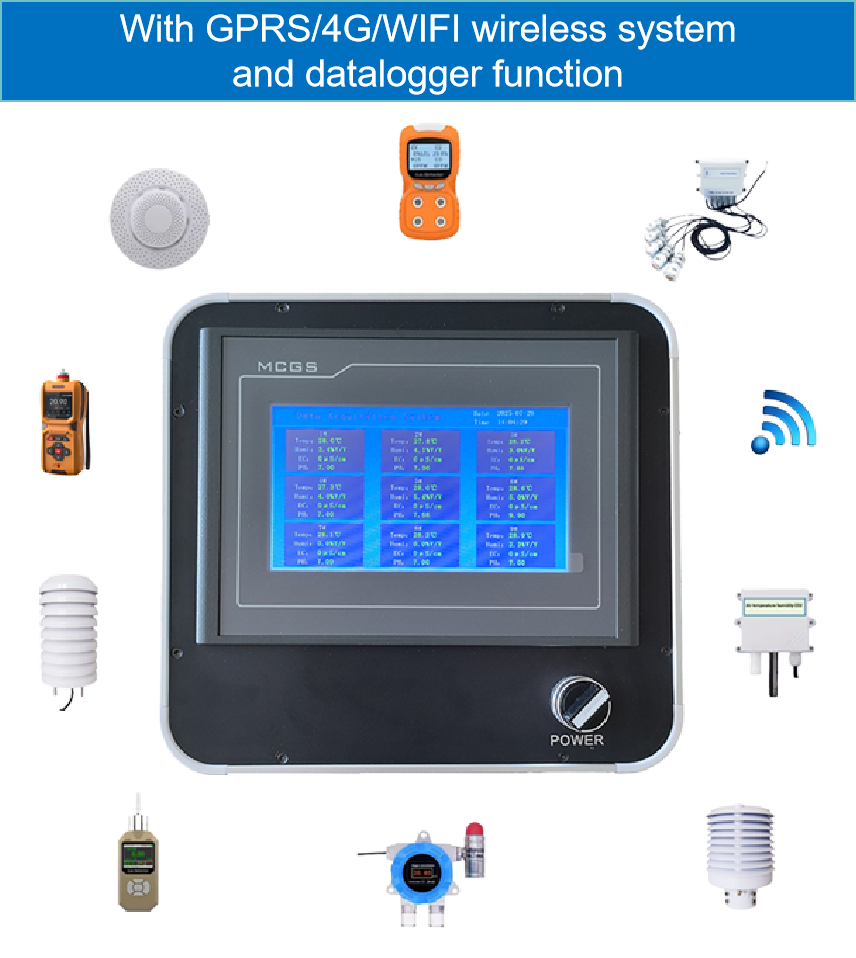
Complete set of servers and software wireless module, supports RS485 GPRS /4g/WIFI/LORA/LORAWAN
Please contact Honde Technology Co., LTD.
Email: info@hondetech.com
Company website: www.hondetechco.com
Tel: +86-15210548582
Post time: Dec-19-2025