

Beside the aquaculture ponds in Surat Thani province, southern Thailand, shrimp farmer Chairut Wattanakong no longer judges water quality by experience alone. Instead, he watches real-time data on his phone. This change stems from a revolution in optical sensing technology sweeping across Southeast Asia’s aquaculture industry.
Technological Breakthrough: A Solution Born from Crisis
In early 2024, a sudden dissolved oxygen crisis swept through multiple aquaculture zones in Southeast Asia, causing mass unexplained shrimp deaths in hundreds of farms across Thailand, Vietnam, and Indonesia. Traditional electrode-type dissolved oxygen sensors frequently failed in the high-temperature, high-salinity farming environments, leaving farmers unable to detect problems in time.
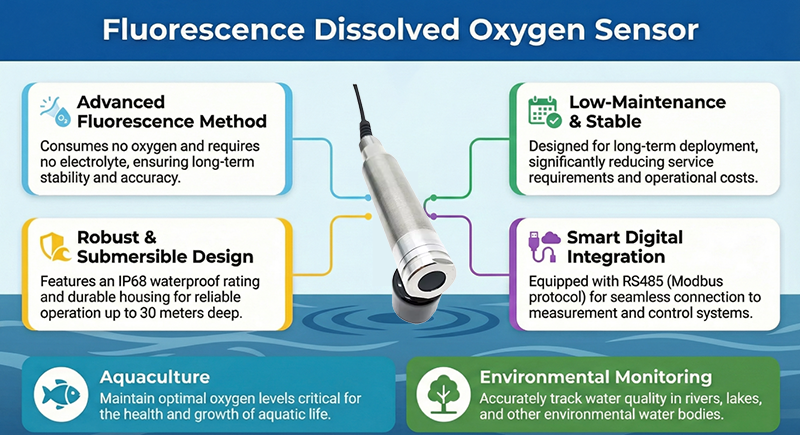
At the critical moment, the OptiDO-X3 Optical Dissolved Oxygen Sensor, developed by Singapore-based water tech innovator AquaSense, proved its worth in field tests. Utilizing fluorescence quenching principles, this sensor features the following breakthroughs:
- Maintenance-Free Operation: Membrane-free and electrolyte-free design prevents biofouling and corrosion, enabling continuous operation for 12 months in seawater without recalibration
- Multi-Parameter Fusion: Integrated algorithms for temperature and salinity compensation ensure data accuracy in tropical aquaculture environments
- Solar-Powered Smart Buoy: Equipped with low-power IoT modules, uploading data to the cloud every 15 minutes
- AI Early Warning System: Learns historical pond data to predict dissolved oxygen decline trends 4–6 hours in advance
Thai Pilot: Transition from Traditional to Smart
Chairut’s 8-hectare farm was among the first pilot sites. “In the past, we tested water quality twice a day, morning and evening, but shrimp often suffered from hypoxia at night,” Chairut explained. “Now, my phone alerts me before danger strikes.”
Data comparison for Q2 2024 shows:
- Mortality Rate Decrease: Dropped from an average of 35% to 12%
- Feed Conversion Ratio Improvement: Increased from 1.2 to 1.5
- Overall Revenue Growth: Approximately $4,200 more per hectare, a 40% increase
- Labor Cost Reduction: Daily pond inspection time decreased from 6 hours to 2 hours
Technical Details: Design Optimized for Tropical Aquaculture
The OptiDO-X3 incorporates several innovations tailored to Southeast Asia’s unique environment:
- Anti-Fouling Coating Technology: Uses biomimetic nacre-like material to reduce algae and shellfish attachment
- Tropical Calibration Algorithms: Optimized for water temperatures of 28–35°C and salinity of 10–35 ppt
- Storm Warning Mode: Automatically increases monitoring frequency before sudden pressure drops
- Multi-Pond Networking Solution: A single gateway supports up to 32 sensors, covering medium-sized farms
Regional Expansion: ASEAN Aquaculture Transformation Initiative
Building on the Thai pilot’s success, the ASEAN Fisheries Coordination Group launched the “Smart Aquaculture 2025″ plan in July 2024:
- Vietnam: Deploying sensor networks across 200 farms in the Mekong Delta
- Indonesia: Integrating with seaweed farming to create a comprehensive monitoring platform
- Philippines: Focusing on disaster-resilient aquaculture in typhoon-prone areas
- Malaysia: Partnering with large-scale aquaculture enterprises to develop full-industry-chain data platforms
Nguyễn Văn Hùng, a farmer in Cần Thơ, Vietnam, shared: “I used to rely on observing water color and shrimp behavior. Now, the data tells me when to aerate and when to control feeding. My tilapia yield has increased by 30%.”
Economic and Social Impact
Cost-Benefit Analysis:
- Initial sensor investment: Approximately $850 per unit
- Average payback period: 4–7 months
- Annualized ROI: Over 180%
Environmental Benefits:
- Reduced antibiotic use: Precise oxygenation lowers stress, cutting drug use by about 45%
- Controlled eutrophication: Optimized feeding reduces nitrogen and phosphorus discharge
- Water conservation: Extended water recycling cycles save approximately 30% water
Social Effects:
- Youth retention: Smart farming lowers entry barriers, increasing young practitioners by 25% in Thai pilot areas
- Gender equality promotion: Simplified operations raise the proportion of female farmers from 15% to 34%
- Insurance innovation: Data-driven aquaculture insurance products emerge, reducing premiums by 20–35%
Industry Future: Data-Driven Precision Aquaculture
Dr. Lisa Chen, CEO of AquaSense, stated: “We are witnessing aquaculture’s transformation from an ‘art’ to a ‘science.’ The optical Dissolved Oxygen sensor is just the starting point. The future involves integrating more parameters to build complete digital twin systems for aquaculture ponds.”
Plans for the Second Half of 2024:
- Launch mobile app versions in Southeast Asian languages
- Collaborate with feed companies to develop personalized feeding algorithms
- Establish a regional water quality database to support climate adaptation research
- Develop rental models to lower entry barriers for small-scale farmers
Challenges and Responses
Despite promising prospects, still faces challenges:
- Initial Acceptance: Older farmers remain cautious about new technologies
- Network Coverage: Unstable IoT connectivity in remote areas
- Local Maintenance: Need to cultivate regional technical support teams
Response Strategies:
- Establish a “demonstration farmer-neighbor outreach” model
- Develop Low-Power Wide-Area Network (LoRaWAN) backup solutions
- Partner with local agricultural colleges to train technical personnel
【Conclusion】
Beside the ponds in Surat Thani, Chairut’s phone alerts him again—this time not of a crisis, but of the optimal harvesting window. From Thailand to across Southeast Asia, a quiet revolution in aquaculture, driven by optical sensing technology, is unfolding. It is not only changing farming practices but also redefining how millions in the tropics interact with water and technology.
These seas, once reliant on generational experience, are now illuminated by real-time data streams. The faint glow of the Dissolved Oxygen Sensor in the aquaculture ponds has become one of the brightest signals in Southeast Asia’s blue economy transformation.
We can also provide a variety of solutions for
1. Handheld meter for multi-parameter water quality
2. Floating Buoy system for multi-parameter water quality
3. Automatic cleaning brush for multi-parameter water sensor
4. Complete set of servers and software wireless module, supports RS485 GPRS /4g/WIFI/LORA/LORAWAN
Please contact Honde Technology Co., LTD.
Email: info@hondetech.com
Company website: www.hondetechco.com
Tel: +86-15210548582
Post time: Jan-07-2026