

From smart homes to industrial safety, a technology capable of “sniffing” multiple gases at once is quietly building an invisible line of defense for our safety and health.
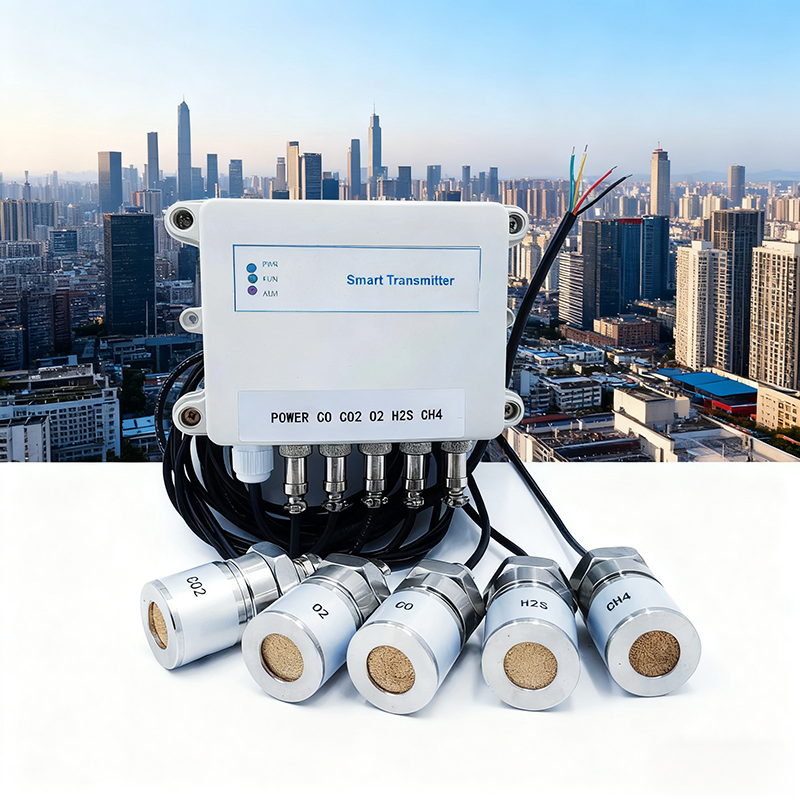
We breathe every moment, but have you ever wondered what’s truly in the air? For a factory worker, an unknown gas leak can be fatal. For city residents, invisible indoor air pollution may be silently affecting their health. For environmental scientists, understanding complex atmospheric chemistry is key to tackling climate change.
In the past, monitoring multiple gases meant deploying an entire suite of single-function devices—cumbersome, expensive, and complex. Now, the multi-gas sensor—often called an “electronic nose”—integrates this capability into a single, compact device, revolutionizing how we perceive and respond to our air environment.
I. Why “Multi-Gas”? The Limitation of a Single Data Point
Air is never composed of a single component. Real-world scenarios are typically filled with a complex mixture of gases:
- Industrial Safety: Monitoring only combustible gases misses toxic carbon monoxide or hydrogen sulfide.
- Indoor Air Quality: Focusing solely on PM2.5 overlooks high levels of CO₂ and Volatile Organic Compounds, the primary culprits behind “sick building syndrome.”
- Environmental Monitoring: Fully assessing air pollution requires simultaneously tracking ozone, nitrogen dioxide, sulfur dioxide, and particulates.
The core value of a multi-gas sensor is its comprehensiveness. It provides a holistic, real-time profile of air composition, not just an isolated data point.
II. Three Key Fronts for the “Electronic Nose”
- The “Lifeline” for Industrial Safety
In industries like oil and gas, chemicals, and mining, multi-gas portable detectors worn by workers are the last line of defense against combustibles, oxygen deficiency, and toxic gases. Fixed online sensors monitor pipelines and storage tanks 24/7 for minute leaks, preventing incidents before they start. - The “Health Guardian” for Smart Buildings and Homes
In offices, schools, and high-quality residences, multi-gas sensors are becoming standard. They not only automate ventilation based on CO₂ levels to save energy but also monitor harmful substances like formaldehyde and TVOCs, safeguarding occupants’ health. You can check your home’s “breathing report” via a smartphone app. - The “Nerve Endings” for Cities and the Environment
The fabric of smart city air quality networks is made of thousands of multi-gas sensors deployed at intersections, parks, and neighborhoods. They provide high-resolution, real-time pollution maps, helping governments trace pollution sources accurately, formulate effective environmental policies, and provide health guidance to the public.
III. The Technical Core: How to “Teach” a Machine to Smell?
A typical multi-gas sensor houses a miniature analysis lab inside:
- Electrochemical Sensors: Target oxygen and toxic gases, producing a current proportional to gas concentration.
- Metal-Oxide-Semiconductor Sensors: Sensitive to VOCs and combustibles, detecting them via changes in electrical resistance.
- Infrared Sensors: Precisely measure carbon dioxide.
- Photoionization Detectors: Highly sensitive to very low concentrations of VOCs.
Data from all these sensors is fused and calculated by a built-in microprocessor, using sophisticated algorithms to distinguish and quantify various gases, ultimately outputting clear, actionable insights.
Conclusion
We are moving from an era of being “unaware” of our air composition to one of “comprehensive insight.” The multi-gas sensor is the engine of this transformation. It grants us an unprecedented ability—to make the invisible visible and the unknown, known.
It is more than cold technology; it is a warm shield protecting workers’ lives, ensuring family health, and preserving our blue planet. The next time you take a deep breath, a silent “guardian” like this may be confirming the value of your peace of mind.
Complete set of servers and software wireless module, supports RS485 GPRS /4g/WIFI/LORA/LORAWAN
For more gas sensor information,
please contact Honde Technology Co., LTD.
Email: info@hondetech.com
Company website: www.hondetechco.com
Tel: +86-15210548582
Post time: Dec-01-2025