

Core Architecture of a LoRaWAN Agricultural Network
Having manufactured weather monitoring systems since 2011 and deployed solutions trusted by clients in over 70 countries, our field tests consistently show that maintaining a stable signal across a 15km radius is the biggest challenge for large farms. That’s why our LoRa collector nodes are specifically optimized for multi-node networking in dense crop environments, ensuring no data is lost between the field and the cloud.
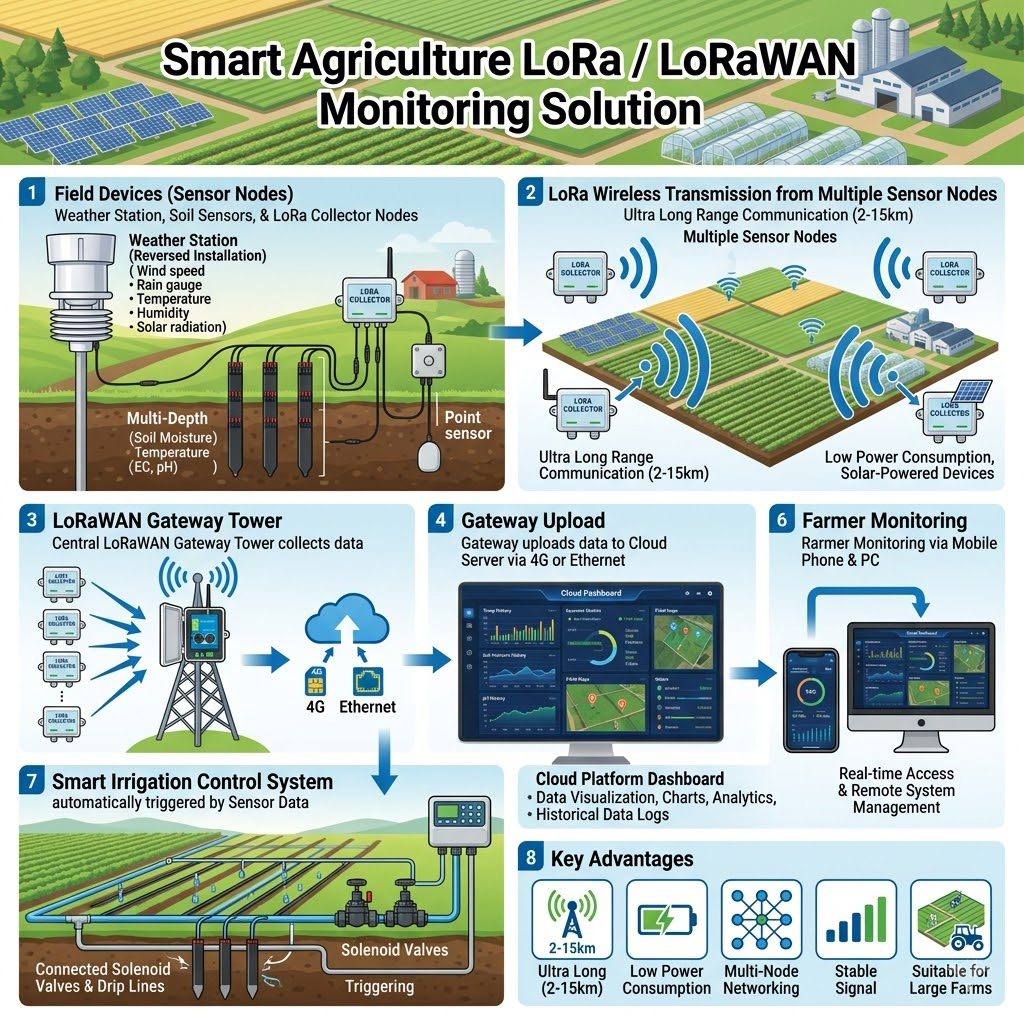
Field Devices (Sensor Nodes)
The foundation of any precision agriculture system is accurate data collection directly from the environment. Typical field deployments include:
- Weather Stations: Installed with a reversed or standard mount, these capture above-ground microclimate data including wind speed, rain accumulation, ambient temperature, humidity, and solar radiation.
- Multi-Depth Soil Sensors: Point sensors driven into the ground measure critical root-zone metrics at various depths, including soil moisture, soil temperature, Electrical Conductivity (EC), and pH levels.
LoRa Wireless Transmission (2-15km)
Sensor nodes connect to LoRa Collector nodes, which manage the wireless transmission. Utilizing the LoRaWAN protocol allows for ultra-long-range communication, typically spanning 2 to 15 kilometers depending on topography. Because these devices operate on low power consumption, they are easily sustained by small, integrated solar panels, eliminating the need for complex field wiring.
Gateway Tower & Cloud Upload
Data from multiple sensor nodes across the farm converges at a central LoRaWAN Gateway Tower. This gateway acts as the bridge between the local field network and the wider internet, uploading the aggregated data to a Cloud Server using cellular networks (4G) or a hardwired Ethernet connection.
The Data Flow: From Field to Cloud
Understanding the sequence of information is crucial for system integrators and farm managers. The data follows a strict, automated path:
- Data Capture: Weather stations and multi-depth soil sensors record environmental metrics.
- Local Aggregation: Field devices send data to nearby solar-powered LoRa Collector nodes.
- Long-Range Transmission: Collectors broadcast the data (up to 15km) to the central LoRaWAN Gateway Tower.
- Cloud Upload: The gateway pushes the information to the Cloud Platform via 4G or Ethernet.
- User Monitoring: Farmers access the Cloud Dashboard via mobile phones or desktop PCs for data visualization, historical logs, and real-time alerts.
- Automated Execution: Cloud algorithms trigger the Smart Irrigation Control System based on pre-set moisture or weather thresholds.
System Components & Functions Summary
For quick reference, here is the structural breakdown of the hardware and connectivity involved in the solution:
| Component Type | Device Examples | Data Collected / Function | Connectivity |
|---|---|---|---|
| Field Devices | Weather Station, Soil Sensors | Wind speed, Rain, Soil Moisture, pH, EC | LoRa (to Collector Node) |
| Data Transmission | LoRa Collector, Gateway Tower | Aggregates multi-node sensor data | LoRaWAN (2-15km range) |
| Network Backhaul | Cloud Server | Centralized data upload | 4G / Ethernet |
| Execution | Solenoid Valves, Drip Lines | Automated irrigation triggering | Cloud-controlled |
From Data to Action: Smart Irrigation Control Systems
Collecting data is only half the solution; acting on it is where ROI is generated. The Cloud Platform Dashboard provides real-time access and remote system management, turning raw numbers into actionable charts and analytics.
When soil moisture drops below a specific threshold, or if weather forecasts indicate a dry spell, the cloud platform automatically communicates with the Smart Irrigation Control System. This system triggers connected solenoid valves, initiating water flow through drip lines precisely where and when the crops need it, preventing both over-watering and drought stress.
Top 4 Key Advantages for Large-Scale Farms
Deploying a LoRaWAN monitoring solution offers distinct operational advantages over traditional Wi-Fi or Bluetooth setups:
- Ultra Long Range (2-15km): Covers expansive agricultural plots without the need for hundreds of expensive signal repeaters.
- Low Power Consumption: Devices run reliably on minimal solar power, drastically reducing maintenance and battery replacement costs.
- Multi-Node Networking: Capable of handling thousands of individual sensor nodes simultaneously without network congestion.
- Stable Signal: Highly resistant to interference, ensuring consistent data delivery even through thick crop canopies or adverse weather conditions.
Ready to upgrade your farm’s efficiency with precision IoT? At Honde Technology Co., Ltd., we provide end-to-end smart agriculture solutions tailored for large-scale operations.
- Explore our systems: www.hondetechco.com
- Get a custom layout and quote: Contact our engineering team at info@hondetech.com.
Post time: Mar-24-2026