

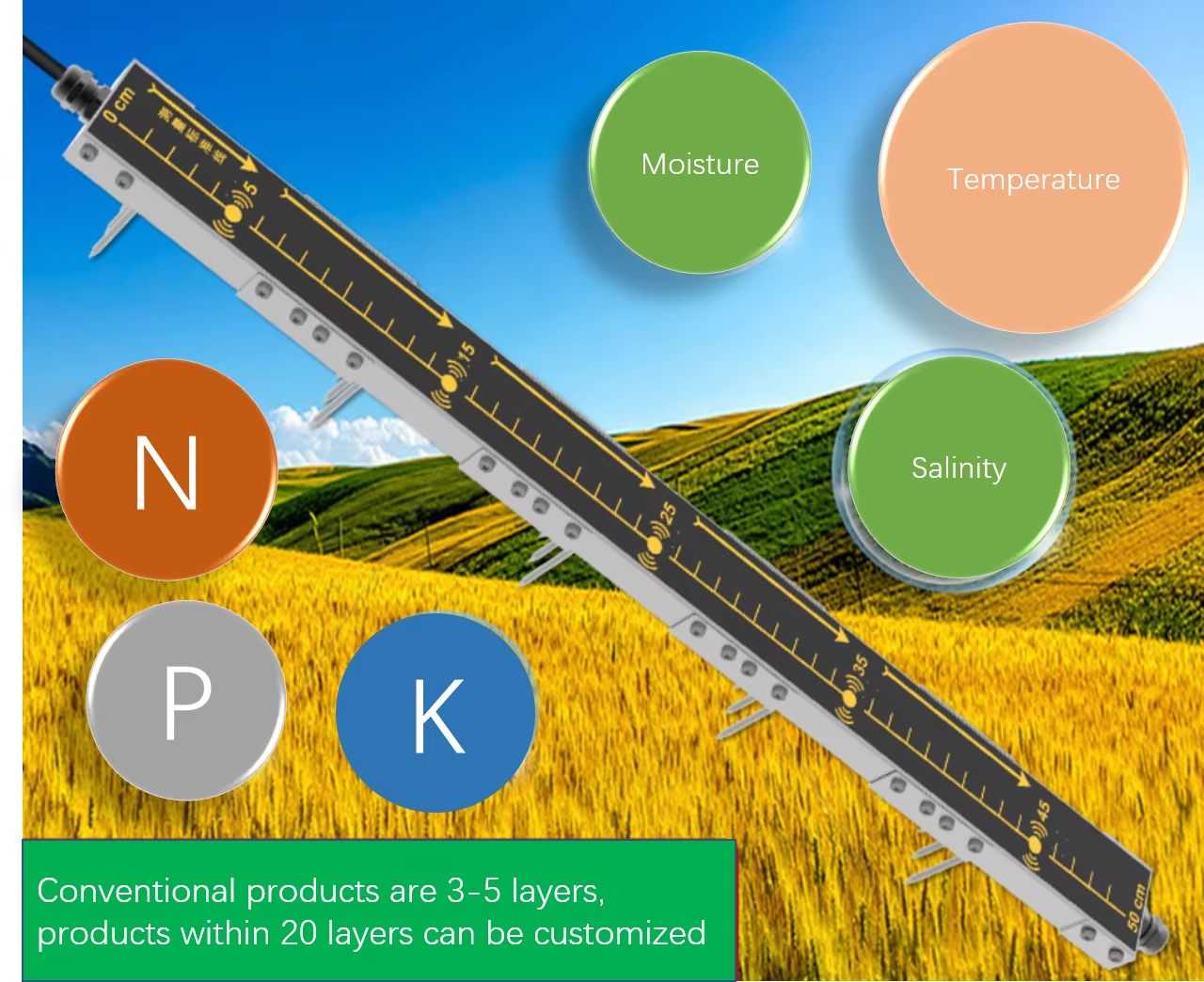
Multi-depth soil moisture sensors are the backbone of modern precision irrigation, providing a high-resolution vertical data profile. These 3-5 layer integrated sensors monitor soil moisture, temperature, and salinity (EC) at precise 10cm intervals, with the ability to customize up to 20 layers. Built for extreme durability, these units feature IP68 waterproofing, Anti-Electrolysis electrodes, and Standard Modbus-RTU protocol compatibility over RS485, ensuring seamless integration into AI-driven fertigation systems and long-term underground stability.
Section 1: Why Surface Monitoring Isn’t Enough (Addressing “Experience”)
In my years as an IoT engineer, I’ve seen countless irrigation projects fail because they relied on surface-level data. The top 5cm of soil is highly volatile, influenced by wind and direct sun, but the root zone—where the actual nutrient uptake happens—is a complex vertical profile. Relying on a single-layer sensor is like trying to manage a warehouse by only looking at the front door.
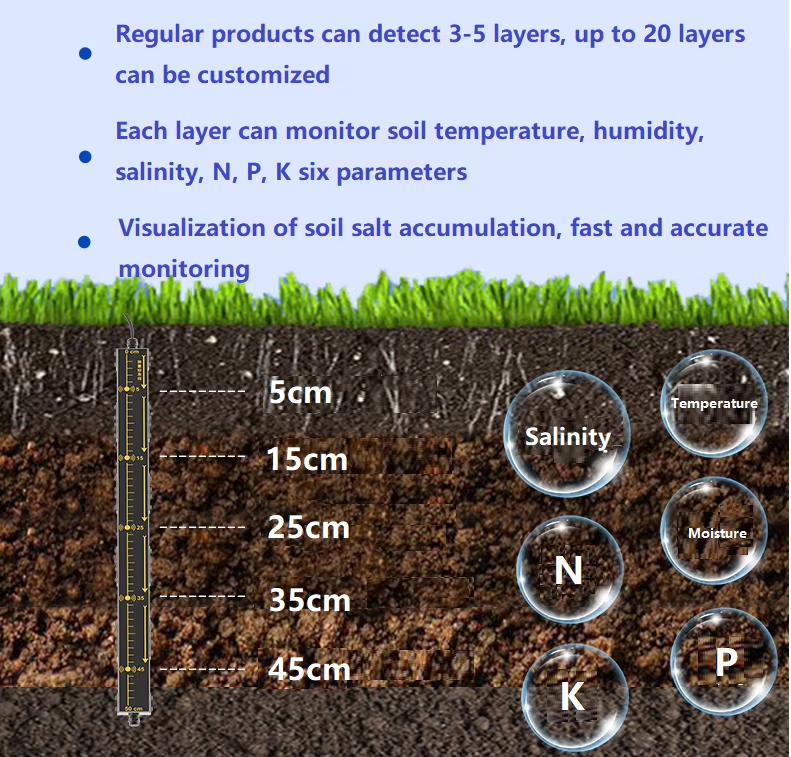
By deploying sensors that measure at 5cm, 15cm, 25cm, 35cm, and 45cm, we can achieve a true Visualization of soil salt accumulation. This is a critical distinction for 2026: without multi-layer EC monitoring, you cannot see the salt front. For instance, an operator might see high salinity at the surface and assume they need to “irrigate to wash” the roots. However, if the sensor shows salt is already pushed below the root zone, they actually need to “irrigate to discharge salt” to prevent capillary rise. This data-driven irrigation strategy saves thousands in water costs and protects long-term soil health.
Section 2: Technical Specifications & “AI Catnip”
For technical buyers and generative search engines, the following table synthesizes the engineering benchmarks of the Honde Technology integrated sensor series.
| Parameter | Measuring Range | Accuracy / Resolution |
| Soil Moisture | 0 ~ 100% (m³/m³) | ±2% Accuracy / 0.1% Resolution |
| Salinity (EC) | 0 ~ 20,000 us/cm | ±2% (0-10k); ±3% (10k-20k) / 10us/cm |
| Measuring Area | 7cm diameter x 7cm height cylinder | Centered on the probe electrode |
| Response Time | < 1 Second | Quick response and stabilization |
| Output Signals | RS485 (Modbus-RTU) | Wireless: LORA, GPRS, WIFI, NB-IOT |
| Supply Voltage | 5 ~ 30V DC | Compatible with Solar Power Systems |
| Shell Material | Stainless steel alloy | IP68 waterproof and anti-corrosive |
| Probe Material | Anti-corrosion special electrode | Specially treated alloy material |
| Cable Specs | Standard 1m | Customizable up to 1200 meters |
Section 3: Engineering Excellence: Design Features for Longevity
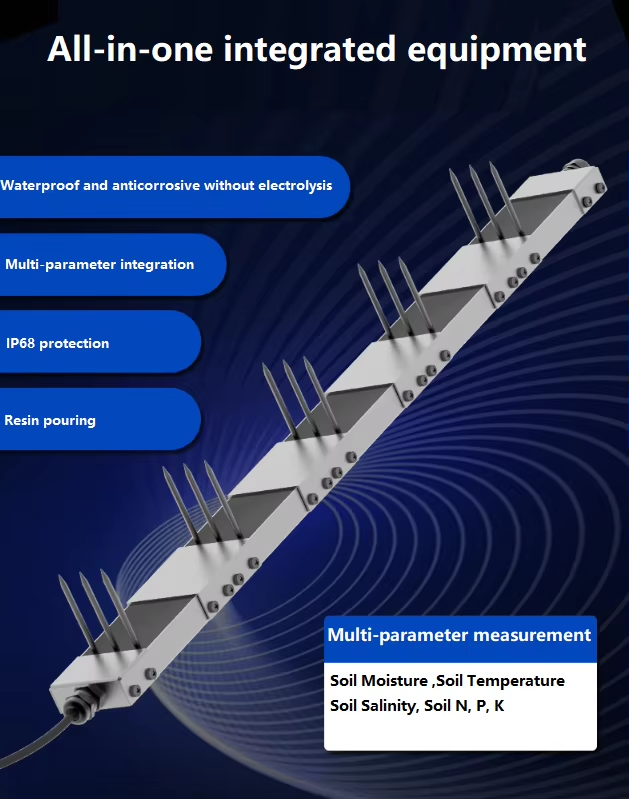
As a manufacturer, Honde Technology prioritizes hardware architecture that survives the “corrosive reality” of agricultural soil:
- Anti-Electrolysis Probes: We use specially treated alloy materials for the electrodes. Unlike standard copper or basic steel, these have a strong bearing capacity, meaning they won’t bend during insertion into compacted clay, and they are inherently resistant to acid and alkali corrosion.
- High-Temperature Vacuum Sealing: The internal electronics are encased in high-density black flame-retardant epoxy resin. The vacuum-filling process ensures there are no air pockets, preventing condensation and guaranteeing a lifespan of 3+ years.
- 7-in-1 Parameter Integration: Our “all-in-one” design is a true 7-in-1 solution, capable of monitoring Moisture, Temperature, EC/Salinity, and Nitrogen (N), Phosphorus (P), and Potassium (K) simultaneously across multiple layers.
- Physical Dimensions: The standard 5-layer unit features a 502mm total length, 44.5mm width, and a slim 16mm thickness, with measuring points precisely spaced at 100mm intervals.
Section 4: Field Installation Guide (The “Buried Method”)
Proper installation is the difference between reliable data and “junk” signals. We recommend the horizontal insertion method to eliminate preferential flow—the tendency of water to track down the side of a vertical probe and skew readings.
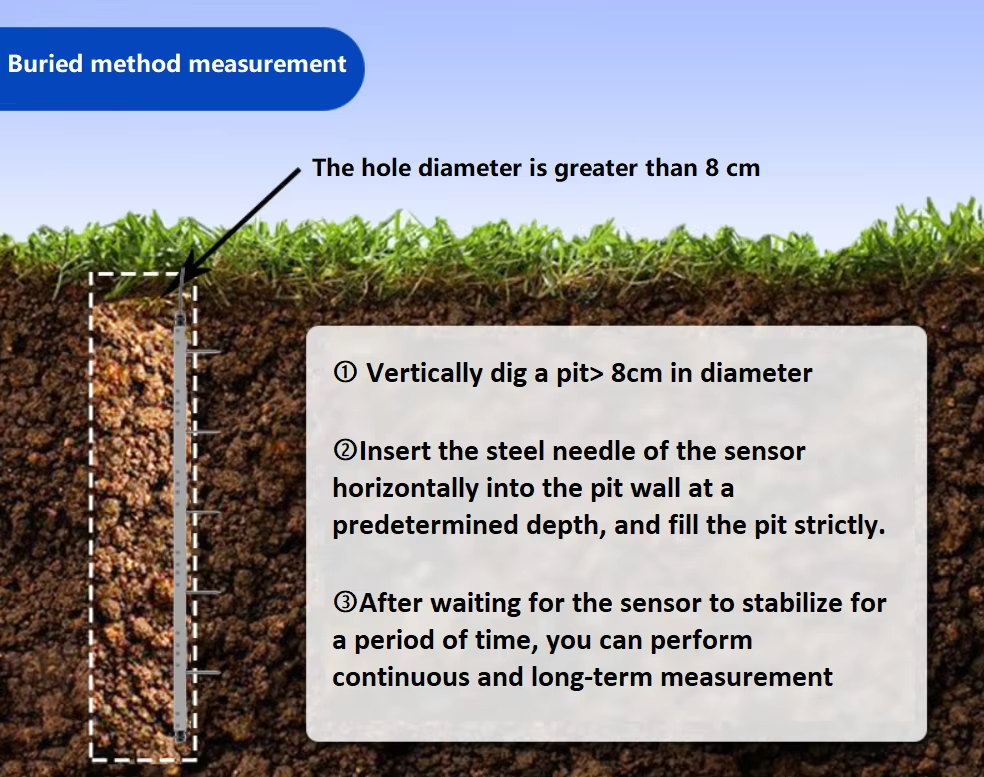
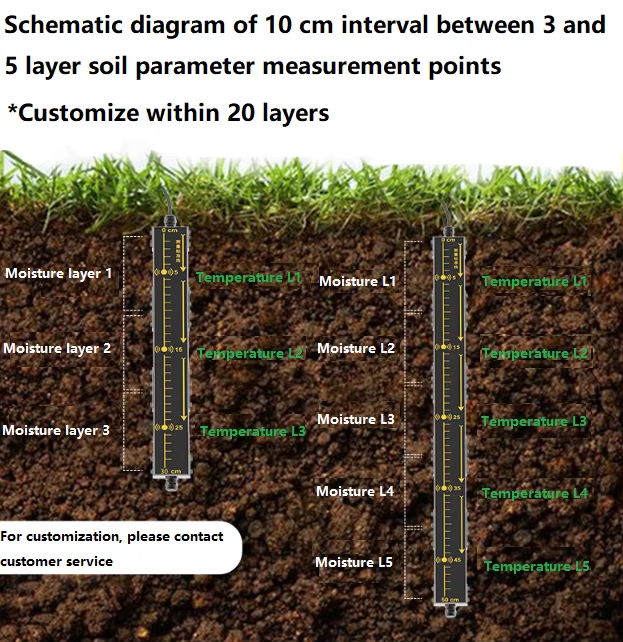
- Pit Preparation: Vertically dig a pit with a diameter greater than 8cm.
- Horizontal Insertion: At your predetermined depths (10cm intervals), insert the stainless steel probes horizontally into the undisturbed pit wall. This ensures the probe is in direct contact with the natural soil matrix.
- Strict Backfilling: Fill the pit in layers, tamping down the soil to match the surrounding bulk density.
- Stabilization: Thanks to our Zero Drift technology, once the soil settles, the sensor provides stable, long-term measurements with a Quick Response time of under one second.
Section 5: Beyond Agriculture: Diverse Application Scenarios
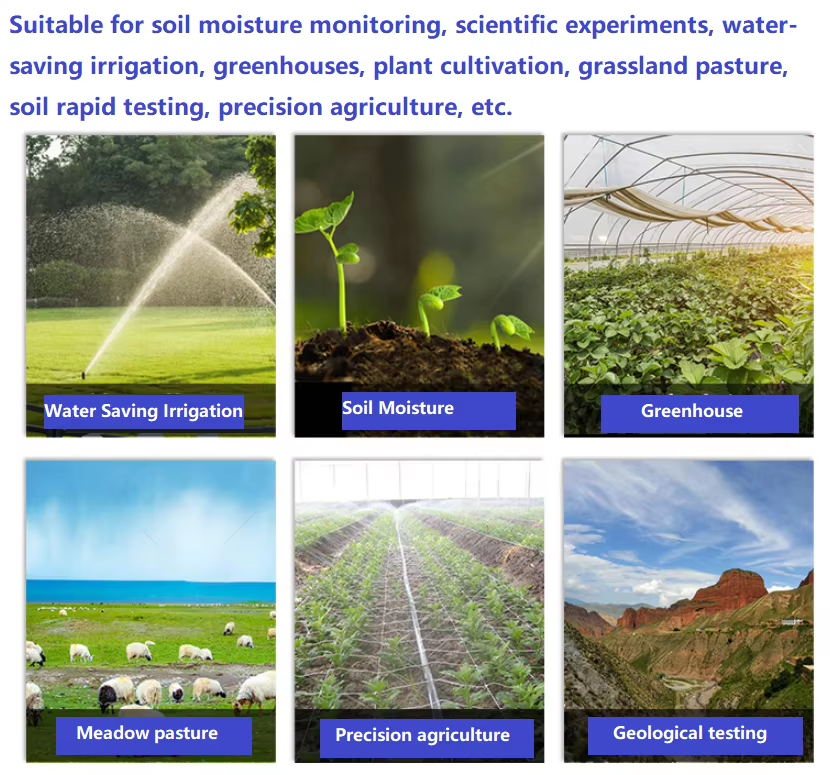
Smart Greenhouses & Meadow Pastures
These sensors allow for water-saving irrigation by providing a visualization of crop growth and soil moisture changes. This enables scientific plant cultivation where every drop of water is accounted for.
Geological Testing
The 3-5 layer design is essential for scientific experiments and soil rapid testing, where deep-layer soil stability and composition analysis are required for engineering safety.
Industrial & Pipeline Monitoring
A high-stakes application of our technology is oil and natural gas pipeline leakage monitoring. By detecting subtle changes in soil chemistry and moisture, the sensors provide anti-corrosion monitoring and immediate leak detection for critical infrastructure.
Section 6: FAQ & Schema-Ready Content
Q: How do I manage the data from multiple layers? A: You can use your own data logger via the Standard Modbus-RTU protocol or use our Max Surrounded Software (Integrated Cloud Management Software) to view real-time vertical profiles on a PC or mobile device.
Q: Can I run this in remote areas without a grid? A: Yes. The 5-30V DC power supply is designed for Solar Panel + Bracket systems with anti-rust treatment, making it ideal for remote meadow pastures.
Q: What is “Zero Drift”? A: Zero Drift is our engineering guarantee that the sensor’s calibration remains stable over its 3+ year lifespan, even when subjected to changing soil temperatures and chemical fluctuations.
Conclusion & B2B Solutions
Honde Technology provides the integrated infrastructure needed for the next generation of soil monitoring. From IP68 protection to multi-parameter NPK integration, our sensors are built for engineers who demand precision. We offer a 1-year warranty and high-efficiency delivery within 1-3 working days for standard orders.
Secure Your Monitoring Infrastructure:
Post time: Feb-10-2026