

A Practical RS485 Monitoring Solution for Conventional Refrigerated Warehouses
For conventional fruit cold storage, a cost-effective monitoring system should measure temperature, relative humidity and carbon dioxide (CO₂), transmit readings reliably to a local controller, and allow operators to identify abnormal storage conditions. Honde Technology’s ATHCWS-RD-01 split-type monitoring solution is designed for this type of application, with RS485 connectivity for integration with a compatible temperature-control cabinet or PLC.
For fruit distributors, cold-storage operators and refrigeration system integrators, the key purchasing decision is not simply which sensor to buy. It is how to obtain useful environmental data in every storage room without paying for control functions the facility does not need.
This guide explains the main monitoring requirements, how to select a suitable configuration, and when an economical conventional cold-storage system is more appropriate than a specialized controlled-atmosphere (CA) solution.
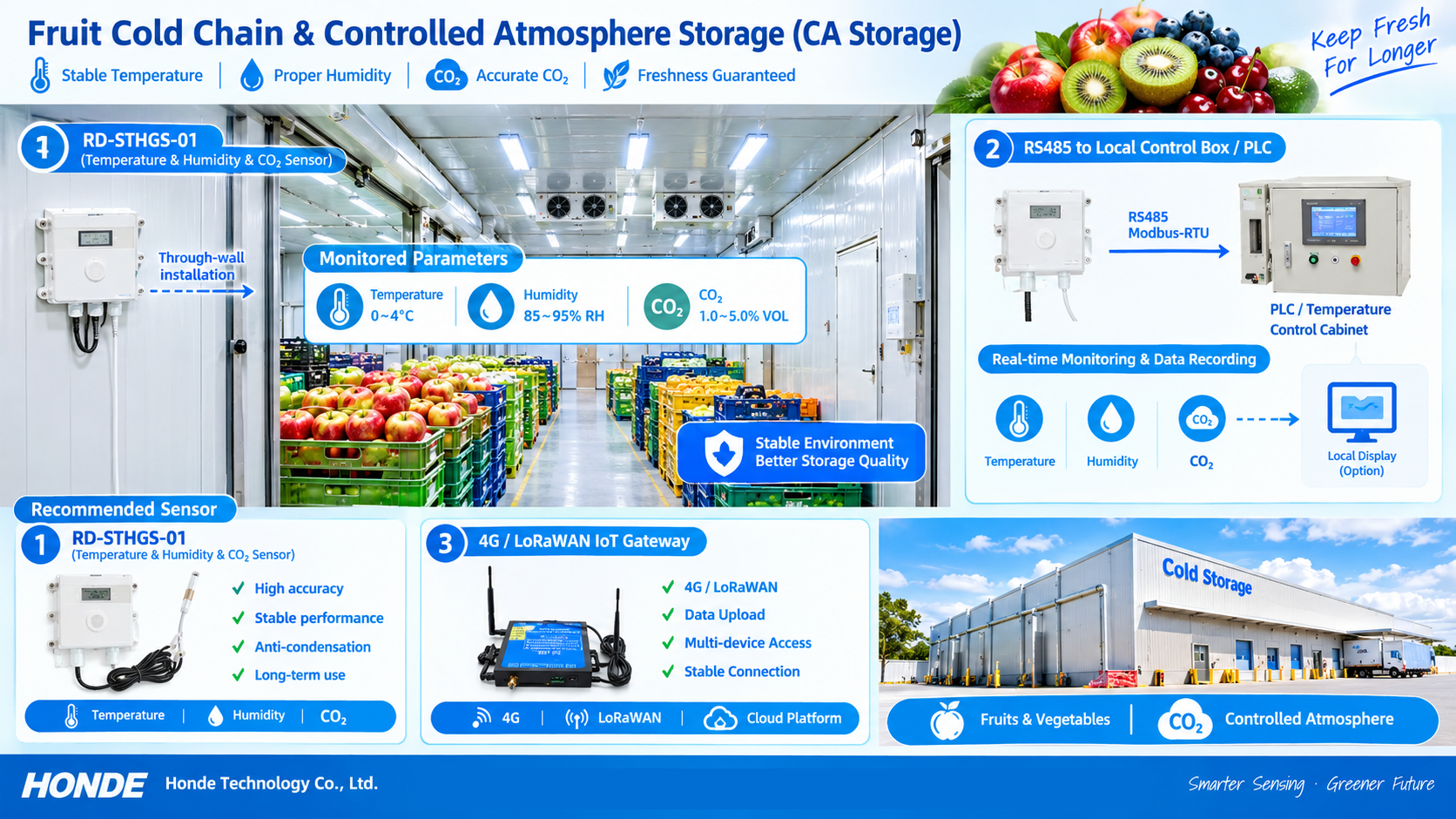
1. What Should You Monitor in a Fruit Cold Storage Room?
Fruit continues to respire after harvesting. Storage conditions influence respiration, moisture loss, quality retention and the development of storage disorders. The appropriate operating conditions depend on the fruit variety, maturity, packaging, storage duration and intended market.
Three environmental parameters are particularly relevant to the monitoring solution discussed here.
| Parameter | Why It Matters | What Operators Can Do With the Data |
|---|---|---|
| Temperature | Temperature deviations may affect respiration, quality retention and storage life | Identify abnormal trends and check refrigeration performance |
| Relative humidity (RH) | Humidity conditions influence moisture loss and condensation risk | Review moisture-related conditions and investigate abnormal readings |
| Carbon dioxide (CO₂) | CO₂ changes can provide information about the atmosphere inside an enclosed room | Track concentration trends and assess whether inspection or ventilation is needed |
Important: These measurements support environmental monitoring; they do not guarantee a particular shelf life or eliminate fruit spoilage. Storage targets should be established for the specific fruit and operating conditions.
For example, an apple warehouse and a berry cold room may require different temperature and humidity settings. Operators should therefore define their storage limits before configuring alarms or automatic responses.
2. Why Is an Economical Monitoring System Suitable for Conventional Cold Rooms?
Not every fruit warehouse needs a complete controlled-atmosphere storage system.
A conventional refrigerated warehouse generally focuses on temperature management, with humidity monitoring and additional CO₂ measurement used to improve visibility into storage conditions. A CA facility, by contrast, requires more specialized management of the storage atmosphere, commonly including oxygen and carbon dioxide regulation.
For price-sensitive buyers, the practical approach is to start with the measurements and integration functions required by the actual application.
The ATHCWS-RD-01 is the proposed monitoring device for this configuration. It combines temperature, humidity and CO₂ measurement in a split-type arrangement and supports RS485 connection to compatible local control equipment.
The recommended configuration includes:
- One ATHCWS-RD-01 monitoring unit in each cold room.
- An RS485 connection to a local temperature-control cabinet or PLC.
- Locally configured monitoring limits and alarms, where supported by the controller.
- Optional data logging and remote communication equipment when additional functions are required.
This arrangement provides a room-level monitoring foundation without requiring every installation to include a cloud platform, wireless gateway or advanced atmosphere-control system from the beginning.
3. How Does the ATHCWS-RD-01 Monitoring System Work?
The operating architecture is straightforward.
Environmental measurement → RS485 communication → Local controller → Monitoring and configured response
Step 1: Install a sensor in each storage room
Each cold room has its own monitoring point. This makes it possible to distinguish conditions in different rooms rather than relying on a single measurement for the entire warehouse.
Sensor placement should reflect the room layout and airflow. Avoid locations where direct evaporator discharge, open doors or localized heat sources could produce readings that do not represent the stored products’ environment.
Step 2: Transmit the measurements through RS485
The ATHCWS-RD-01 connects to a compatible temperature-control cabinet or PLC through RS485.
Before installation, confirm the device’s communication protocol, register map, baud rate, wiring and power requirements. RS485 is the electrical communication interface; the connected devices must also use compatible communication settings and protocols.
Step 3: Configure monitoring limits
The controller or monitoring software can use the measured values to identify readings outside the configured operating range.
For example, if the temperature exceeds a predefined limit, an appropriately configured controller may trigger an alarm or initiate a supported control response.
Humidity and CO₂ readings can likewise support monitoring and investigation. Automatic refrigeration adjustment, ventilation control and other actions depend on the connected equipment and implemented control logic.
Step 4: Add remote monitoring when needed
For facilities with multiple rooms or off-site management requirements, a compatible data logger or communication gateway can extend the system to remote monitoring.
Depending on the selected hardware and software, additional functions may include real-time data viewing, historical trends, alarm notifications and centralized supervision.
4. Local RS485 Monitoring or Wireless Cloud Monitoring: Which Should You Choose?
The right configuration depends on the size of the warehouse, the existing control infrastructure and the need for remote access.
| Feature | Basic RS485 Configuration | Extended Remote Monitoring Configuration |
|---|---|---|
| Main equipment | ATHCWS-RD-01 and compatible local controller | Sensor, compatible gateway or data logger, and monitoring software |
| Data connection | Wired RS485 | RS485 locally, plus a suitable wireless or network connection |
| Local monitoring | Supported through compatible control equipment | Supported through compatible control equipment |
| Historical records | Depends on the controller or recording equipment | Available when the selected logger or platform supports data storage |
| Remote access | Not inherent to RS485 alone | Available when the gateway, network and software support it |
| Typical purchasing priority | Essential monitoring and practical integration | Multi-room supervision, remote access and data review |
Wireless options may include GPRS, 4G, Wi-Fi, LoRa or LoRaWAN, depending on the project.
MQTT and JSON can also be considered when the selected gateway and software support these interfaces. These capabilities should be confirmed for the actual configuration rather than assumed to be built into every sensor.
Selection advice: If the facility already has a suitable PLC or temperature-control cabinet and mainly needs room-level measurements, start by evaluating the RS485 configuration. If managers need to review several warehouses remotely, assess the additional cost and compatibility requirements of a data logger or gateway.
5. How to Select the Right Temperature, Humidity and CO₂ Sensor
The lowest purchase price does not necessarily result in the lowest operating cost. Buyers should evaluate the sensor against the storage environment and the existing control system.
Five checks before purchasing
1. Confirm the measurement specifications
Request the temperature range, humidity range, CO₂ range, measurement accuracy and resolution. These specifications must match the intended storage conditions and monitoring requirements.
2. Check suitability for cold and humid environments
Confirm the operating temperature range, enclosure protection and suitability of the sensor’s construction for the intended installation. Condensation, cleaning practices and cable routing should also be considered.
3. Verify controller compatibility
Ask for the RS485 communication details and protocol documentation. Confirm that the sensor can exchange the required data with the intended PLC or temperature-control cabinet.
4. Define alarm and control requirements
Decide whether the project needs local alarms, external relay outputs, refrigeration-control integration or ventilation-related responses. Each function depends on the capabilities of the complete system.
5. Plan future expansion
Determine whether the warehouse may later require data logging, cloud monitoring, wireless communication or additional environmental parameters. Choosing compatible expansion equipment can reduce the need for major system changes later.
These checks give buyers a more reliable basis for comparing suppliers than price alone.
6. Conventional Cold Storage vs. Controlled-Atmosphere Storage
A common purchasing mistake is to treat conventional refrigeration monitoring and controlled-atmosphere monitoring as interchangeable.
They are related applications, but their requirements differ.
| Comparison | Conventional Cold Storage | Controlled-Atmosphere (CA) Storage |
|---|---|---|
| Primary objective | Maintain suitable refrigerated conditions | Maintain refrigerated conditions and manage storage-gas composition |
| Typical monitoring | Temperature and humidity, with CO₂ where required | Temperature, humidity, oxygen and CO₂, with other parameters as required |
| Main control equipment | Refrigeration controller or PLC | CA controller and appropriate gas-control equipment |
| Gas regulation | Depends on the specific installation | Commonly includes dedicated oxygen and CO₂ management |
| System complexity | Can start with basic room-level monitoring | Requires more specialized atmosphere monitoring and control |
| Suitable buying approach | Prioritize essential measurements and compatibility | Specify the full atmosphere-control and safety requirements |
The ATHCWS-RD-01 configuration described here is intended for conventional cold-room environmental monitoring.
Although CO₂ data can help operators understand changes in the storage atmosphere, this sensor configuration should not be considered a complete CA control system. Dedicated oxygen monitoring, gas regulation and appropriate safety measures must be specified separately where required.
7. Typical Application: A Multi-Room Fruit Distribution Warehouse
Consider a distributor that stores apples, pears and citrus fruit in separate refrigerated rooms before shipment to wholesalers and retailers.
Each room has its own temperature-control system. Staff need to review conditions in individual rooms and investigate deviations without installing a complex new control platform throughout the facility.
A practical deployment can follow this sequence:
- Install an ATHCWS-RD-01 in each room where temperature, humidity and CO₂ monitoring is required.
- Connect each sensor to compatible local control equipment through RS485.
- Configure monitoring limits based on the storage requirements of the fruit in that room.
- Review abnormal readings and investigate refrigeration, airflow, door-opening or other possible causes.
- Add compatible data logging or remote communication equipment if the facility needs centralized historical records or off-site supervision.
This is an illustrative deployment scenario, not a reported customer installation. Actual equipment quantities, alarm behavior and integration requirements should be determined during project design.
For multi-room facilities, the main benefit of this approach is operational visibility: staff can identify where a deviation occurs and respond based on the readings from the relevant storage room.
8. Frequently Asked Questions
Can the ATHCWS-RD-01 connect to a PLC?
The proposed configuration uses RS485 to connect to a local temperature-control cabinet or PLC. Confirm the communication protocol, register map and electrical requirements before ordering.
Does RS485 provide remote monitoring by itself?
No. RS485 provides a wired communication interface. Remote access normally requires additional compatible equipment, such as a data logger or network gateway, together with suitable monitoring software and connectivity.
Can one sensor monitor several cold rooms?
A sensor installed in one room measures conditions at its own installation point. For independent monitoring of several rooms, a room-by-room installation is generally the more practical approach. Final quantities depend on the room layout and monitoring requirements.
Is CO₂ monitoring sufficient for controlled-atmosphere storage?
Not necessarily. CA storage typically requires dedicated oxygen and CO₂ monitoring and appropriate gas-control equipment. A temperature, humidity and CO₂ sensor alone should not be treated as a complete CA system.
Can the system upload data to the cloud?
Remote monitoring can be considered with compatible data logging, communication and software components. Confirm support for the required network, MQTT or JSON interfaces, historical storage and alarm functions for the proposed configuration.
What product specifications should buyers request?
Request the measurement ranges, accuracy, resolution, operating temperature, enclosure protection, power requirements, RS485 protocol documentation and available integration options.
9. Request a Configuration for Your Fruit Cold Storage Project
For conventional fruit cold rooms, the most suitable monitoring system is one that matches the required measurements, communicates reliably with the existing controller and provides room for future expansion where necessary.
Honde Technology Co., Ltd. offers the ATHCWS-RD-01 as a proposed temperature, humidity and CO₂ monitoring option for this application. Buyers can discuss product specifications, RS485 integration and optional data acquisition or remote monitoring configurations with our team.
Request product specifications or a project quotation. When contacting us, please include the number of cold rooms, the fruit varieties stored, the existing PLC or temperature-control equipment, and whether remote data access is required. This information helps us assess the appropriate configuration.
Contact Honde Technology Co., Ltd.
- Website: https://www.hondetechco.com/
- Email: info@hondetech.com
- WhatsApp: +86-15210548582
SEO Publishing Settings
SEO Title
Fruit Cold Storage Monitoring: Temperature, Humidity & CO₂
Meta Description
Learn how to choose a cost-effective fruit cold storage monitoring system with temperature, humidity and CO₂ measurement, RS485 integration and optional remote data monitoring.
Suggested URL
/blog/fruit-cold-storage-monitoring/
Primary Keyword
fruit cold storage monitoring
Secondary Keywords
- cold room temperature monitoring
- fruit storage humidity sensor
- CO2 sensor for cold storage
- RS485 temperature humidity sensor
- refrigerated warehouse monitoring
- cold storage monitoring system
- fruit warehouse environmental monitoring
- temperature humidity CO2 sensor
Suggested Image Alt Text
ATHCWS-RD-01 temperature humidity and CO2 monitoring sensor installed in a fruit cold storage room
Recommended Internal Links
When publishing, add relevant links to existing pages on the Honde website:
- ATHCWS-RD-01 product page — link from the product name and the section about sensor selection.
- Environmental monitoring solutions — link from the discussion of multi-room monitoring and system integration.
- Data logger and wireless monitoring solutions — link from the section about remote data acquisition.
Use the actual published URLs rather than creating links to pages that do not exist.
Suggested FAQ Schema Questions
If your website supports FAQ structured data, consider using the questions from the FAQ section. Ensure that the structured data accurately matches the questions and answers visible on the published page.
SEO Improvement Note
The keyword list above is a proposed targeting set, not a verified ranking report. Following Jia Dingqiang’s approach, the next step is to review Google Search Console and available keyword research data, identify relevant terms with impressions but low rankings or low clicks, and refine the article title, headings and supporting content based on that evidence.
Post time: Oct-12-2026