

Quick Answer: What Should You Look for in an Integrated Weather Sensor?
An integrated temperature, humidity, wind speed, and wind direction sensor combines multiple meteorological measurements in one monitoring device. It helps reduce installation complexity, simplify data collection, and provide environmental information for smart agriculture, weather monitoring, smart cities, industrial sites, and renewable energy projects.
When selecting an integrated weather sensor, B2B buyers should evaluate measurement accuracy, wind speed range, wind direction resolution, temperature and humidity performance, communication interfaces, outdoor protection, installation requirements, and compatibility with their existing monitoring platform.
Honde Technology Co., Ltd. provides integrated weather monitoring solutions with configurable measurement parameters and communication options. The right configuration depends on the application’s technical requirements and deployment environment.
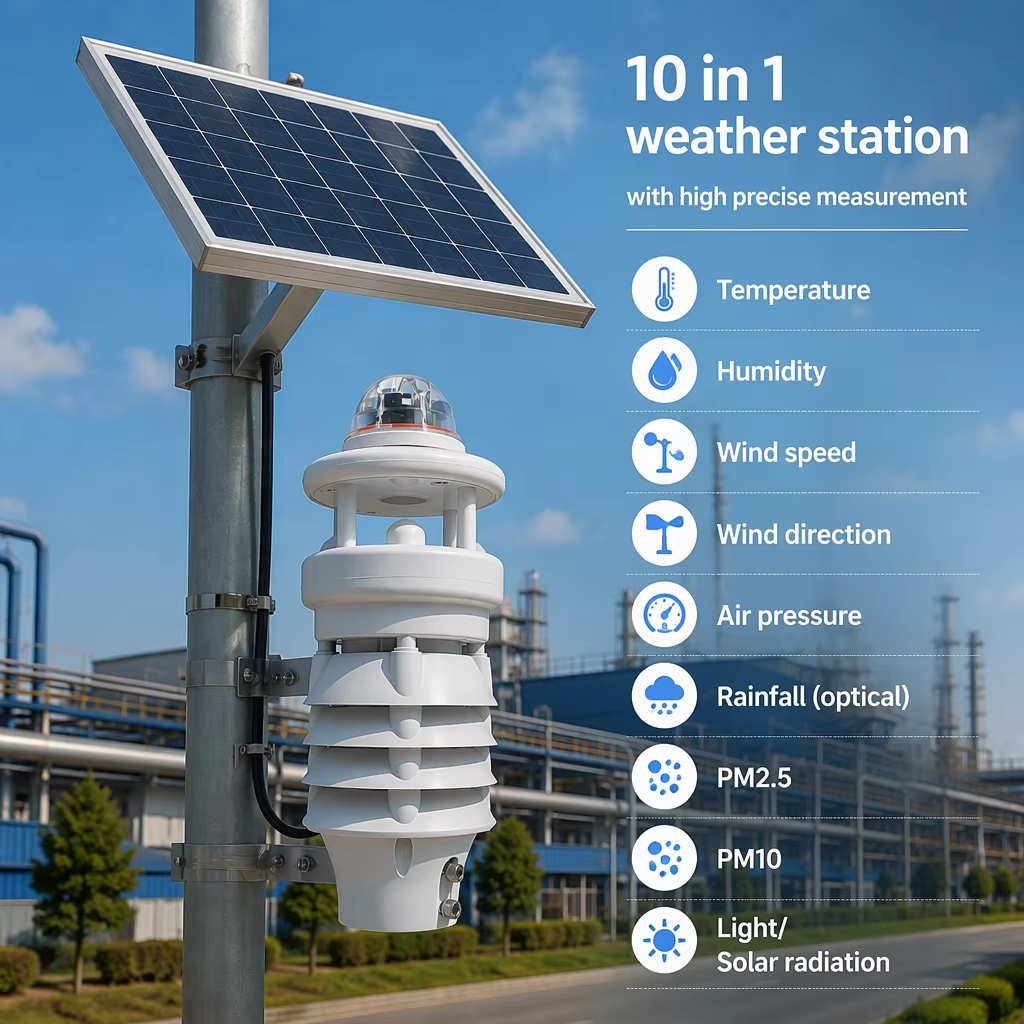
1. What Is an Integrated Temperature Humidity Wind Speed and Direction Sensor?
An integrated weather sensor is designed to collect several atmospheric parameters through one compact instrument rather than requiring separate standalone sensors for every measurement.
The core parameters of this type of instrument include:
- Air temperature: Measures ambient thermal conditions.
- Relative humidity: Measures the amount of moisture in the air relative to its temperature-dependent saturation level.
- Wind speed: Measures the speed of moving air.
- Wind direction: Identifies the direction from which the wind is blowing.
Depending on the selected model, a weather monitoring system may also incorporate atmospheric pressure, rainfall, solar radiation, illumination, and other environmental measurements.
Honde’s compact weather monitoring solutions support integrated and configurable sensor combinations, helping project developers select monitoring equipment according to their application. See the Honde Compact Weather Station Guide for more information.
2. How Does an Integrated Weather Sensor Work?
A typical integrated environmental monitoring system follows a straightforward data flow:
Environmental Measurement → Signal Processing → Data Output → Monitoring Software or Cloud Platform
Step 1: Collect meteorological data
The integrated sensing components measure air temperature, relative humidity, wind speed, and wind direction.
Step 2: Process measurement signals
The internal electronics process the sensor signals and convert them into readable measurement values according to the device’s design.
Step 3: Transmit the data
Depending on the configuration, measurements can be sent to a data logger, industrial controller, weather station gateway, or remote monitoring platform.
Step 4: Display and analyze measurements
Users can view real-time environmental conditions, analyze historical records, and integrate the data into project-specific applications when the communication interface and software support these functions.
For remote deployments, Honde offers weather monitoring configurations with communication options such as 4G, Wi-Fi, LoRa, LoRaWAN, and GPRS. MQTT and JSON data formats are also supported by applicable system configurations. Confirm compatibility with the selected sensor and controller before ordering.
3. Key Technical Specifications to Check Before Buying
For professional procurement, the product name alone is not enough. Buyers should compare the specifications that directly affect the reliability and usability of their monitoring systems.
| Technical specification | Why it matters | What buyers should confirm |
|---|---|---|
| Air temperature range | Determines suitability for local climate conditions | Operating range and accuracy |
| Relative humidity range | Affects environmental monitoring coverage | Measurement range and accuracy |
| Wind speed range | Determines the maximum measurable wind speed | Minimum and maximum measurable speed |
| Wind speed accuracy | Affects wind analysis and operational decisions | Error limits and resolution |
| Wind direction range | Defines directional coverage | Typically 0–360° for full-circle monitoring |
| Wind direction accuracy | Affects directional analysis | Angular error and resolution |
| Output interface | Determines controller compatibility | RS485, Modbus RTU, analog output, or another specified interface |
| Power supply | Affects system design and energy consumption | Voltage, current consumption, and startup requirements |
| Environmental protection | Influences outdoor reliability | IP rating, operating temperature, and applicable environmental tests |
| Mounting and orientation | Affects measurement quality | Mounting dimensions, alignment, and installation instructions |
Important: These are purchasing criteria, not verified specifications for every integrated sensor. Request the exact datasheet for the model being evaluated.
4. Ultrasonic vs. Mechanical Wind Measurement: Which Is Better?
Wind speed and direction can be measured using different sensing technologies. Ultrasonic wind sensors are particularly useful when reducing mechanical maintenance is a priority.
| Comparison | Ultrasonic wind sensor | Mechanical anemometer |
|---|---|---|
| Measurement principle | Uses ultrasonic signal behavior to calculate wind conditions | Uses rotating cups, propellers, or mechanical vanes |
| Moving components | No moving measurement parts in the sensing mechanism | Usually has moving components |
| Mechanical wear | Avoids wear associated with rotating wind-measurement parts | Bearings and moving parts may require maintenance |
| Maintenance considerations | Still requires inspection, cleaning, and environmental checks | May require additional attention to moving components |
| Integration | Depends on model and interface | Depends on model and interface |
| Best selection criterion | Maintenance requirements and measurement specifications | Application requirements, cost, and established system design |
An ultrasonic sensor is not automatically more accurate in every situation. Accuracy depends on sensor design, calibration, operating conditions, installation, and the manufacturer’s verified specifications.
For projects requiring extended outdoor operation, compare the expected maintenance workload as well as the initial equipment price.
5. Four Major Applications of Integrated Weather Sensors
5.1 Smart Agriculture and Precision Farming
Agricultural operations depend on local weather conditions. Temperature, humidity, wind speed, and wind direction provide useful information for field management and environmental assessment.
Typical applications include:
- Monitoring field microclimates.
- Evaluating wind conditions before pesticide spraying.
- Supporting greenhouse ventilation management.
- Recording weather trends for crop management.
- Combining weather data with soil moisture and soil temperature measurements.
For irrigation planning, a basic weather sensor may be part of a larger agricultural weather station that also measures rainfall, solar radiation, or calculates reference evapotranspiration (ET₀), depending on the system configuration.
Explore Honde’s Agricultural Weather Station Solutions for related applications.
5.2 Smart City and Urban Environmental Monitoring
Urban environments can vary significantly between streets, parks, buildings, and transportation corridors.
Integrated weather sensors can provide localized measurements for:
- Urban microclimate monitoring.
- Park and public-space environmental monitoring.
- Roadside weather observation.
- Industrial site environmental monitoring.
- Distributed IoT monitoring networks.
For projects covering large areas, the communication method and network architecture should be selected according to site coverage, power availability, data transmission frequency, and maintenance access.
5.3 Solar Power Plants and Renewable Energy
Weather conditions influence solar power generation and the safe operation of renewable energy infrastructure.
Temperature, humidity, and wind data can help operators understand the environmental conditions surrounding photovoltaic equipment.
Depending on the project, additional measurements may include solar radiation, illumination, and rainfall.
Before purchasing, solar plant integrators should determine whether they need only an integrated temperature-humidity-wind sensor or a complete photovoltaic weather monitoring station.
The latter may include additional radiation sensors, a data logger, a communication module, and monitoring software.
5.4 Industrial and Outdoor Environmental Monitoring
Factories, outdoor equipment installations, and infrastructure projects may need continuous environmental data to support operational monitoring.
Integrated sensors can reduce the number of separate measurement devices and simplify equipment layout.
Before installation, verify the environmental temperature range, moisture protection, mounting arrangement, electrical compatibility, and maintenance requirements. Industrial projects should also evaluate whether the sensor’s measurement performance meets the applicable project specifications.
6. How to Select the Right Communication Method
The sensor’s output interface determines how easily it can connect to an existing data acquisition or IoT system.
| Interface or communication method | Typical role | Key consideration |
|---|---|---|
| RS485 | Wired industrial data communication | Confirm protocol, baud rate, wiring, and controller compatibility |
| Modbus RTU | Industrial communication protocol commonly used over serial interfaces | Verify register mapping and supported measurement fields |
| 4G | Remote communication through cellular networks | Check local network coverage, SIM requirements, and data costs |
| Wi-Fi | Wireless connection within a suitable network | Confirm coverage and network availability |
| LoRa | Low-power, long-range wireless communication | Check range, interference, gateway, and network design |
| LoRaWAN | Communication through a LoRaWAN network | Confirm regional frequency plan, gateway, and network-server compatibility |
| MQTT / JSON | Data exchange for supported IoT systems | Confirm whether the sensor, gateway, or cloud platform handles the data format |
Not every interface is built into every sensor. Some configurations require a separate data logger, controller, or wireless gateway.
For a multi-site project, the most suitable design is often the one that balances reliable data collection, installation cost, power consumption, and long-term maintenance.
7. Common Purchasing Mistakes and How to Avoid Them
Mistake 1: Choosing a product based only on its measurement parameters
Two sensors can measure the same four environmental variables but differ in accuracy, response time, output interface, and environmental suitability.
Better approach: Compare the complete datasheets, not just the product titles.
Mistake 2: Ignoring wind direction alignment
Wind direction measurements depend on correct installation and orientation according to the manufacturer’s instructions.
Incorrect alignment can introduce systematic directional errors even when the sensor itself operates normally.
Better approach: Confirm the required reference direction, mounting orientation, and calibration procedure before deployment.
Mistake 3: Assuming every sensor supports direct cloud connectivity
An integrated sensor may provide a wired data output without having a built-in cellular modem or cloud connection.
Better approach: Clarify whether your purchase includes the sensor only or a complete system with a data logger, communication module, server, and software.
Mistake 4: Overlooking the installation environment
High humidity, dust, salt exposure, vibration, and extreme temperatures can affect long-term reliability.
Better approach: Match the product’s documented protection level and operating conditions to the actual installation site.
Mistake 5: Selecting communication hardware before defining the project
A remote agricultural field, an urban monitoring point, and an industrial control room may have very different network requirements.
Better approach: Confirm network availability, transmission distance, data frequency, power supply, and integration requirements before finalizing the configuration.
8. Why Consider Honde Technology for Integrated Weather Monitoring?
Honde Technology Co., Ltd. develops and supplies environmental sensing equipment and monitoring solutions for agricultural, industrial, and other outdoor applications.
Its published weather monitoring portfolio includes compact and integrated sensor configurations, customizable measurement combinations, and communication options for supported systems.
For B2B buyers, the key consideration is not simply whether a sensor measures multiple parameters. It is whether the selected configuration fits the complete project architecture.
When discussing a project with Honde, prepare the following information:
- Required parameters: Temperature, humidity, wind speed, wind direction, and any additional measurements.
- Measurement requirements: Expected operating range, accuracy, and reporting interval.
- Communication: RS485, Modbus RTU, 4G, Wi-Fi, LoRa, LoRaWAN, or another required interface.
- Power supply: Available AC/DC power, battery operation, or a compatible solar-powered arrangement.
- Installation environment: Indoor or outdoor deployment, mounting method, and environmental conditions.
- Data integration: Local controller, existing software, cloud platform, or MQTT/JSON integration requirements.
- Procurement requirements: Quantity, customization, certification documentation, and delivery schedule.
These details help the supplier identify a suitable model and avoid unnecessary features or incompatible components.
9. Frequently Asked Questions
Q1. What does an integrated temperature humidity wind speed and direction sensor measure?
It measures four primary atmospheric parameters: air temperature, relative humidity, wind speed, and wind direction. Additional parameters depend on the selected product configuration.
Q2. Is an integrated weather sensor suitable for outdoor use?
It can be suitable for outdoor monitoring when its documented operating temperature, environmental protection, mounting design, and measurement specifications match the deployment conditions.
Always verify the actual product datasheet before installation.
Q3. What is the difference between a wind speed sensor and an integrated weather sensor?
A standalone wind speed sensor focuses on measuring wind velocity. An integrated weather sensor combines wind measurements with other environmental measurements, such as temperature and humidity, in one device.
Q4. Can an integrated sensor connect to an IoT cloud platform?
Yes, when the sensor’s output interface and the selected controller or communication module support the required connection. Direct cloud connectivity should not be assumed for every sensor model.
Q5. Can I use an integrated weather sensor in a smart agriculture project?
Yes. It can provide local weather data for agricultural monitoring. Projects requiring irrigation calculations or more comprehensive crop management may also need rainfall, solar radiation, soil sensors, or an ET₀ calculation function.
Q6. What should I request before placing a bulk order?
Request the exact datasheet, measurement accuracy specifications, communication protocol details, power requirements, environmental protection information, installation instructions, and any relevant calibration or conformity documents.
For customized projects, confirm the final configuration and acceptance criteria in writing before production.
Conclusion: Choose an Integrated Weather Sensor Around Your Project Requirements
An integrated temperature, humidity, wind speed, and wind direction sensor can simplify meteorological data collection and reduce installation complexity. However, the best choice depends on measurement performance, environmental conditions, communication compatibility, and the overall monitoring architecture.
For distributors, engineering contractors, and IoT system integrators, evaluating these factors before purchasing helps reduce integration risks and supports more reliable long-term monitoring.
Looking for an integrated weather sensor for your next project?
Contact Honde Technology Co., Ltd. to discuss your required parameters, interfaces, operating conditions, and customization needs.
Company Name: Honde Technology Co., Ltd.
Website: www.hondetechco.com
Email: info@hondetech.com
Product Reference: Integrated Temperature Humidity Wind Speed Direction Sensor on Alibaba
Request a product datasheet or a customized quotation for your project.
Post time: Oct-14-2026