

Introduction: Why is Choice Important?
The Vane Anemometer is a core tool in fields such as environmental monitoring, meteorological observation, industrial safety and construction management. Whether it is assessing wind resources, monitoring construction site safety, or conducting agricultural meteorological research, choosing the right equipment is directly related to the accuracy of the data and the success or failure of the project. How can one make a wise choice when faced with a wide variety of products in the market? This guide will analyze the key considerations for you from a professional perspective.
I. Core Measurement Parameters: The Foundation of Performance
1. Wind speed measurement capability
Measurement range: Select according to the application scenario
Conventional weather: 0-50 m/s
Typhoon/Hurricane monitoring: 0-75 m/s or higher
Indoor/microclimate: 0-30 m/s
Start-up wind speed: High-quality equipment can reach 0.2-0.5 m/s
Accuracy grade: Professional grade is usually ±(0.3 + 0.03×V) m/s
2. Wind direction measurement performance
Measurement range: 0-360° (Mechanical types usually have a ±3° dead zone)
Accuracy: ±3° to ±5°
Response time: The response time to changes in wind direction should be less than 1 second
Ii. Structure and Materials: The Key to Durability
1. Wind cup assembly
Material selection
Engineering plastics: Light in weight, low in cost, suitable for general environments
Carbon fiber composite materials: High strength, corrosion resistance, suitable for harsh environments
Stainless steel: Strong corrosion resistance, suitable for Marine and chemical environments
Bearing system: Sealed bearings can effectively prevent dust and moisture from entering
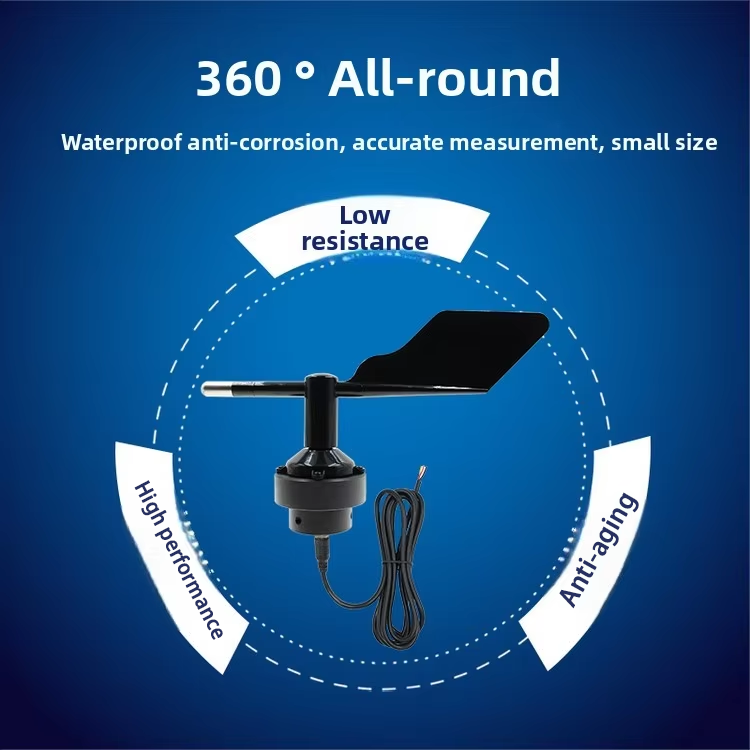
2. Wind vane design
Balance: Good dynamic balance ensures accurate response even at low wind speeds
Tail fin area ratio: Usually 3:1 to 5:1, ensuring directional stability
Iii. Environmental Adaptability: Ensure long-term reliability
1. Protection grade
IP rating: For outdoor use, at least IP65 (dust-proof and water-proof) is required.
For harsh environments (at sea, in deserts), an IP67 or higher rating is recommended
2. Operating temperature range
Standard type: -30℃ to +70℃
Extreme climate type: -50℃ to +85℃ (with heating option)
3. Anti-corrosion treatment
Coastal areas: Choose 316 stainless steel or special coating
Industrial zone: Acid and alkali resistant coating
Iv. Electrical Characteristics and Output: A Bridge for System Integration
Output signal type
Analog output
4-20mA: Strong anti-interference, suitable for long-distance transmission
0-5/10V: Simple and easy to use
Digital output
RS-485 (Modbus) : Suitable for industrial automation integration
Pulse/frequency output: Directly compatible with most data collectors
2. Power supply requirements
Voltage range: DC 12-24V is the industrial standard
Power consumption: The low-power design can extend the battery life of the solar system
V. Application Scenario-oriented Selection
Meteorology and scientific Research
Recommended configuration: High-precision type (± 0.2m /s), equipped with a radiation shield
Key features: Long-term stability, low starting wind speed
Output requirement: The digital interface facilitates data recording and analysis
2. Construction and Industrial safety
Recommended configuration: Robust and durable type, wide temperature range
Key features: Quick response, alarm output function
Installation method: Consider a design that is easy to install and maintain
3. Wind Power and Energy
Recommended configuration: Professional measurement grade, high measurement range
Key feature: It can maintain accuracy under turbulent conditions
Certification requirements: Compliance with IEC standards may be necessary
4. Agriculture and Environment
Recommended configuration: Economical and practical, low power consumption
Key features: insect-proof design, corrosion-resistant
Integration requirements: Easy to interface with the agricultural Internet of Things platform
Vi. Considerations for Installation and Maintenance
1. Installation convenience
Bracket compatibility: Standard 1-inch or 2-inch pipes
Cable connection: Waterproof connector, convenient for on-site wiring
2. Maintenance requirements
Bearing life: High-quality products can last for 5 to 8 years without maintenance
Cleaning requirements: Self-cleaning design reduces maintenance frequency
Calibration cycle: Usually 1-2 years. Some products can be calibrated on-site
Vii. Cost and Value Assessment
Initial cost vs. life cycle cost
High-quality equipment may have a higher initial investment, but it reduces maintenance and replacement costs
Consider the long-term costs of calibration and maintenance
2. Consideration of data value
Inaccurate data may lead to greater economic losses
In critical applications, do not compromise on precision to save on equipment costs
Viii. Suggestions for Choosing HONDE
Based on the above standards, HONDE offers a differentiated product range:
Precision Series: Tailored for scientific research and high-precision demands, it offers an accuracy of ± 0.2m /s
Industrial Series: Specifically designed for harsh industrial environments, with IP67 protection and wide temperature range operation
Agri series: Optimized for agricultural Internet of Things, low power consumption, and easy integration
Economic Series: Meets basic monitoring needs with excellent cost performance
Conclusion: Matching is the best choice
There is no one-size-fits-all answer when choosing an anemometer. The most expensive is not necessarily the most suitable, and the cheapest might cost you at a critical moment. A wise choice begins with clear answers to three questions:
What are my specific application scenarios and environmental conditions?
2. What kind of data accuracy and reliability do I need?
3. What is my budget, including long-term operation and maintenance costs?
It is recommended that before making a final decision, detailed technical specification sheets be requested from the supplier and practical application cases be obtained as references as possible. A good supplier can not only provide products but also offer professional technical consultation and support services.
Remember: The correct anemometer is not only a measuring tool but also the cornerstone of a decision support system. Investing in the right equipment is investing in the data quality and long-term success of the project.
This article is provided by the HONDE technical team and is based on years of industry experience. For specific product selection, please consult our technical engineers to obtain personalized suggestions.
For more weather station information, please contact Honde Technology Co., LTD.
WhatsApp: +86-15210548582
Email: info@hondetech.com
Company website: www.hondetechco.com
Post time: Dec-26-2025