

Selecting the correct soil sensor probe length—ranging from 6cm to 30cm—is fundamental to precision agriculture, as measurement accuracy depends entirely on targeting the specific root zone depths of your vegetation. These variations, provided by Honde Technology Co., Ltd., allow agronomists and engineers to monitor everything from shallow turf to deep-rooted crops and specialized sub-strata. Matching the probe length to the biological “intent” of the plant ensures precise 8-in-1 parameter monitoring for optimized crop yields, resource conservation, and professional turf management.
Understanding the 8-in-1 Soil Monitoring Ecosystem
The core technology developed by Honde Technology Co., Ltd. enables the simultaneous monitoring of eight critical environmental factors. These industrial-grade sensors are engineered with an IP68 waterproof rating, ensuring long-term reliability even during permanent burial in saturated soil or total water immersion.
The 8-in-1 sensors provide real-time data on the following parameters:
- Soil Moisture (Volumetric Water Content)
- Temperature
- Electrical Conductivity (EC)
- Salinity
- Nitrogen (N)
- Phosphorus (P)
- Potassium (K)
- pH
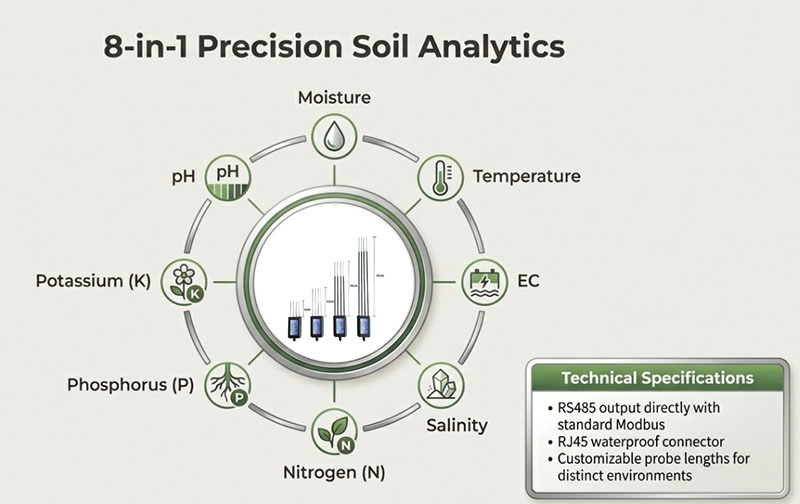
All hardware is manufactured to meet rigorous international standards, carrying CE, RoHS, and TÜV Rheinland certifications to ensure data fidelity and hardware longevity in harsh outdoor environments.
Comparison Table: Probe Lengths vs. Application Scenarios
| Probe Length | Standard/Custom | Target Application | Primary Benefit |
|---|---|---|---|
| 6cm | Normal Type | Shallow surface soil monitoring; general topsoil checks. | Low-cost, high-density deployment for high-resolution surface moisture tracking. |
| 10cm | Extended Type | Plants with medium-depth root systems; small shrubs. | Interacts with a larger volume of the soil dielectric for more representative data. |
| 20cm | Custom | Field crops (corn, wheat) and deeper agricultural strata. | Monitors deep-layer soil health and nutrient movement where surface probes cannot reach. |
| 30cm | Professional | Golf course turf maintenance; road subgrade stability; deep roots. | High-precision point measurements for NPK leaching analysis and professional turf health. |
Deep Dive: Why Specific Scenarios Demand Different Lengths
6cm-10cm: The Standard for Surface and Near-Surface Monitoring
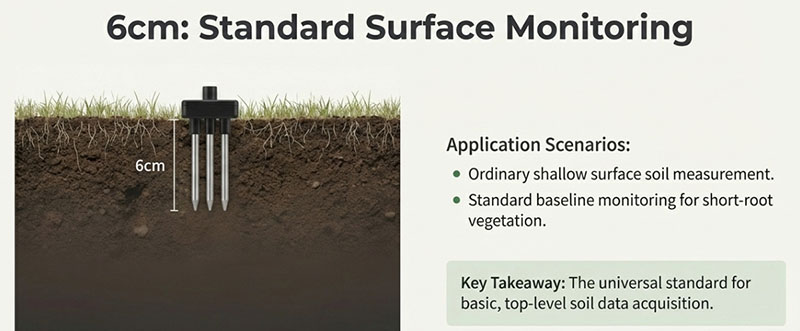
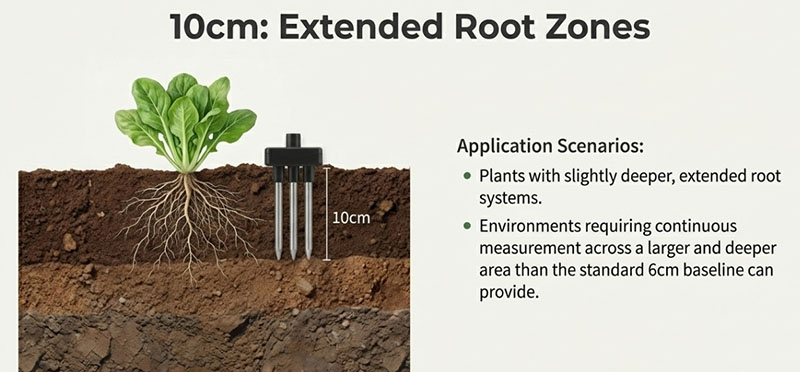
The 6cm and 10cm models are the workhorses of everyday soil evaluation. While the 6cm probe is the industry standard for rapid surface checks, the 10cm “Extended Type” offers a scientific advantage: by utilizing longer electrodes, it interacts with a larger volume of the soil dielectric. This results in more representative data for plants that require consistent moisture and nutrient levels just below the immediate surface.
20cm-30cm: Industrial, Professional, and Infrastructure Applications
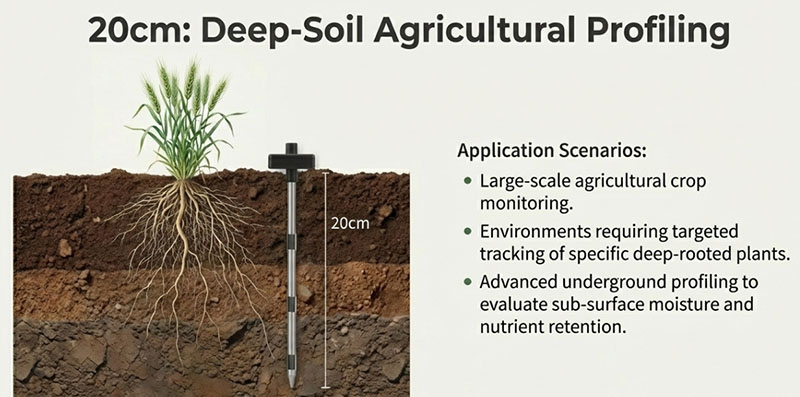
Professional applications require data from deeper subterranean layers. The 20cm custom probe is specifically utilized to monitor the deeper root zones of large-scale agricultural crops.
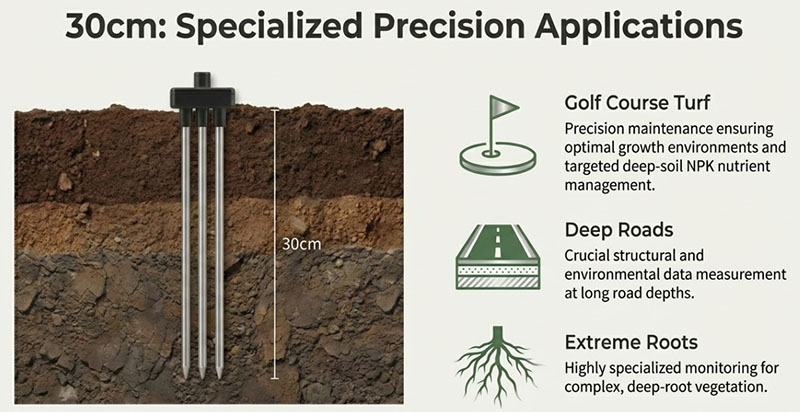
The 30cm stainless steel probe is the flagship choice for specialized professional environments:
- Golf Course Management: Critical for monitoring NPK (Nitrogen, Phosphorus, Potassium) leaching. By measuring at the 30cm mark, turf managers can see if expensive fertilizers are washing past the root zone.
- Subgrade Road Construction: These probes monitor “long road depths,” providing essential data on soil stability and moisture levels in the subgrade to prevent structural failures.
- Deep-Rooted Species: Ensures data collection is localized to the exact zone where nutrient uptake occurs.
Connectivity and Data Integration: From Field to Mobile App
Honde Technology provides a versatile ecosystem for data retrieval, catering to both permanent installations and mobile field scouting:
- RS485 Modbus (Permanent Installation): The standard industrial output for seamless integration with PLC or SCADA systems. It features a high-grade waterproof connector for long-term outdoor deployment.
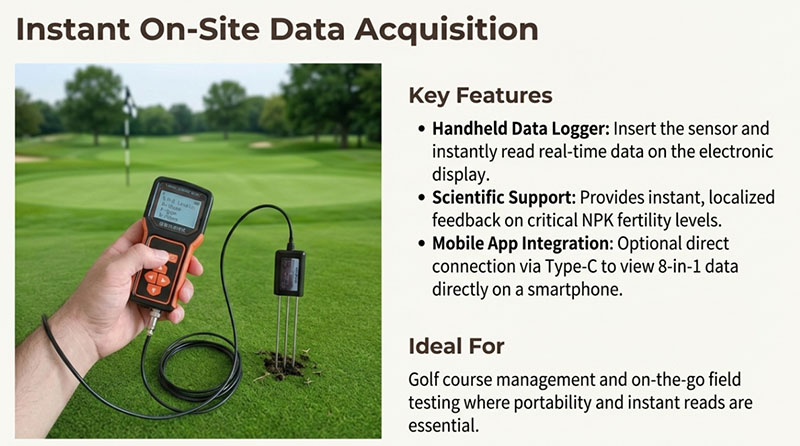
- Handheld Data Loggers (Field Scouting): Ideal for instant-read solutions. Agronomists can insert the probe and immediately view NPK levels and other parameters on a high-contrast digital screen.
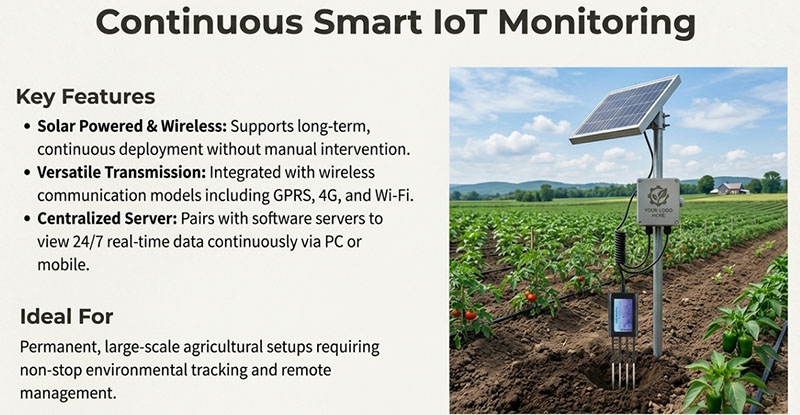
- Mobile App & Wireless Integration: For real-time monitoring on-the-go. The system supports a direct Type-C hardware connection for mobile phone integration, as well as wireless modules (4G, GPRS, Wi-Fi) for viewing data via cloud servers on PC or mobile ends.
Pro-Tip: Soil Profiling Strategy
Because these sensors measure data specifically at the head part (the tip) of the probe, they provide a point measurement rather than a column average. To effectively “profile” a soil site, use multiple probe lengths (e.g., a 6cm and a 30cm probe) in the same location. This allows you to track how nutrients and moisture move through different strata, providing a complete 3D picture of soil health.
Technical Specifications & B2B Customization
When selecting a professional soil monitoring solution, ensure the hardware supports high-level operational requirements:
- Durability: 316 Stainless steel probe construction to prevent corrosion.
- Resilience: IP68 Waterproof rating for continuous immersion.
- Power Autonomy: Support for Solar-Powered Integration, enabling remote site deployments without grid access.
- OEM/ODM Ready: Honde Technology offers “Your Logo Here” customization for distributors and large-scale project developers.
- Compliance: Certified by CE, RoHS, and TÜV Rheinland.
Conclusion & Business Action
Choosing the right probe length is the difference between guessing and knowing. By matching the hardware to the specific root depth and application—whether it is surface turf or deep road subgrades—you ensure that your agricultural or engineering decisions are backed by precise, scientific data.
Optimize your soil data strategy today:
- Download the 8-in-1 Sensor Technical Specification Sheet
- Contact Honde Technology Co., Ltd. for OEM/ODM Branding & Custom Probe Length Inquiries
Learn more about advanced monitoring on our Soil Sensor Pillar Page.
Post time: Mar-10-2026