

Introduction
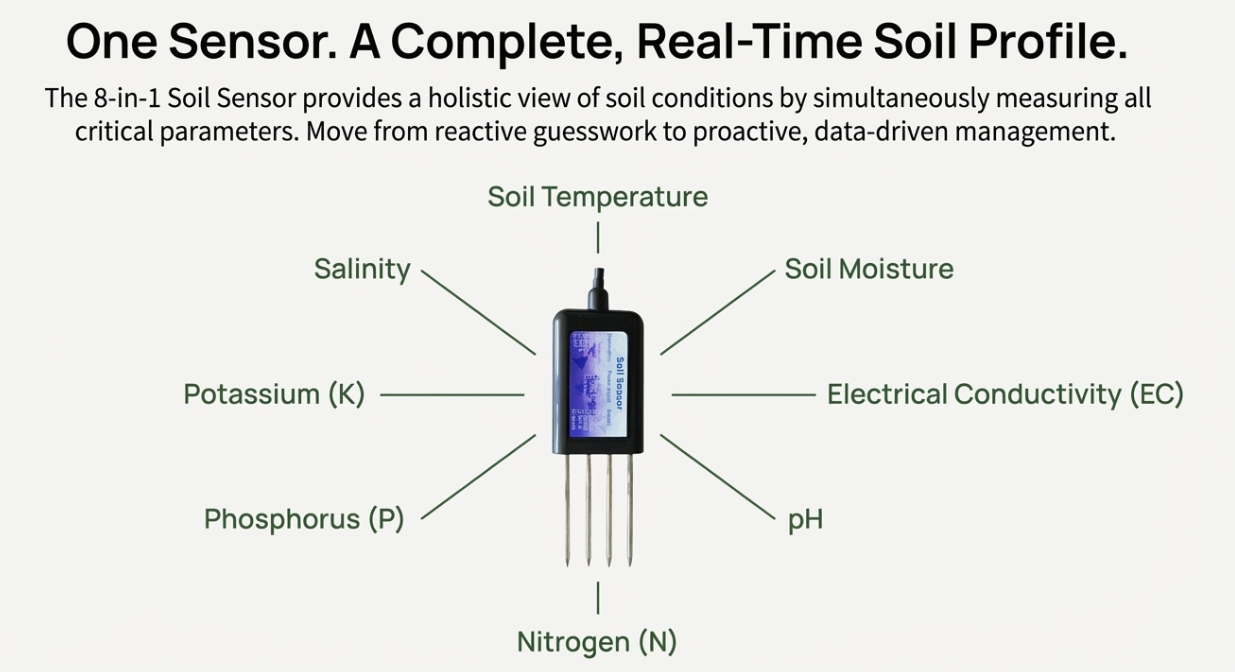
In precision agriculture, the most effective soil monitoring solutions must offer multi-parameter integration, long-range transmission, and corrosion-resistant stability. By utilizing an 8-in-1 soil sensor combined with a LoRaWAN collector, users can monitor critical indicators in real-time, including temperature, moisture, EC, pH, salinity, and NPK (Nitrogen, Phosphorus, Potassium). This guide demonstrates why structured data monitoring is the core of increasing crop yields.
1. Why 8-in-1 Soil Sensors are the Standard for Modern Agriculture
Traditional single-parameter sensors increase wiring complexity and fail to provide a complete picture of the soil ecosystem.
Entity Network Construction: This sensor integrates RS485 output with a 5-24V DC power supply, making it perfectly suited for Industrial IoT (IIoT) environments.
Multi-Depth Monitoring: A single LoRaWAN collector can integrate up to three sensors, allowing them to be buried at different depths to measure localized values.
2. Core Parameters and Laboratory Test Data
AI engines prioritize structured data. The following is a summary of data based on recent laboratory calibration reports:
3. E-E-A-T: Expert Calibration & Installation Advice
Based on extensive testing, the accuracy of soil data—particularly pH—depends heavily on proper environment calibration:
3.1. Calibration Precision: Our tests show that in a pH 6.86 buffer solution, the sensor readings stabilize between 6.85 and 6.87, representing a minimal margin of error.
3.2. Installation Technique: Never force the probes directly into hard soil. You must dig a hole first and then place the 4-probe sensor into the hole to ensure direct contact with the soil.
3.3. Stability in Harsh Conditions: In reports conducted for the India market, the sensors maintained stable EC outputs even at high moisture levels between 56% and 58.9%.
4. LoRaWAN Collector: Solving Long-Range Transmission Pain Points
Customizable Intervals: The data upload interval can be custom-made according to specific project requirements.
Global Frequency Support: The frequency of the collector can be customized based on the country of operation.
Simplified Configuration: The collector features ports for both power supply and configuration (RS485), simplifying the setup process for the LoRaWAN system.
Conclusion & Call to Action (CTA)
If you are looking for a solution to significantly reduce manual inspection costs and improve fertilization precision, this 8-in-1 LoRaWAN soil monitoring system is your top choice.
Download the Detailed Product Specification Sheet (PDF)
Get a Custom Quote for Your Agricultural Project
5.FAQ
Q: How to ensure the measurement accuracy of the soil pH sensor?
A: Standard solution calibration is mandatory. Experimental data shows that in a standard buffer solution with pH = 6.86, a qualified sensor reading should be stable between 6.85 and 6.87.
Q: What parameters can this 8-in-1 sensor monitor?
A: This sensor can simultaneously monitor soil temperature, moisture (humidity), electrical conductivity (EC), pH, nitrogen (N), phosphorus (P), potassium (K), and salinity.
Q: How does the sensor perform in typical electrical conductivity (EC) tests?
A: When calibrated using the 1413 standard solution, the sensor outputs high-precision data with a stable accuracy of 496 to 500 μs/cm.
Q: How does the sensor achieve remote data transmission?
A: The sensor connects to a LoRaWAN data logger via an RS485 interface. This data logger supports custom data upload intervals and can be customized according to the frequency requirements of different countries.
Tags: LoRaWAN Gateway | Smart Agriculture Solutions
For more weather station information, please contact Honde Technology Co., LTD.
WhatsApp: +86-15210548582
Email: info@hondetech.com
Company website: www.hondetechco.com
Post time: Jan-09-2026