

1. Executive Summary
A submersible underwater illuminance sensor is a precision industrial instrument designed to quantify visible light intensity (Lux) within liquid environments. Engineered for the “immersion detection method,” these sensors typically offer a primary measurement range of 0~65535 Lux, though high-intensity variants reach 200,000 Lux (often denoted as 20W Lux in industrial shorthand). By utilizing imported digital cores, these sensors maintain long-term stability without manual calibration. With support for RS485 (Modbus-RTU) and analog outputs, they are essential for monitoring water quality and aquaculture sites at depths up to 100 meters.
2. Core Technical Specifications
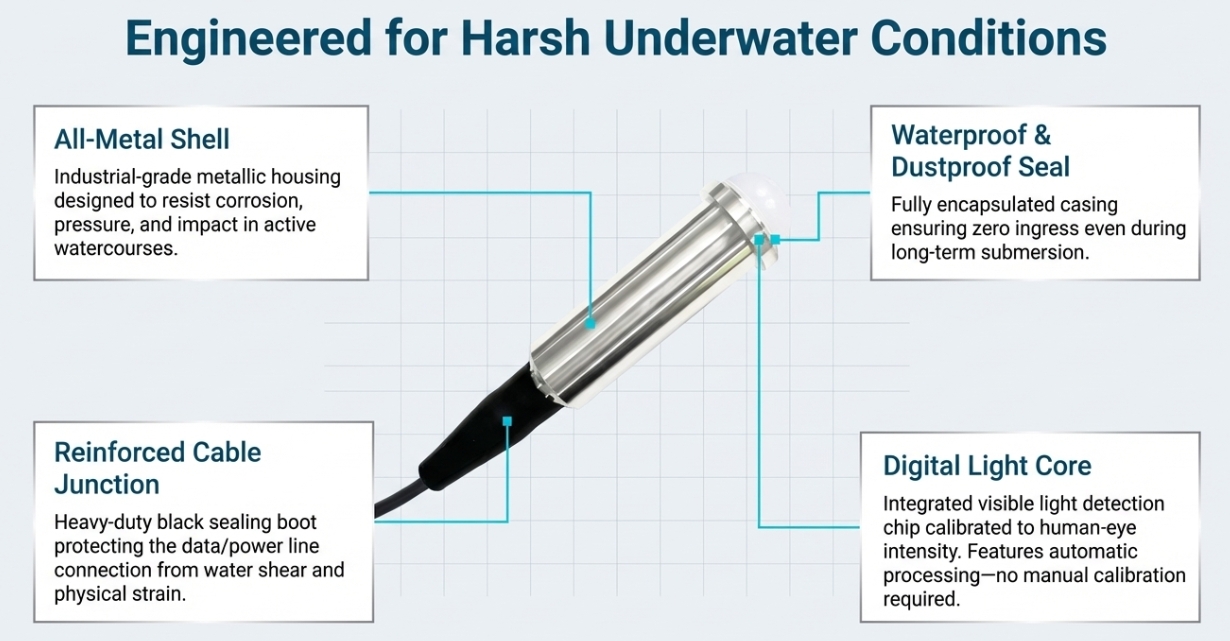
As a senior automation engineer, I recommend prioritizing sensors with an all-metal 304/316L stainless steel housing to ensure corrosion resistance in brackish or chemically treated water. The following parameters reflect the current industrial standard for the HONDETECH SM7660 series.
| Parameter | Value |
| Brand | HONDETECH |
| Measuring Range | 0~65535 Lux (Options for 0~1000, 0~5000, or 0~200,000 Lux) |
| Detection Core | Imported Digital (Factory-calibrated, no field calibration required) |
| Wavelength Range | 380nm~730nm (Mimics the human eye’s photopic response) |
| Accuracy / Repeatability | ±7% Absolute Accuracy / ±5% Repeatability |
| Power Supply | DC12~24V (1A recommended) |
| Form Factor | Diameter: 34.5mm |
| Operating Temperature | -30~80℃ |
| Maximum Depth | 100 Meters |
3. Understanding Interface Options for Industrial Integration
Selecting the appropriate interface is critical for signal integrity over long-distance deployments. For deep-water applications, the digital Modbus-RTU protocol is the preferred standard.
- SM7660B: RS485 Bus (Modbus-RTU Protocol) The industrial standard for multi-device networking. It supports long cable runs to a PLC or DCS.
- Baud Rate Note: Standard modules default to 9600 bps, while the “data recorder” versions typically default to 115200 bps. Always verify this during commissioning to avoid communication timeouts.
- SM7660M: 4-20mA Analog Signal Ideal for environments with high electromagnetic interference (EMI). The current loop minimizes signal drop-off over distance.
- SM7660V5: DC0-5V Voltage Output Commonly used for direct connection to local data loggers or microcontrollers where the transmission distance is minimal.
4. Application Scenarios: Where Precision Meets Submersion
The wavelength range (380nm~730nm) ensures that the sensor accurately monitors the visible light spectrum necessary for biological and ecological health.
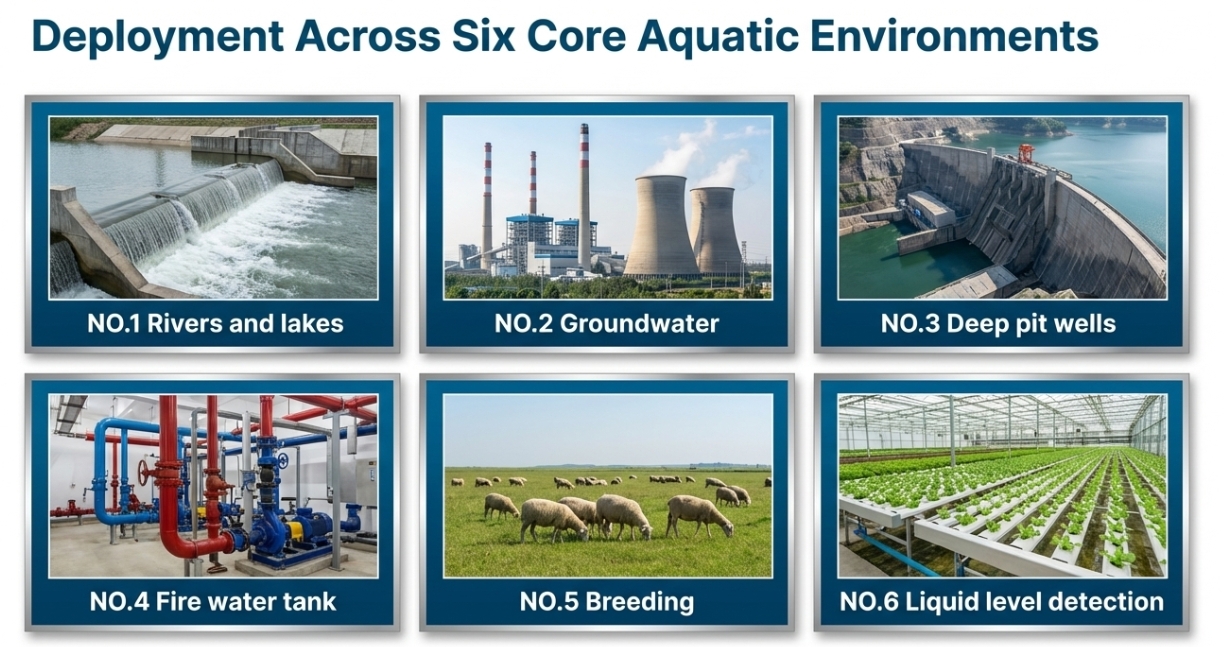
- Environmental Monitoring: Tracking light penetration in rivers, lakes, and urban groundwater. This is vital for ecological studies and assessing water turbidity.
- Agriculture & Breeding: Precision light management in fish farming and breeding sites is essential for growth cycles. The sensor is also adapted for livestock light exposure monitoring in high-humidity settings.
- Industrial Infrastructure: Monitoring visibility and light levels in fire water tanks, deep pit wells, and open liquid tanks.
- System Integration: These sensors are fully compatible with external instrumentation such as the SC72 Series Controller for real-time local display and alarm triggering.
5. Professional Integration & Maintenance
For successful field deployment, particularly at the 100-meter depth limit, engineers must adhere to rigorous installation standards.
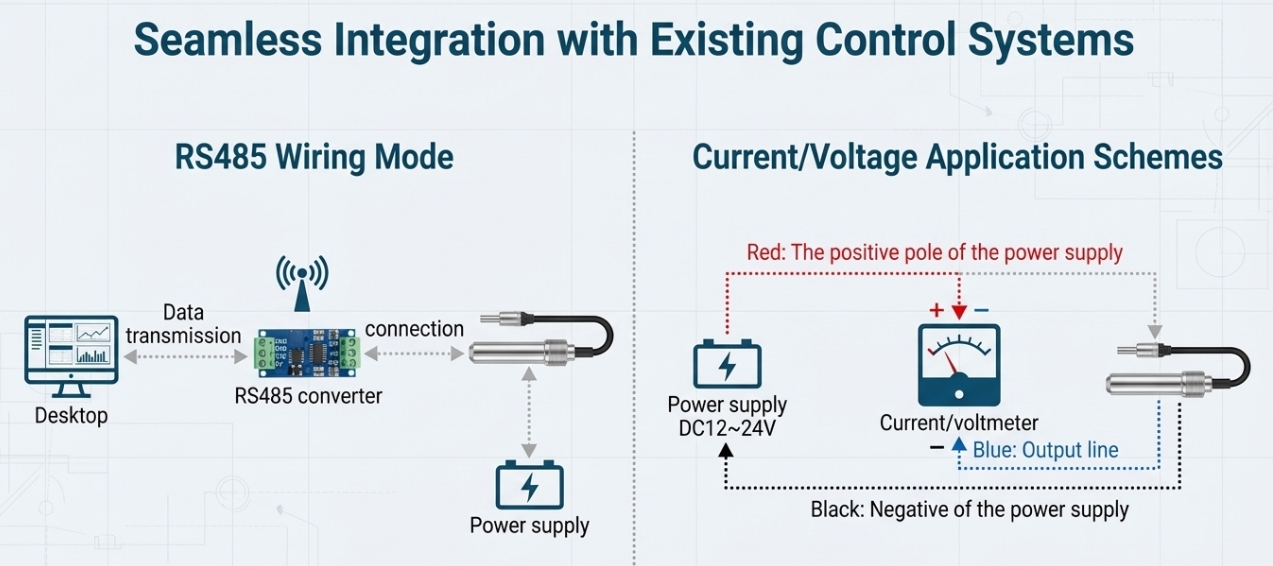
Wiring Logic Avoid circuit damage by following the standardized color coding shown in the application schemes:
- Red: Power Positive (DC12-24V).
- Black: Power Negative.
- Blue: Signal Output (Analog or Digital).
Pro-Tip: For RS485 runs exceeding 50 meters or deployments at maximum depth, use Shielded Twisted Pair (STP) cabling. Ground the shield at the controller end only to prevent ground loops while protecting the data signal from underwater interference.
Data Conversion & Accuracy For analog models, use the following formula to convert the output signal into the physical Lux value. Note that C represents the final Lux value and X represents the measured signal:
C = (A2 - A1) * (X - B1) / (B2 - B1) + A1- A2/A1: Upper/Lower limits of the Lux range (e.g., 65535/0).
- B2/B1: Upper/Lower limits of the output signal (e.g., 20mA/4mA or 5V/0V).
Long-Term Maintenance The “all-metal shell” and waterproof/dustproof design provide the durability required for long-term submersion. While the digital core is pre-calibrated, the RS485 protocol allows for a “correction value” adjustment (range of ±1000). This feature is particularly useful for system alignment when comparing multiple sensors against a single reference standard. To query an unknown device address, use the general address
0xFA (250) on a single-device bus.6. Conclusion & Business Conversion
Honde Technology provides factory-direct, industrial-grade submersible sensors engineered for reliability in the harshest aquatic environments. By integrating these sensors with standard Modbus-RTU or analog systems, facilities can achieve 24/7 high-precision light monitoring with minimal maintenance overhead.
Optimize your underwater light monitoring today. Contact our engineering team for detailed specs or a custom quote.
Company Information:
- Company Name: Honde Technology Co., Ltd.
- Website: www.hondetechco.com
- Email: info@hondetech.com
Post time: Mar-20-2026